
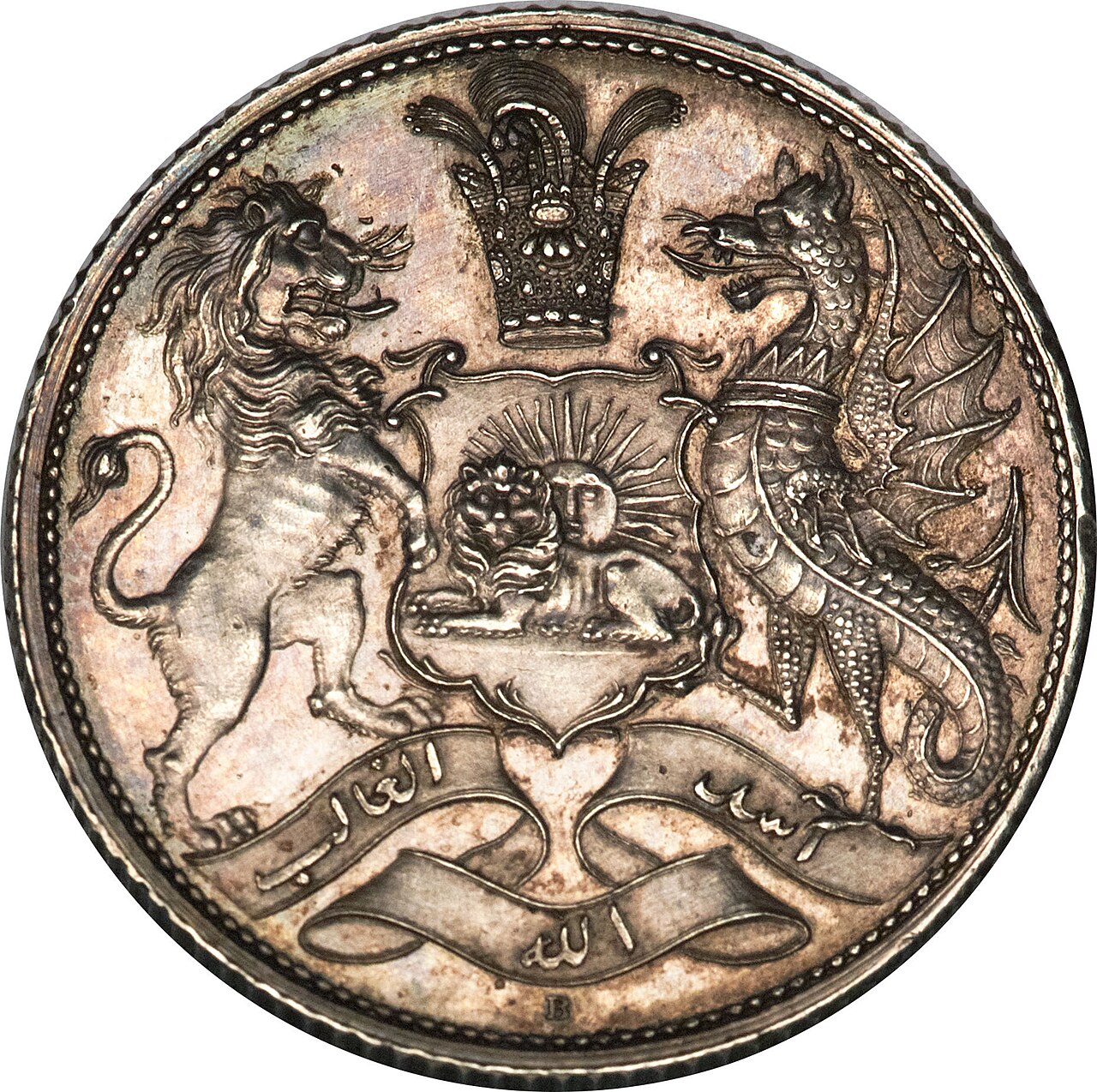
Reverse of a 1 qiran coin of Fath-Ali Shah Qajar with lion-and-sun emblem · 1830 · Silver coin · Iran
Fath Ali Shah Qhajar Royal Mintage · Public domain · Wikimedia Commons record
One catalogued Iranian example whose museum title names this motif; not a defining specimen.
Readings of this motif
Scholars and makers disagree about what this motif means. The readings below are presented side by side; none is endorsed as the settled answer.
- An astrological image of Leo and the sun.
- A former national emblem, with political meanings that changed over time.
How to recognise it
Read the Lion and sun as a whole composition rather than a repeating unit: how it is centred and framed, how its proportions relate to the field or page, and which details — corners, figures, inscriptions — are drawn with the most care. Related compositions appear across weaving, metal, tile and painting, so a match is a starting point for comparison, never proof of origin.
Astrology to emblem
The lion with the sun rising behind it derives from the astrological image of the sun in Leo, found on medieval coins and metalwork. Over later centuries it became a royal and then national emblem of Iran, with a sword added in Qajar use. It was Iran's official emblem until 1979.
References: [1]
Dating by form
Details such as the sword, the crown, the sun's face and the lion's posture changed over time, so they can suggest a period for flags, medals and coins. On crafts, however, makers revive older forms freely; the emblem alone cannot date an object.
References: [1]
Sensitive context
Today the emblem carries political associations for many Iranians. The archive records it as a historical motif without endorsing any political position.
References: [1]
Practical questions
- Where did it begin? In the astrological sun-in-Leo image.
- Does it date an object? Not by itself; forms were revived.
| Observation | Useful description | Not established |
|---|---|---|
| Lion with sword | Later emblem form | Qajar manufacture |
| Sun with face | Personified sun | Period |
| Emblem on new craft | Revival design | Antiquity |
References and further reading
- [1] A. U. Pope & P. Ackerman (eds.), A Survey of Persian Art, Oxford University Press, 1938–39.Broad historical context; individual claims need current scholarship.
- [2] Encyclopaedia Iranica ↗Peer-reviewed entries on motifs, crafts and terms.
These sources provide context, not authentication or provenance for an individual object. Editorial interpretations remain under review.
Used in these crafts
Square polychrome tiles painted with several overglaze colours and fired together, allowing large architectural schemes to be produced faster than cut tile mosaic.
The Iranian tradition of decorating copper, brass and silver vessels with small chisels struck by hammer, working the metal into line, ground and relief.
A hand-knotted pile textile woven across Iran in city workshops, village looms and pastoral camps, distinguished by regional structure, palette and design vocabulary.