
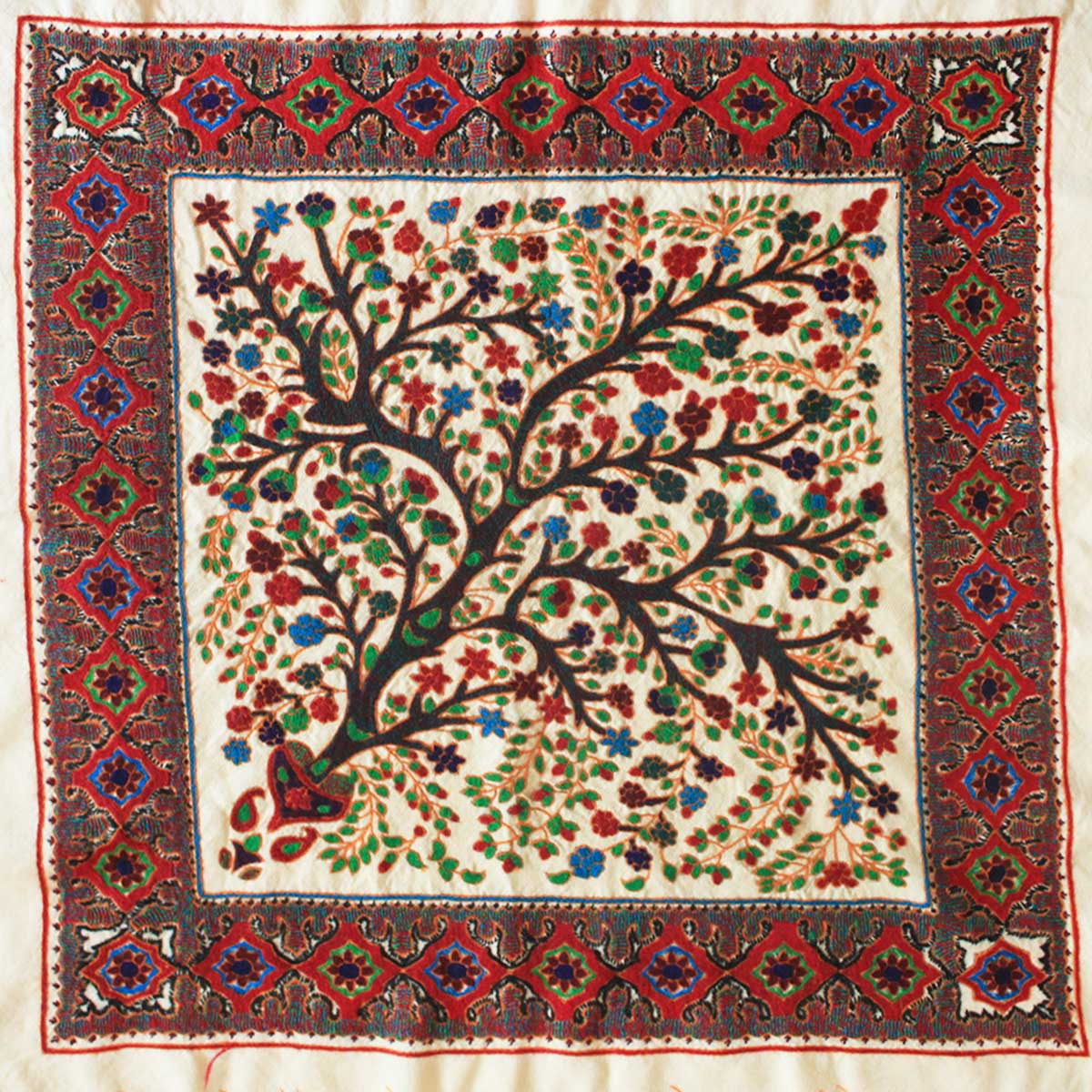
Pateh embroidered panel with boteh and tree design · date not stated · Wool embroidery on wool ground · Iran
Sr3207 · CC BY-SA 4.0 · Wikimedia Commons record
One catalogued Iranian example whose museum title names this motif; not a defining specimen.
Readings of this motif
- A regional take on the boteh.
- Wedding and household display.
How to recognise it
Look for the Kerman boteh cluster as a repeated unit rather than a single image: its scale, density and the way it sits in a border or field often tell you more about workshop and region than the form alone. The same motif crosses weaving, metal, tile and painting, so a match is a starting point for comparison, never proof of origin.
Boteh as stitched ornament
Pateh combines a wool ground, often called ariz, with wool embroidery; its boteh is formed by stitches rather than by the ground weave. Follow the outline and then compare the denser filling and smaller surrounding details. Large paired boteh, border repeats and scattered arrangements are different compositions, even when sellers use one general name. The same curved motif appears in printed cloth and woven shawls, but those objects are not pateh merely because their outline matches.
Palette, thread and reverse
Cream and red grounds and several contrasting thread colours occur in pateh, but palette is not a dating test. Look at the relation between thread thickness, stitch density and visible ground, and document both faces. Colour variation can arise from dye batches, fading, dirt or a later repair; it cannot establish natural dyes on sight. Regular stitching is compatible with skilled handwork. A photograph of the reverse helps identify construction, but maker documentation remains necessary for a claim of handmade Iranian production.
Maker records and safe display
Ask who embroidered the piece, where the work was completed and whether the seller can distinguish the embroiderer from the designer or reseller. Kerman is a documented centre of the tradition, not proof of origin for every cloth bearing a boteh. Record dimensions, earlier use and any repairs before display. Support heavy stitched areas and avoid suspending a fragile cloth from two corners. Do not wash or iron an undocumented older example; vulnerable wool, dyes and raised stitching need an individual conservation assessment.
Historical and Regional Evolution
Kerman's distinct tradition of needlework flourished against the backdrop of its historic wool and shawl industries. In the eighteenth and nineteenth centuries, when the local market for woven Kermani shawls faced economic shifts and increasing foreign competition, domestic embroidery gained momentum as both an artistic outlet and a source of livelihood. The boteh motif, deeply intertwined with Iranian decorative vocabularies, found a fertile canvas in pateh. While the teardrop-shaped emblem is often said to evoke a stylized cypress, a burst of flame, or a bent sprig, in Kerman it assumed monumental, curvilinear forms, frequently repeated in concentric rings or anchor arrangements known as toranj. The ground cloth, traditionally known as 'ariz', was woven from hand-spun wool and colored with regional vegetable extracts like madder and walnut hulls. Embroidery became a predominantly female domain, practiced in domestic spaces across Kerman, Mahan, and Sirjan, bridging elite courtly textile traditions with communal craft practices that persisted through generational transmission.
Examination, Materials, and Preservation
When evaluating an embroidered pateh, one should closely inspect both sides of the fabric. Traditional masterworks demonstrate exceptional density in the stem stitch (saqhedoozi) and filling stitches, leaving negligible visible spaces of raw ground fabric within motifs. The tension must remain uniform; excessive tightening by an inexperienced needleworker causes puckering along the contours of the boteh. Authentic vintage examples typically feature vegetable-dyed wools that exhibit subtle chromatic irregularities (abrash) rather than flat, synthetic vibrancy. Collectors should be cautious when examining modern reproductions, which may employ factory-milled synthetic felt bases or acrylic yarns prone to bleeding. Regarding preservation, wool textiles are exceptionally susceptible to insect predation and environmental humidity. Clean pateh exclusively through gentle conservation methods without caustic chemical detergents. If display is desired, mount the textile onto acid-free museum board without adhesive, using archival stitching, and keep it sheltered from direct solar radiation, which rapidly fades madder and indigo pigments.
Practical questions
- Is pateh printed? No; embroidered.
- Where made? Kerman.
| Observation | Useful description | Not established |
|---|---|---|
| Stitched boteh | Pateh | Maker |
| Printed boteh | Pateh | |
| Cream ground | Traditional palette | Date |
References and further reading
- [1] H. E. Wulff, The Traditional Crafts of Persia, MIT Press, 1966; A. U. Pope & P. Ackerman, A Survey of Persian Art, 1938–39.Historical context; not evidence for an individual object.
- [2] Encyclopaedia Iranica ↗Peer-reviewed entries on crafts, motifs and terms.
These sources provide context, not authentication or provenance for an individual object. Editorial interpretations remain under review.
Used in these crafts
A hand-embroidered wool textile from Kerman in which coloured silk or wool threads are worked in dense chain and satin stitching over a woollen ground, typically in a limited palette against a natural or dyed field.
A patterned Iranian brocade woven with supplementary wefts, historically in silk and wool, associated above all with Yazd and Kerman.