
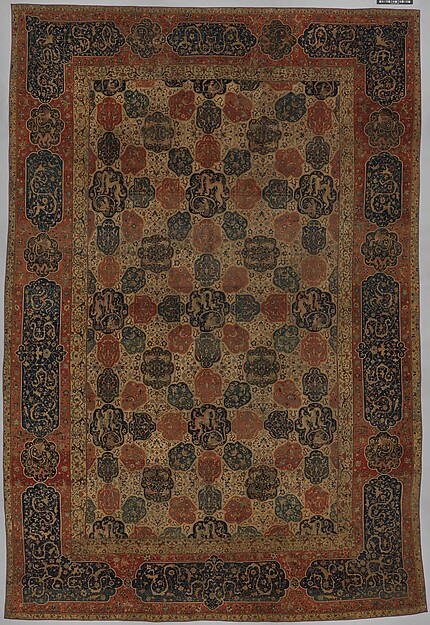
Carpet with a Compartment Design · first half 16th century · Silk (warp and weft), wool (pile); asymmetrically knotted pile · Iran
The Metropolitan Museum of Art, 10.61.3 · CC0 · Museum record
One catalogued Iranian example whose museum title names this motif; not a defining specimen.
Readings of this motif
- A garden plan seen from above.
- A practical grid that suits village weaving.
How to recognise it
Look for the Panel (khesti) as a repeated unit rather than a single image: its scale, density and the way it sits in a border or field often tell you more about workshop and region than the form alone. The same motif crosses weaving, metal, tile and painting, so a match is a starting point for comparison, never proof of origin.
The garden in compartments
Khesti (brick-like) or qāb-qābi designs divide the field into rectangular or square panels, each holding a tree, vase, flower or animal. The layout is famous in Bakhtiari rugs of the Chaharmahal region, where it is often called a garden design.
References: [1]
Relation to garden carpets
The compartments are often compared with the plots of a Persian garden. Classical garden carpets also show water channels and fish; khesti rugs usually omit them. The comparison helps viewers but does not establish that every panel represents a garden bed.
References: [1]
Variation
Panels may repeat a few motifs or vary each one. Uneven panel sizes, changes in drawing and colour across the rug are normal in village weaving and are not defects in themselves.
References: [1]
Practical questions
- Is every compartment rug Bakhtiari? No; other groups use panels too.
- Are uneven panels a defect? Not by themselves.
| Observation | Useful description | Not established |
|---|---|---|
| Field in panels | Khesti layout | Bakhtiari origin |
| Tree in each panel | Garden imagery | Literal garden plan |
| Uneven panel sizes | Hand-drawn layout | Poor quality |
References and further reading
- [1] A. U. Pope & P. Ackerman (eds.), A Survey of Persian Art, Oxford University Press, 1938–39.Broad historical context; individual claims need current scholarship.
- [2] Encyclopaedia Iranica ↗Peer-reviewed entries on motifs, crafts and terms.
These sources provide context, not authentication or provenance for an individual object. Editorial interpretations remain under review.
Used in these crafts
Village and tribal carpets from the Chaharmahal and Bakhtiari region, best known for the garden (khesti) design of repeated panels.
A hand-knotted pile textile woven across Iran in city workshops, village looms and pastoral camps, distinguished by regional structure, palette and design vocabulary.