
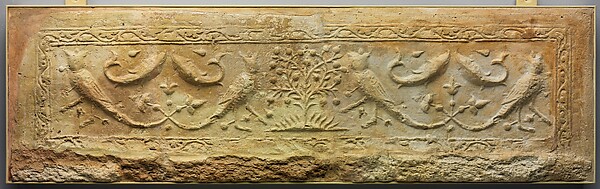
Panel with Harpies, Fish, and Trees · 11th–12th century · Terracotta; molded (?), painted · Iran
The Metropolitan Museum of Art, 40.170.166 · CC0 · Museum record
One catalogued Iranian example whose museum title names this motif; not a defining specimen.
Readings of this motif
Scholars and makers disagree about what this motif means. The readings below are presented side by side; none is endorsed as the settled answer.
- Harmony between earth and water.
- Good wishes for a marriage.
How to recognise it
Look for the Birds and fish as a repeated unit rather than a single image: its scale, density and the way it sits in a border or field often tell you more about workshop and region than the form alone. The same motif crosses weaving, metal, tile and painting, so a match is a starting point for comparison, never proof of origin.
Bird and fish
Morgh-o-mahi ('bird and fish') pairs a bird and a fish, often in a circular yin-yang-like composition, widely found in Isfahan qalamkar, metalwork and folk art.
Readings
Readings include sky and water, union of opposites and good fortune; none is documented as original intent.
Modern popularity
It is a popular contemporary souvenir motif; handmade status must be checked separately.
Symbolic Trajectory and Craft Environments
The morgh-o-mahi motif, weaving together the terrestrial bird and the aquatic fish, occupies a fluid position between literary allegory, cosmological imagery, and Iranian artisan craft. While scholarly consensus hesitates to trace an unbroken line to ancient solar or fertility mythologies, the pairing appears intermittently in pre-modern Persian ceramics, illuminated borders, and metal chasing before gaining pervasive popularity in Isfahani craft guilds during the nineteenth and twentieth centuries. In cities like Isfahan and Kashan, it became a beloved standard for woodblock-printed calico (qalamkar), hammered brass vessels, and domestic ceramics. The juxtaposition of creatures belonging to disparate celestial and subterranean spheres resonated with local understandings of natural balance and domestic blessing. It was often integrated into the domestic sphere on dastarkhwans (tablecloths) and storage cloths, where folkloric associations with prosperity and life-giving waters naturally complemented daily household rituals without necessarily carrying rigid esoteric doctrine.
Connoisseurship, Production Marks, and Conservation
Assessing an object adorned with the morgh-o-mahi motif requires discerning the specific medium and manufacturing methodology. In printed qalamkar textiles, connoisseurs look for authentic hand-carved pear-wood block impressions rather than continuous silk-screened imitations. Manual block stamping reveals subtle misalignments, overlapping pigment boundaries, and natural variations in ink absorption, particularly around the delicate feathers of the bird and the cross-hatching of fish scales. On chased metalwork, hand-chasing displays uneven chisel strikes, variable relief depths, and faint tool guidelines that mechanical stamping or acid etching cannot emulate. In both media, natural dye or antique patina should never appear artificially uniform. When conserving textiles bearing this design, avoid chlorinated cleaning agents and prolonged water soaking, which degrade tannin-based mordants and iron-gall black outlines. For hammered brass or copper, avoid abrasive commercial metal polishes that strip historical tarnish and soften the sharp definition of the chiselled lines.
Practical questions
- Ancient symbol? Unclear.
- Handmade? Check each piece.
| Observation | Useful description | Not established |
|---|---|---|
| Bird and fish circle | Morgh-o-mahi | Meaning |
| Block print | Qalamkar | Isfahan |
| Souvenir item | Popular motif | Handmade |
References and further reading
- [1] H. E. Wulff, The Traditional Crafts of Persia, MIT Press, 1966; A. U. Pope & P. Ackerman, A Survey of Persian Art, 1938–39.Historical context; not evidence for an individual object.
- [2] Encyclopaedia Iranica ↗Peer-reviewed entries on crafts, motifs and terms.
These sources provide context, not authentication or provenance for an individual object. Editorial interpretations remain under review.
Used in these crafts
The Iranian tradition of decorating copper, brass and silver vessels with small chisels struck by hammer, working the metal into line, ground and relief.
A decorative technique in which powdered coloured glass is fused by heat onto the surface of gold, silver or copper objects, producing a smooth, glossy coloured surface, historically practised in Isfahan on vessels, jewellery and decorative panels.
A resist-dyed and block-printed cotton textile, historically associated with Isfahan, in which carved wooden blocks stamp repeating floral and figural patterns onto cloth in successive colour stages.