
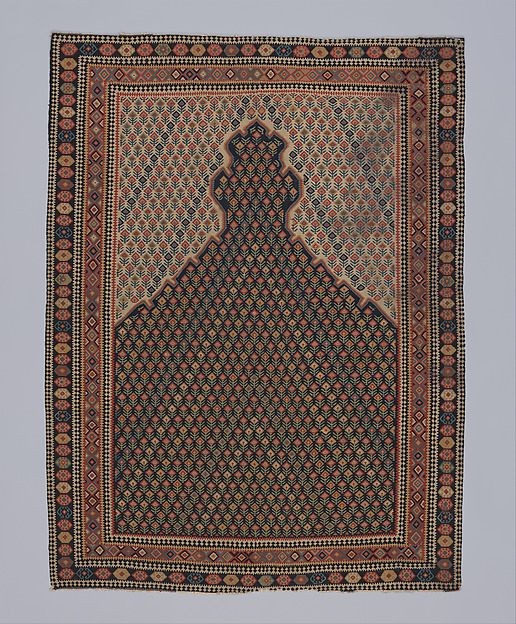
"Senneh" Prayer Rug · late 18th–early 19th century · Cotton (warp), wool (weft); tapestry-woven · Northwestern Iran
The Metropolitan Museum of Art, 1970.302.8 · CC0 · Museum record
One catalogued Iranian example whose museum title names this motif; not a defining specimen.
Readings of this motif
Scholars and makers disagree about what this motif means. The readings below are presented side by side; none is endorsed as the settled answer.
- A prayer-rug niche.
- An architectural arch used decoratively.
How to recognise it
Read the Prayer niche (mehrabi) as a whole composition rather than a repeating unit: how it is centred and framed, how its proportions relate to the field or page, and which details — corners, figures, inscriptions — are drawn with the most care. Related compositions appear across weaving, metal, tile and painting, so a match is a starting point for comparison, never proof of origin.
The arch
Mehrabi designs place an arch (mihrab) at one end of the field, typical of prayer rugs (sajjadeh). Columns, a lamp or a tree may fill the niche.
Use
Many arch rugs were made for decoration or sale, not necessarily prayer. Size and wear help interpret use.
Respect
Inscriptions with sacred text deserve respectful display, not floor use.
Regional Evolution and Architectural Dialogue
The architectural niche known as the mihrab is widely considered one of the most enduring motifs in Islamic material culture, yet its carpet manifestation evolved along distinct regional trajectories. In Safavid court workshops, single-arch carpets incorporated opulent silk foundations, metal-wrapped threads, and sophisticated calligraphic bands containing Quranic verses or poetic panegyrics. Concurrently, village and nomadic weavers across Khorasan, Fars, and Iranian Azerbaijan adapted the form into simplified, highly stylized stepped arches. In eastern Iran, particularly among Baluch tribal groups, prayer rugs acquired earthy palettes dominated by deep aubergine, madder, and camel wool, often featuring stylized tree-of-life forms within the arch rather than mosque lamps. Regional comparisons reveal that while Ottoman Anatolian prayer rugs frequently privileged architectural pillars and solid color fields, Persian examples generally dissolved the niche into dense floral arabesques or naturalistic foliage. This dispersion illustrates how an ostensibly religious architectural silhouette was continuously reimagined through localized weaving languages across urban and pastoral realms.
Connoisseurship, Wear Patterns, and Preservation
When evaluating or caring for arch-design rugs, physical evidence often illuminates original function and structural integrity. Directional wear is a critical diagnostic tool; authentic devotional use over prolonged periods typically creates localized pile compression and abrasion at the base where knees rested and near the apex where the forehead made contact. Conversely, carpets intended strictly as prestige wall hangings or export floor coverings exhibit generalized, even wear across the central field. Assess the selvages and end finishes carefully, as prayer rugs were frequently suspended, leaving stitch perforations or tension distortion along the upper kilim skirt. For conservation, pieces bearing sacred texts or fine poetic inscriptions require special handling; they should never be walked upon or placed in high-traffic corridors. Instead, support them using continuous Velcro strips stitched to custom cotton webbing along the top edge on a sealed wooden batten, avoiding direct sunlight and heavy humidity fluctuations to preserve fragile foundation threads.
Practical questions
- Every arch rug a prayer rug? Not necessarily.
- Floor use with inscriptions? Avoid.
| Observation | Useful description | Not established |
|---|---|---|
| Arch at one end | Mehrabi design | Prayer use |
| Hanging lamp | Mosque imagery | Religious maker |
| Inscription | Text | Date |
References and further reading
- [1] H. E. Wulff, The Traditional Crafts of Persia, MIT Press, 1966; A. U. Pope & P. Ackerman, A Survey of Persian Art, 1938–39.Historical context; not evidence for an individual object.
- [2] Encyclopaedia Iranica ↗Peer-reviewed entries on crafts, motifs and terms.
These sources provide context, not authentication or provenance for an individual object. Editorial interpretations remain under review.
Used in these crafts
A hand-knotted pile textile woven across Iran in city workshops, village looms and pastoral camps, distinguished by regional structure, palette and design vocabulary.
Square polychrome tiles painted with several overglaze colours and fired together, allowing large architectural schemes to be produced faster than cut tile mosaic.
A technique of architectural revetment in which monochrome glazed tiles are cut into small individual pieces to a template and set together, glaze face down, into a mortar bed to form complex polychrome patterns and inscriptions.