
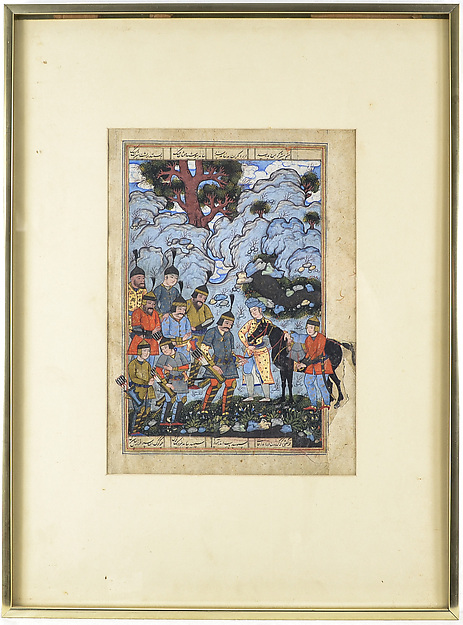
Illustrated Folio from a Shahnama · mid-17th century · Ink and opaque watercolor on paper · Iran
The Metropolitan Museum of Art, 2017.248 · CC0 · Museum record
One catalogued Iranian example whose museum title names this motif; not a defining specimen.
Readings of this motif
- Heroic legend and national epic.
How to recognise it
Read the Shahnameh scene as a whole composition rather than a repeating unit: how it is centred and framed, how its proportions relate to the field or page, and which details — corners, figures, inscriptions — are drawn with the most care. Related compositions appear across weaving, metal, tile and painting, so a match is a starting point for comparison, never proof of origin.
Epic illustration
Scenes from Ferdowsi's Shahnameh—Rostam, Sohrab, Zal and the Simorgh, Bizhan and Manizheh—appear in manuscripts, tiles, coffee-house paintings and pictorial rugs.
Identifying scenes
Key attributes help: Rostam's leopard-skin coat and mace, his horse Rakhsh, the White Div.
Coffee-house painting
Qajar and later coffee-house painters (e.g. Hossein Qollar-aghasi) created a vigorous popular style.
From Imperial Manuscripts to Popular Public Formats
Illustrations of Ferdowsi's Shahnameh hold an unbroken centrality in Iranian artistic heritage, acting as enduring repositories of national myth, moral exemplars, and martial virtue. While imperial scriptoriums from the Ilkhanid, Timurid, and Safavid eras created lavish manuscripts to legitimize dynastic rule through the legendary kings, the nineteenth and twentieth centuries witnessed a profound democratization of epic imagery. In the late Qajar period, epic tableaux expanded beyond elite codices into communal social spaces through public tilework friezes, printed lithographic editions, and monumental coffee-house paintings (naqqashi-ye qahveh-khanehi). Popular masters rendered heroes like Rostam with robust proportions, direct dramatic gazes, and theatrical compositions tailored to the oral recitations of professional storytellers (naqqals). This transformation adapted monumental epic narrative to street-level vernaculars and popular religious-patriotic sentiment, leaving an indelible imprint upon Iranian decorative arts across urban workshops in Shiraz, Isfahan, and Tehran.
Iconographic Scrutiny, Material Checks, and Maintenance
Identifying and caring for Shahnameh artefacts demands careful examination of iconography and historical materials. When discerning whether a canvas belongs to traditional coffee-house painting or recent workshop replication, analysts examine the canvas weave, nail fastenings, and surface craquelure. Genuine older oil-on-canvas pieces often exhibit age-related tension cracks along the stretcher bars and a mellowed surface darkened by years of tobacco smoke and oil-lamp soot. When assessing tiles depicting epic battles, look for genuine underglaze polychrome painting (haft-rang) rather than modern transfer decals, which exhibit telltale pixel dots under magnification. In conservation, canvas paintings must be evaluated by qualified conservators before attempting to clean surface grime; inappropriate aqueous solutions can strip brittle oil glazes. For architectural tiles, avoid cementing them rigidly with modern non-porous epoxies or setting them in freezing outdoor environments, where trapped moisture inevitably causes spalling and glaze detachment.
Practical questions
- How recognise Rostam? Leopard-skin coat, mace.
- Only manuscripts? No; many media.
| Observation | Useful description | Not established |
|---|---|---|
| Hero in leopard skin | Rostam | Date |
| Bold popular style | Coffee-house painting | Artist |
| Tile panel | Qajar tile | Site |
References and further reading
- [1] H. E. Wulff, The Traditional Crafts of Persia, MIT Press, 1966; A. U. Pope & P. Ackerman, A Survey of Persian Art, 1938–39.Historical context; not evidence for an individual object.
- [2] Encyclopaedia Iranica ↗Peer-reviewed entries on crafts, motifs and terms.
These sources provide context, not authentication or provenance for an individual object. Editorial interpretations remain under review.
Used in these crafts
The Iranian tradition of small-scale painting made for manuscripts and albums, built from fine line, flat luminous colour and layered spatial convention rather than single-point perspective.
Square polychrome tiles painted with several overglaze colours and fired together, allowing large architectural schemes to be produced faster than cut tile mosaic.
Traditional Iranian string-puppet theatre, and the craft of making its carved and costumed puppets, including the well-known character Mobarak.