
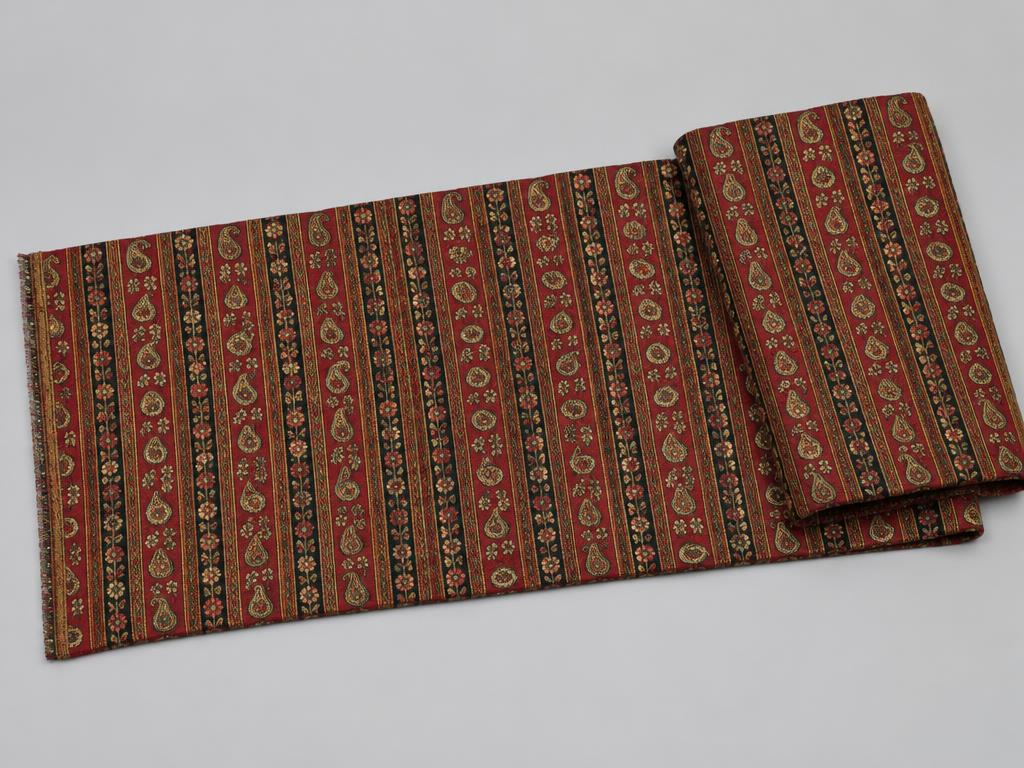
 AI illustration
Narrow pen-box (ghalamdani) stripes filled with tiny boteh and flowers, in the manner of Yazd termeh.
AI-generated illustration — not a photograph of a real object, place or person, and not evidence of any piece's origin. Shown because no suitable real photograph has been found yet.
Readings of this motif
- A trade layout name for termeh.
How to recognise it
Look for the Pen-box stripe as a repeated unit rather than a single image: its scale, density and the way it sits in a border or field often tell you more about workshop and region than the form alone. The same motif crosses weaving, metal, tile and painting, so a match is a starting point for comparison, never proof of origin.
- Persian
- ترمه قلمدانی — pen-box termeh
- Craft
- Termeh drawloom weaving, chiefly Yazd
- Layout
- Long, narrow panels like a pen-case lid
Pen-box pattern
Ghalamdani termeh arranges boteh in parallel diagonal or vertical bands, recalling pen-box decoration. It is one of the classic Yazd termeh layouts.
Other layouts
Related names include khafteh, shah-abbasi and lachak-toranj termeh.
Handloom vs machine
Most termeh today is machine-woven; handloom pieces are rare and should be documented.
Regional Evolution and Cultural Context
The banded layout known as ghalamdani is generally associated with the textile centers of Yazd and Kerman during the later Qajar era, though its aesthetic roots reach deeper into Iranian decorative arts. The name evokes the painted or lacquered papier-mâché pen-boxes (ghalamdan) carried by scribes and officials, which were frequently embellished with rhythmic scrolls, floral sprays, or diagonal registers. In domestic and ceremonial settings, ghalamdani termeh served varied functions, often tailored into sashes, coats, or festive wrapping cloths (boqcheh). While both Yazd and Kerman supported skilled drawloom weavers, Yazd gradually emerged as the primary commercial hub for patterned twill weaves. Trade networks distributed these luxurious textiles throughout the Iranian plateau and across regional pilgrimage routes. Although later industrialization altered workshop structures and introduced mechanized jacquard systems, the linear cadence of alternating boteh within striped fields remained a defining hallmark of central Iranian textile prestige.
Technical Examination, Fiber Identification, and Conservation
When examining a ghalamdani piece, scholars inspect the reverse structure to understand its manufacturing technique. Traditional drawloom termeh displays complex, discontinuous supplementary wefts woven by hand, creating subtle irregularity and soft transitions at the borders of each motif. In contrast, modern industrial reproductions typically exhibit mechanical uniformity, rigid tension, and continuous floats across the back. Fiber identification requires careful scrutiny; historic examples generally employed fine fleece or down (kork) for the pattern weft on a cotton or silk foundation, whereas late-twentieth-century examples often substitute rayon, polyester, or mercerized cotton, which lack the warm tactile depth of natural animal fibers. Collectors must avoid assuming that a silk-like luster indicates natural silk. Preserving these delicate textiles requires storage in dark, humidity-controlled settings. Creasing along the decorative bands must be avoided by rolling the textile face-outward around an acid-free archival cylinder, interleaved with unbuffered tissue paper to prevent stress along aged weft turns.
Practical questions
- Why 'pen-box'? Banded layout like pen boxes.
- Handwoven? Rarely today.
A layout named after the pen-box
In termeh, the 'qalamdani' layout divides the cloth into long, narrow compartments that recall the shape of a lacquer pen-box (qalamdan). Each compartment is filled with boteh, flowers or small figures, and the compartments are separated by thin stripes.
The name describes the arrangement, not a connection to any particular pen-box. It is one of several termeh layout names used by Yazd weavers and sellers, alongside striped, scattered and medallion arrangements.
What to look for
Measure the compartments: true qalamdani panels are several times longer than they are wide. Check the back of the cloth for long weft floats, characteristic of termeh's supplementary-weft structure, and look closely at whether the patterning is woven in or printed on.
- Long, narrow panels: qalamdani layout.
- Woven floats on the back: termeh structure.
- Pattern only on the front with no floats: likely printed, not termeh.
Why the page has no photo
Museum termeh records describe the cloth as 'silk and wool textile' and seldom name the layout. Until we find a record that names the pen-box layout or a documented Yazd workshop photograph, the page stays unillustrated; the termeh craft page shows a real example of the weave.
| Observation | Useful description | Not established |
|---|---|---|
| Boteh in bands | Ghalamdani layout | Yazd |
| Perfect repeat | Possible jacquard | Handloom |
| Silk sheen | Silk content | Pure silk |
| What to look at | What it helps with | What it does not prove |
|---|---|---|
| Layout, scale and repeat | Comparing design families | Where or when the piece was made |
| Material and technique | How the design was executed | Iranian handmade origin on its own |
| Dated or signed museum record | A documented reference point | The date or maker of a different object |
References and further reading
- [1] H. E. Wulff, The Traditional Crafts of Persia, MIT Press, 1966; A. U. Pope & P. Ackerman, A Survey of Persian Art, 1938–39.Historical context; not evidence for an individual object.
- [2] Encyclopaedia Iranica ↗Peer-reviewed entries on crafts, motifs and terms.
- [3] The Metropolitan Museum of Art, Islamic Art collection search (filter: Iran) ↗
- [4] Encyclopædia Iranica — entries on carpets, textiles and decorative arts ↗
These sources provide context, not authentication or provenance for an individual object. Editorial interpretations remain under review.
Used in these crafts
A patterned Iranian brocade woven with supplementary wefts, historically in silk and wool, associated above all with Yazd and Kerman.