
 AI illustration
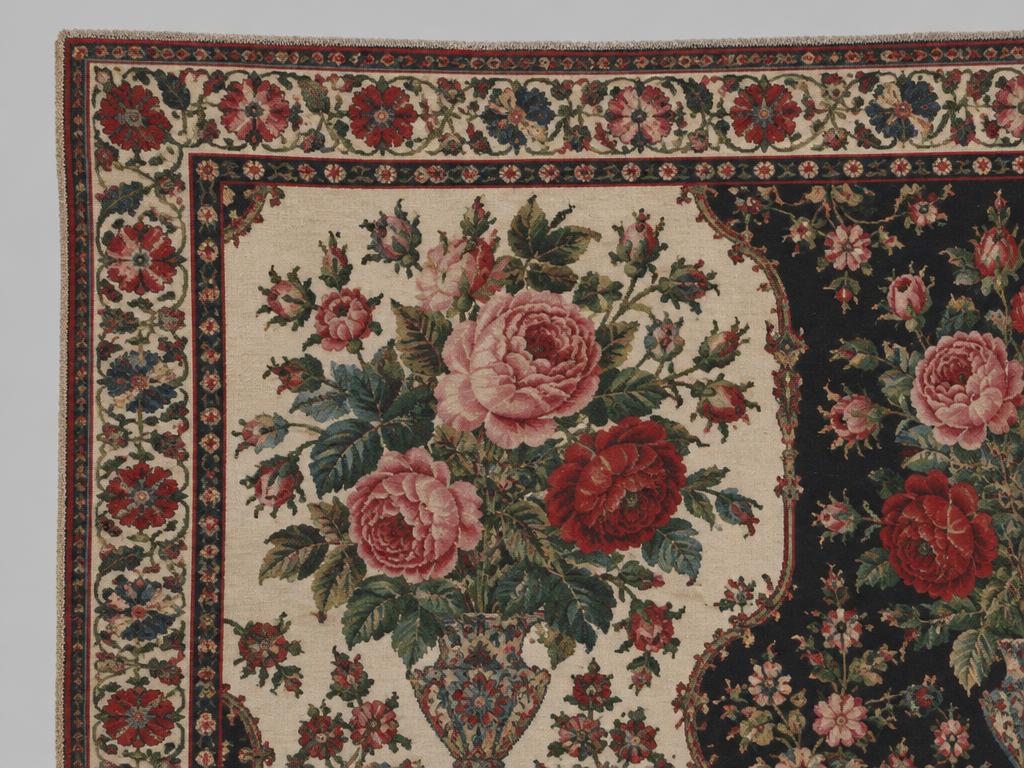
Naturalistic European-style roses (gol-farang) inside a Persian floral border, typical of Qajar-era taste.
AI-generated illustration — not a photograph of a real object, place or person, and not evidence of any piece's origin. Shown because no suitable real photograph has been found yet.
Readings of this motif
- Trade with Europe and new decorative tastes.
How to recognise it
Look for the Gol-farang rose as a repeated unit rather than a single image: its scale, density and the way it sits in a border or field often tell you more about workshop and region than the form alone. The same motif crosses weaving, metal, tile and painting, so a match is a starting point for comparison, never proof of origin.
- Persian
- گل فرنگ — 'European flower'
- Typical period
- Qajar, nineteenth to early twentieth century
- Common in
- Carpets, lacquer, painted tile, textiles
European roses
Gol-farang ('foreign flower') denotes naturalistic European-style roses and bouquets that entered Iranian art in the Qajar period, seen in lacquer, tiles, kilims and rugs, notably Bijar and Senneh.
Shaded petals
Shading and three-dimensional modelling distinguish it from stylised Persian flowers.
Iranian work
Despite the name, gol-farang pieces are Iranian-made adaptations, not imports.
Historical and Regional Context
The gol-farang or naturalistic rose cluster entered the visual culture of Iran predominantly during the late eighteenth and nineteenth centuries, reflecting expanding commercial, diplomatic, and cultural encounters with Europe. Initially popularized through imported botanical prints, French textiles, and foreign gift exchanges at the Qajar court, this ornament quickly transcended royal miniature painting and papier-mâché lacquerwork. Regional textile centers soon assimilated the shaded, open-petaled blossom into their own repertories. Weavers in Bijar rendered the cabbage rose with remarkable structural density and vibrant local wool, while urban and village workshops in Senneh incorporated delicate floral bouquets into intricate slit-tapestry kilims and finely knotted rugs. Rather than representing passive imitation, the motif underwent significant aesthetic transformation: Iranian master draughtsmen and rural weavers integrated the voluminous European blossom into traditional layouts alongside split-leaf arabesques and central medallions, creating an idiosyncratic hybrid style deeply woven into late nineteenth-century Persian visual heritage.
Examination, Comparison, and Care
Evaluating gol-farang textiles requires close attention to chromatic gradation and petal modeling. In high-caliber nineteenth-century examples, weavers achieved tonal depth through the careful juxtaposition of naturally dyed yarns—often modulating from madder-derived pinks to cochineal crimsons—rather than through abrupt, unblended bands. Inspect the back of the textile to determine whether knotting density supports the curving contours of the bouquets; coarser village weaves necessarily step the outlines, creating a stylized vernacular rhythm distinct from urban workshop precision. Watch for early synthetic magenta dyes, introduced in the late nineteenth century, which often fade into dull grey-tan tones on the pile surface while retaining harsh tinting at the knot base. When caring for flatweaves or pile rugs featuring gol-farang motifs, protect them from direct sunlight, which readily destabilizes delicate red mordant dyes. Store flat or rolled in breathable unbleached muslin, avoiding plastic packaging that traps moisture.
Practical questions
- Is it European-made? No; Iranian adaptation.
- Period? Mostly Qajar onward.
Cabbage roses in Persian design
Gol-farang describes the full, shaded cabbage rose and bouquet that entered Persian decoration through European prints, chintz and porcelain in the Qajar period. Unlike older stylised Persian flowers, these blooms are drawn with light and shadow, often in pink, red and cream, and are frequently tied with ribbons or set in vases.
In carpets, gol-farang fields and borders appear in pieces associated with Karabagh-influenced and northwestern weaving as well as in Persian city workshops; in lacquer and tile they sit beside portraits and landscapes.
Signs of the style
Look for shading inside a single petal (several tones of pink or red), naturalistic leaves with veins, and bouquets rather than palmettes. On lacquer pen-boxes and mirror cases the roses are often paired with nightingales — the gol-o-bolbol theme — which has its own page.
- Shaded petals and leaves: gol-farang.
- Flat, symmetrical palmettes: an older Persian floral tradition instead.
- Ribbon swags and vases: European-derived framing devices that often travel with it.
Why the page is unillustrated
The style was also made in the Caucasus and in European workshops for Persian markets, so a rose-pattern piece cannot be assumed Iranian. We have not yet found an open-access record that is catalogued as Iran and names the rose design in its title, so the page carries no lead photo.
| Observation | Useful description | Not established |
|---|---|---|
| Shaded roses | Gol-farang | Qajar date |
| Bouquet in kilim | Senneh-type | Origin |
| Ribbon garlands | European ornament | Import |
| What to look at | What it helps with | What it does not prove |
|---|---|---|
| Layout, scale and repeat | Comparing design families | Where or when the piece was made |
| Material and technique | How the design was executed | Iranian handmade origin on its own |
| Dated or signed museum record | A documented reference point | The date or maker of a different object |
References and further reading
- [1] H. E. Wulff, The Traditional Crafts of Persia, MIT Press, 1966; A. U. Pope & P. Ackerman, A Survey of Persian Art, 1938–39.Historical context; not evidence for an individual object.
- [2] Encyclopaedia Iranica ↗Peer-reviewed entries on crafts, motifs and terms.
- [3] The Metropolitan Museum of Art, Islamic Art collection search (filter: Iran) ↗
- [4] Cleveland Museum of Art open-access collection (Islamic art, Iran) ↗
- [5] Encyclopædia Iranica — entries on carpets, textiles and decorative arts ↗
These sources provide context, not authentication or provenance for an individual object. Editorial interpretations remain under review.
Used in these crafts
A hand-knotted pile textile woven across Iran in city workshops, village looms and pastoral camps, distinguished by regional structure, palette and design vocabulary.
A decorative technique in which papier-mâché or wooden objects, such as boxes, mirror cases and pen boxes, are painted with fine miniature-style scenes or floral ornament and then sealed under multiple coats of clear lacquer varnish.
A decorative technique in which powdered coloured glass is fused by heat onto the surface of gold, silver or copper objects, producing a smooth, glossy coloured surface, historically practised in Isfahan on vessels, jewellery and decorative panels.