
 AI illustration
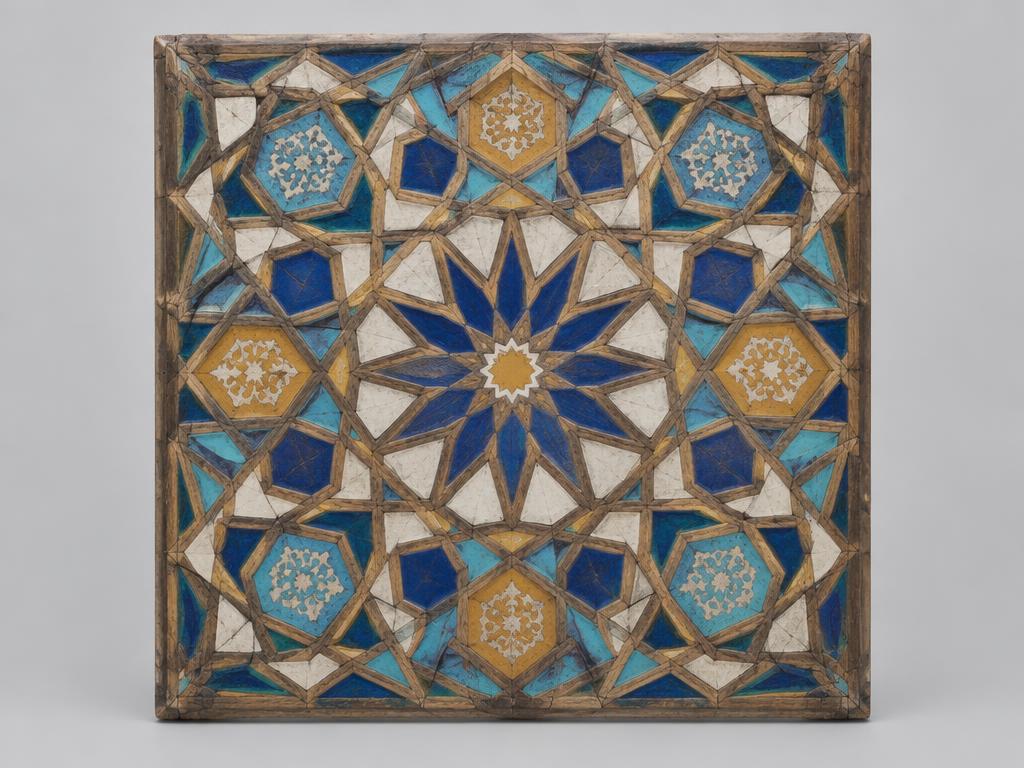
A geometric star rosette set in interlocking girih shapes; count the points on real pieces — a true shamseh-dah has ten.
AI-generated illustration — not a photograph of a real object, place or person, and not evidence of any piece's origin. Shown because no suitable real photograph has been found yet.
Readings of this motif
- A geometric centre valued for its complexity.
How to recognise it
Read the Ten-point rosette as a whole composition rather than a repeating unit: how it is centred and framed, how its proportions relate to the field or page, and which details — corners, figures, inscriptions — are drawn with the most care. Related compositions appear across weaving, metal, tile and painting, so a match is a starting point for comparison, never proof of origin.
- Persian
- شمسه دهپر — ten-pointed sun
- Geometry
- Ten-fold star within a gereh grid
- Common in
- Lattice woodwork, tilework, bookbinding
Ten-point rosette
Shamseh-dah is the ten-pointed star rosette of girih geometry, surrounded by kite and pentagon shapes, seen in tile, wood and stucco.
Construction
Masters construct it with compass and straightedge from a circle divided into ten.
Quasi-periodic
Some girih patterns using ten-fold units have been studied for quasi-crystalline properties (Lu & Steinhardt, 2007).
Historical and Regional Context
The decagonal star motif, commonly known in Iranian geometry as shamseh-dah, holds an esteemed place within Islamic architectural ornament. Developing substantially from the medieval period onward, particularly in Seljuk, Ilkhanid, and Timurid contexts, this ten-fold rosette became central to complex girih systems spanning cities such as Isfahan, Yazd, Maragha, and Tabriz. Master craftsmen applied the ten-pointed star across diverse media, including glazed tile mosaics, carved stucco, cut brickwork, and intricate wooden joinery (gereh-chini). Historical monuments demonstrate how the motif served as a generating node, radiating outward through kite and pentagonal tiles into expansive tessellations that decorated domes, squinches, and wooden window lattices. While scholars have highlighted the advanced quasi-crystalline properties displayed by certain ten-fold girih schemes, within traditional guild workshops the knowledge was transmitted through geometric rules, compass constructions, and scroll drawings rather than modern mathematical theories. The enduring prevalence of the shamseh-dah reflects a shared regional aesthetic across Persianate urban centers.
Examination, Connoisseurship, and Care
When examining historic wooden panels or architectural tiles featuring the shamseh-dah, specialists must look beyond surface appearances to construction techniques and materials. In antique gereh-chini woodwork, examine the mortise-and-tenon tongue joints; authentic historic assemblages rely on precise wood-on-wood joinery without modern wire nails or synthetic adhesives. Natural shrinkage over decades often creates slight, uneven gaps between the ten-pointed star and surrounding polygonal pieces, whereas modern machine-cut reproductions usually present rigid, uniformly glued seams. For ceramic tiles, inspect glaze stability, observing localized micro-crazing and signs of authentic kiln firing rather than modern printed enamel surfaces. Collectors and custodians should never evaluate an object based solely on geometric complexity, as modern craftspeople replicate historic patterns with remarkable skill. For preservation, maintain stable relative humidity to prevent wood warping or joint separation, avoid liquid immersion, and dust gently with soft natural-bristle brushes rather than abrasive commercial cleansers.
Practical questions
- How drawn? Compass and straightedge.
- Quasicrystal? Studied in some patterns.
A ten-point star and its grid
The ten-pointed rosette is a central star in many Persian gereh (knot) compositions. Its ten points are surrounded by kite and pentagon shapes that tile outward, so the rosette is the visible result of an underlying geometric construction rather than a stand-alone ornament.
It appears in carved and inlaid wooden doors, cut-tile mosaic, stucco and tooled book covers. The same star family occurs across the Islamic world, so the motif alone never identifies Iran.
Counting and checking
Count the points carefully — eight-, ten- and twelve-pointed stars look similar at a glance. Then follow the lines leaving each point: in a true gereh the strands continue unbroken into the next star. In woodwork, check whether each piece is separately cut and fitted or whether the pattern is carved into one board.
- Ten points, with pentagons between stars: the ten-fold family.
- Continuous strands: drawn as a gereh, not as isolated rosettes.
- Fitted pieces: gereh-chini joinery; carved board: surface carving.
Evidence status
Museum records usually describe 'geometric' or 'star' decoration without counting the points, so we could not match a record whose own text names a ten-pointed rosette and an Iranian origin. The related shamseh page shows a real example of a radiating sun composition.
| Observation | Useful description | Not established |
|---|---|---|
| Ten-point star | Shamseh-dah | Date |
| Kite shapes around | Girih system | Region |
| In woodwork | Gereh-chini | Master |
| What to look at | What it helps with | What it does not prove |
|---|---|---|
| Layout, scale and repeat | Comparing design families | Where or when the piece was made |
| Material and technique | How the design was executed | Iranian handmade origin on its own |
| Dated or signed museum record | A documented reference point | The date or maker of a different object |
References and further reading
- [1] H. E. Wulff, The Traditional Crafts of Persia, MIT Press, 1966; A. U. Pope & P. Ackerman, A Survey of Persian Art, 1938–39.Historical context; not evidence for an individual object.
- [2] Encyclopaedia Iranica ↗Peer-reviewed entries on crafts, motifs and terms.
- [3] The Metropolitan Museum of Art, Islamic Art collection search (filter: Iran) ↗
- [4] Encyclopædia Iranica — 'Geometric patterns' and 'Gereh' entries ↗
These sources provide context, not authentication or provenance for an individual object. Editorial interpretations remain under review.
Used in these crafts
A joinery technique for building geometric lattice screens and panels from small, precisely cut wooden pieces assembled without glue or nails, using interlocking notched joints to form windows, doors and room dividers with openwork star and polygon patterns.
A technique of architectural revetment in which monochrome glazed tiles are cut into small individual pieces to a template and set together, glaze face down, into a mortar bed to form complex polychrome patterns and inscriptions.
The carving and moulding of gypsum plaster into architectural ornament, including mihrabs, inscriptions, muqarnas and wall panels.