
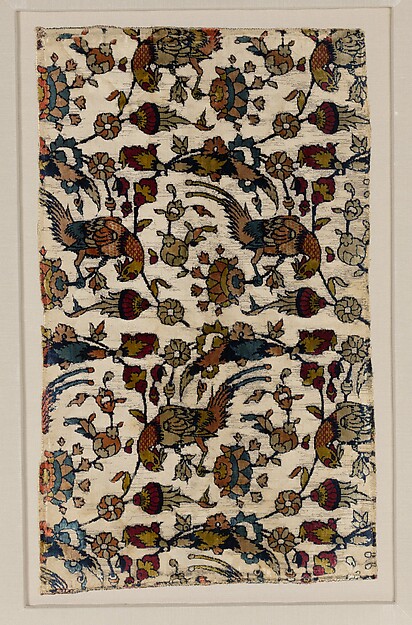
Velvet Fragment with Bird and Flower Design · second half 16th century · Silk; cut and voided velvet, with continuous floats of flat metal thread · Iran
The Metropolitan Museum of Art, 1972.26 · CC0 · Museum record
One catalogued Iranian example whose museum title names this motif; not a defining specimen.
Readings of this motif
- A lyric image of the nightingale and the rose drawn from Persian poetry.
- A decorative convention used without narrative intent.
How to recognise it
Look for the Gol-o-morgh as a repeated unit rather than a single image: its scale, density and the way it sits in a border or field often tell you more about workshop and region than the form alone. The same motif crosses weaving, metal, tile and painting, so a match is a starting point for comparison, never proof of origin.
Visual structure and repeat
Describe the bird species only when identifiable, the flower arrangement, branch, background and any inscription. A single bird near flowers differs compositionally from a balanced paired arrangement. Record how brushwork or carving changes the detail in each medium.
History, naming and interpretation
Rose and nightingale imagery can invoke Persian poetry, but not every bird-and-flower design illustrates a named poem. The Qajar period is an important context, not the beginning of every related image or a date for an undocumented object.
Build an object-specific comparison
Record the complete design and a detail at a comparable scale. Note medium, dimensions, condition, documented maker and source. Compare a dated museum example without transferring its date to your object. A motif match cannot authenticate Iranian handmade origin or distinguish a replica from an original.
| Observation | Useful comparison | Not proof of |
|---|---|---|
| Repeat and orientation | Pattern organisation | Place of manufacture |
| Material and technique | How a design was executed | Date from motif alone |
| Signed or dated reference | Documented comparator | Authentication of another object |
References and further reading
- [1] Sheila S. Blair and Jonathan M. Bloom, The Art and Architecture of Islam 1250–1800, Yale University Press, 1994.Broad historical context; not an object attribution.
- [2] The Metropolitan Museum of Art — Islamic Art collection ↗Consult individual catalogue records for dates, materials and provenance.
These sources provide context, not authentication or provenance for an individual object. Editorial interpretations remain under review.
Used in these crafts
The Iranian tradition of small-scale painting made for manuscripts and albums, built from fine line, flat luminous colour and layered spatial convention rather than single-point perspective.
Square polychrome tiles painted with several overglaze colours and fired together, allowing large architectural schemes to be produced faster than cut tile mosaic.
The Iranian tradition of decorating copper, brass and silver vessels with small chisels struck by hammer, working the metal into line, ground and relief.
A resist-dyed and block-printed cotton textile, historically associated with Isfahan, in which carved wooden blocks stamp repeating floral and figural patterns onto cloth in successive colour stages.
A hand-embroidered wool textile from Kerman in which coloured silk or wool threads are worked in dense chain and satin stitching over a woollen ground, typically in a limited palette against a natural or dyed field.
A decorative technique in which powdered coloured glass is fused by heat onto the surface of gold, silver or copper objects, producing a smooth, glossy coloured surface, historically practised in Isfahan on vessels, jewellery and decorative panels.
A relief wood-carving technique in which solid panels, furniture and architectural elements are carved directly with chisels to produce raised or recessed floral, arabesque and geometric ornament, distinct from inlay techniques that build a surface from separate pieces.
A decorative technique in which papier-mâché or wooden objects, such as boxes, mirror cases and pen boxes, are painted with fine miniature-style scenes or floral ornament and then sealed under multiple coats of clear lacquer varnish.
A silk weaving technique producing a cut or voided pile on a foundation weave, used in Iran for garments, cushion covers and furnishing panels, with figured Safavid velvets among the most studied survivals.
A figured silk weaving technique in which supplementary wefts, often including gold- or silver-wrapped thread, create pictorial or floral designs on a silk ground.
A broad term for Iranian needle embroidery on cotton, silk or wool grounds, including counted, darned and satin-stitch work used on covers, garments and prayer cloths.