
 AI illustration
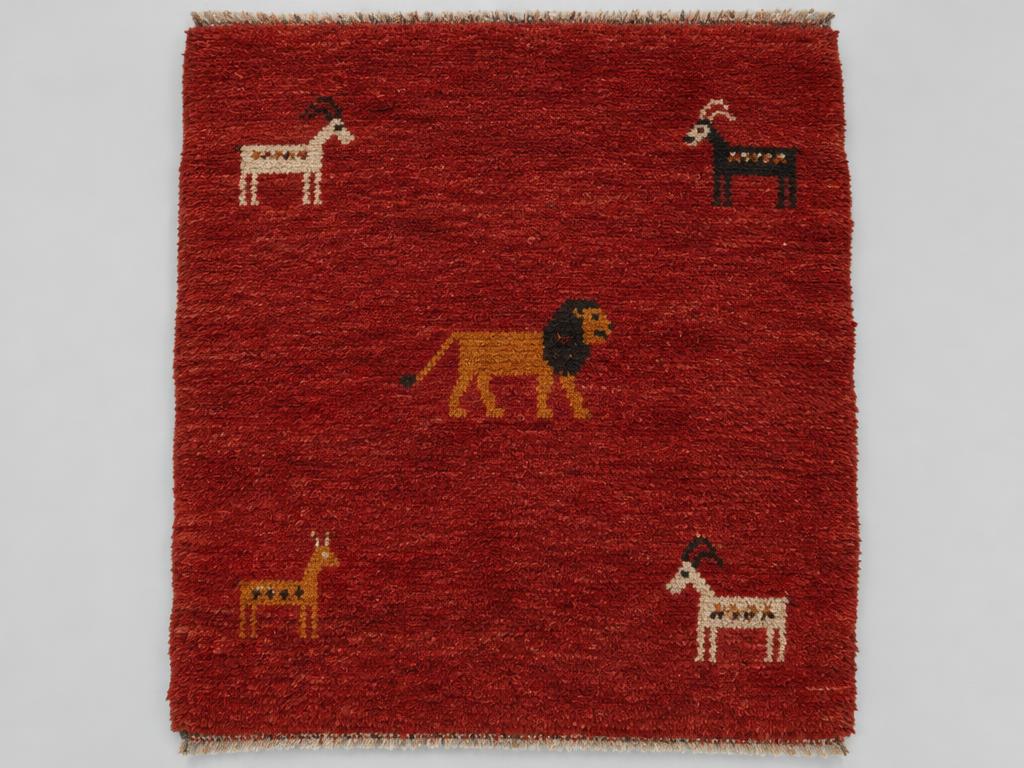
Simple animal figures on a plain, thick-piled gabbeh field.
AI-generated illustration — not a photograph of a real object, place or person, and not evidence of any piece's origin. Shown because no suitable real photograph has been found yet.
Readings of this motif
- Scenes from herding life.
- Figures added to taste by the weaver.
How to recognise it
Look for the Gabbeh animal figures as a repeated unit rather than a single image: its scale, density and the way it sits in a border or field often tell you more about workshop and region than the form alone. The same motif crosses weaving, metal, tile and painting, so a match is a starting point for comparison, never proof of origin.
- Craft
- Gabbeh pile rugs of Fars (Qashqai and Luri weavers)
- Motifs
- Goats, deer, lions, birds, human figures
- Layout
- Few large figures on an open, often plain field
Simple figures
Gabbeh rugs of Fars, woven by Qashqai and Luri women, often show simple goats, deer, people or trees on open, softly coloured fields.
Spontaneity
Figures are woven from memory and daily life, without cartoons; irregular sizes are characteristic.
Market gabbeh
Commercial gabbeh-style rugs are now made in other countries; the archive accepts only Iranian-woven examples.
Historical and Regional Context
The figurative animal motifs characteristic of traditional gabbeh rugs developed within the nomadic pastoral communities of southwestern Iran, primarily among the Qashqai, Luri, and Khamseh tribal groups of Fars. Originally woven strictly for domestic domesticity rather than commercial export, gabbehs served as warm sleeping mattresses, insulated floor coverings, and protective pack items suited to transhumant migrations across the Zagros mountain range. Women weavers drew inspiration directly from their natural surroundings and pastoral routines, depicting stylized goats, gazelles, birds, horses, and human figures without the guidance of pre-drawn cartoons. These creatures were rendered with striking, minimalist economy, floating across broad, unadorned fields of naturally colored or simply dyed wool. The resulting imagery reflected an intimate, living relationship between the weavers and their herds, distinct from the rigid, formal floral schemes produced by contemporaneous urban court and commercial manufactories in central Iranian cities.
Examination, Connoisseurship, and Care
Connoisseurship of animal-motif gabbehs requires discerning authentic tribal weaving from modern commercial workshop reproductions. Examine the yarn structure: traditional nomadic gabbehs feature hand-spun, lustrous local wool that varies noticeably in thickness, giving the pile an organic, tactile depth. Modern commercial imitations—produced both in Iran and elsewhere—frequently employ uniform, machine-spun yarns with mechanical regularity in animal silhouettes. Check the handle of the textile; an authentic tribal gabbeh possesses a pliable, supple body with multiple weft passes between knot rows, whereas modern copies often feel stiff or excessively dense. Inspect dye qualities for genuine abrash (natural color shifts) rather than artificial chemical fading. Caring for thick-pile gabbehs requires vigilant pest management, as deep wool pile provides an ideal habitat for clothes moth larvae. Regular aeration, gentle shaking, and light vacuuming are essential. Never submerge a heavy gabbeh in water without professional conservation support, as dense foundations retain moisture and risk rotting.
Practical questions
- Is every gabbeh Iranian? No.
- Why irregular? Woven without a cartoon.
Figures on an open field
Gabbeh are thick, long-piled rugs woven by Qashqai and Luri families in Fars. Their open fields often hold a handful of animal or human figures — goats, deer, lions, birds, a rider — drawn in simple, blocky outline. The figures are usually woven from the weaver's own design rather than a cartoon, so each is slightly different.
Since the 1980s, gabbeh with minimal fields and a few animals have also been produced for export from workshops, sometimes with dyed-to-order colours, which changes how the figures are chosen and placed.
Reading the figures
Check whether figures are spaced freely or set on a planned grid; free spacing and slight differences in size point to a weaver composing as she goes. Look at the number of wefts between knot rows — gabbeh typically have several — and at the long, coarse pile.
- Unequal, freely spaced animals: hand-composed design.
- Identical figures in a strict grid: a production design.
- Several weft passes between rows: typical gabbeh structure.
Evidence status
The gabbeh craft page shows a real Fars gabbeh, but its photo does not show animal figures, so it is not reused here. Machine-made and non-Iranian 'gabbeh-style' rugs with animals are widely sold; only a documented maker or seller statement plus a hand-knotted back supports a handmade Iranian attribution.
| Observation | Useful description | Not established |
|---|---|---|
| Simple animals | Gabbeh figure | Iranian weaving |
| Open field | Gabbeh layout | Tribe |
| Uniform figures | Possible commercial | Origin |
| What to look at | What it helps with | What it does not prove |
|---|---|---|
| Layout, scale and repeat | Comparing design families | Where or when the piece was made |
| Material and technique | How the design was executed | Iranian handmade origin on its own |
| Dated or signed museum record | A documented reference point | The date or maker of a different object |
References and further reading
- [1] H. E. Wulff, The Traditional Crafts of Persia, MIT Press, 1966; A. U. Pope & P. Ackerman, A Survey of Persian Art, 1938–39.Historical context; not evidence for an individual object.
- [2] Encyclopaedia Iranica ↗Peer-reviewed entries on crafts, motifs and terms.
- [3] Encyclopædia Iranica — entries on carpets, textiles and decorative arts ↗
- [4] Encyclopædia Iranica — 'Gabba' (gabbeh) and Qashqai weaving ↗
These sources provide context, not authentication or provenance for an individual object. Editorial interpretations remain under review.
Used in these crafts
A thick, coarsely knotted pile rug woven mainly by pastoral and village weavers of the Zagros, with open fields, few motifs and a directly personal design language.
A flat, pileless woven textile made across Iran by interlocking or slit-weaving coloured weft threads over a warp, used as floor covering, storage bag, saddle cover and tent divider depending on region.
A non-woven wool textile made by matting and pressing raw wool fibres with moisture, heat and friction rather than by weaving, traditionally produced across Iran for floor coverings, cloaks and protective mats.