
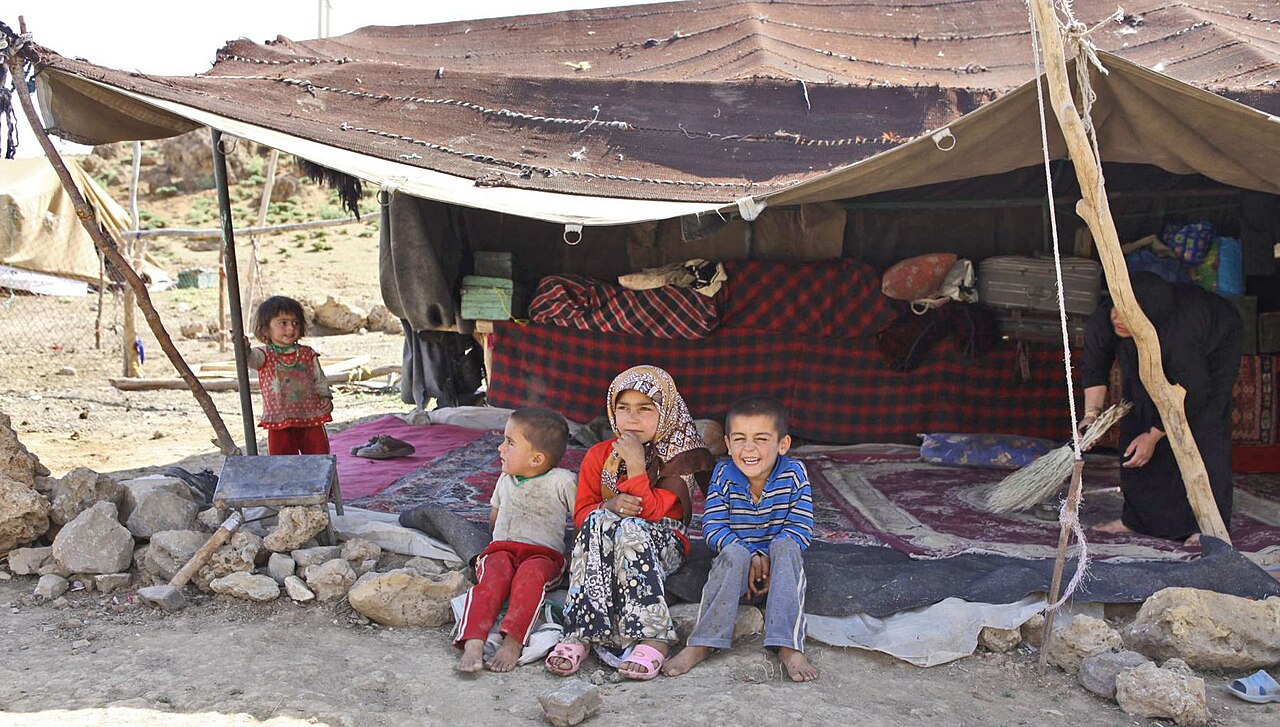
Bakhtiari nomad tent in summer pasture · Photographed 23 June 2011 · Woven tent roof on wooden poles · Iran (Bakhtiari territory)
Ninara from Helsinki, Finland · CC BY 2.0 · Wikimedia Commons record
Bakhtiari black tents are traditionally woven from goat hair; the photographer's record does not state the fibre of this roof. One example, not a defining specimen.
Origin
Nomadic herds.
Properties
- Strong
- Water-shedding
- Coarse
Preparation
Spin tightly and weave on ground looms.
Care & preservation
Store dry and watch for moths.
General guidance only. For valuable or fragile pieces, consult a qualified conservator before cleaning or treatment.
A nomadic fibre
Goat hair (mu-ye boz) has long been spun by pastoral communities in Iran for the black tents (siāh-chādor) of groups such as the Bakhtiari, Qashqai and Lur, and for ropes, sacks and the selvedges or warps of some rugs. The coarse outer hair is strong, sheds water when tightly woven and swells in rain, while finer down from some goats is separated as kork. Goat hair and sheep's wool are therefore not interchangeable in function.
Tent weaving
Black-tent panels are typically woven as long narrow strips on horizontal ground looms and then sewn together; worn strips are replaced over time, so a tent is continually renewed. The work has traditionally been done largely by women. Documentation of tents in museum and ethnographic collections is uneven; photographs of camps illustrate practice but do not date a particular panel.
Goat hair in rugs and flatweaves
In some tribal rugs, dark goat hair is used for selvedge overcasting or edge cords because it is hard-wearing; occasionally it appears in warps or mixed yarns. Its presence suggests a weaver's material choice, not a specific tribe. Hair is harder to dye evenly than wool and is often left natural dark brown or black.
Care
Goat hair is stiff and can become brittle with age and dryness; avoid folding old tent panels along the same lines. Like wool, it is susceptible to clothes moths and carpet beetles. Store clean and dry, inspect seasonally and freeze-treat infested textiles only under conservation guidance.
Practical questions
- Is a goat-hair selvedge proof of nomadic origin? No; it is a material indication only.
- Why are tents black? Undyed dark goat hair is the usual material.
| Observation | Useful description | Not established |
|---|---|---|
| Coarse dark edge cord | Possible goat hair | A named tribe |
| Sewn narrow strips | Tent-panel construction | Date of the panel |
| Brittle fibres | Age or dryness | Specific age |
References and further reading
- [1] H. E. Wulff, The Traditional Crafts of Persia, MIT Press, 1966.Historical process context; not evidence for an individual object.
- [2] Canadian Conservation Institute — Caring for cultural objects ↗General preventive care; treatment requires assessment of the actual object.
These sources provide context, not authentication or provenance for an individual object. Editorial interpretations remain under review.
Used in these crafts
A flat, pileless woven textile made across Iran by interlocking or slit-weaving coloured weft threads over a warp, used as floor covering, storage bag, saddle cover and tent divider depending on region.
A narrow-strip flatwoven textile, usually made in warp-faced bands on a portable loom and then sewn together into a wider cloth, traditionally used as bedding cover, floor spread or door hanging by village and pastoral households.