
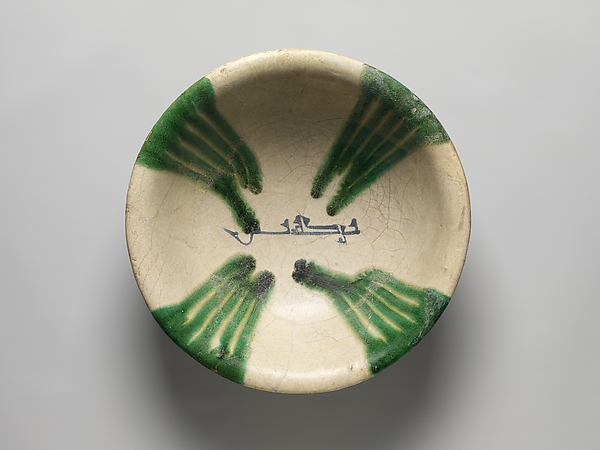
Bowl with Green Splashes · 9th century · Earthenware; 'splash-painted' on opaque white glaze · Iran
The Metropolitan Museum of Art, 30.112.46 · CC0 · Museum record
One catalogued Iranian example whose museum medium line names this material; not a defining specimen.
Origin
Recipes vary; tin and other opacifiers were used.
Properties
- Opaque
- Smooth
- Can craze
Preparation
Apply over the body before painting and firing.
Care & preservation
Do not soak crazed or flaking glaze.
General guidance only. For valuable or fragile pieces, consult a qualified conservator before cleaning or treatment.
Opaque white glaze
Adding tin oxide to a lead glaze makes it opaque white, hiding a red or buff clay body. Potters in Iraq and Iran used tin-opacified glazes from about the ninth century, partly to imitate Chinese white wares, and it formed the ground for early lustre and cobalt painting.
Tin glaze vs slip
A white slip under a clear glaze gives a similar look. Breaks or chips show whether whiteness lies in the glaze or in a clay layer. Lead content in historic glazes means such vessels should not be used for food.
Care
Tin glazes are prone to flaking at rims where the body is exposed. Handle by the body and avoid soaking.
Practical questions
- Is historic tin-glazed ware food-safe? Assume not; glazes often contain lead.
- How to tell slip from tin glaze? Look at a chip.
| Observation | Useful description | Not established |
|---|---|---|
| Opaque white surface | White ground | Tin content |
| Red body at chip | Earthenware body | Glaze type |
| Lustre on white | Lustre decoration | Date |
References and further reading
- [1] H. E. Wulff, The Traditional Crafts of Persia, MIT Press, 1966.Historical process context; not evidence for an individual object.
- [2] Encyclopaedia Iranica ↗Peer-reviewed entries on crafts and materials.
These sources provide context, not authentication or provenance for an individual object. Editorial interpretations remain under review.
Used in these crafts
Square polychrome tiles painted with several overglaze colours and fired together, allowing large architectural schemes to be produced faster than cut tile mosaic.