
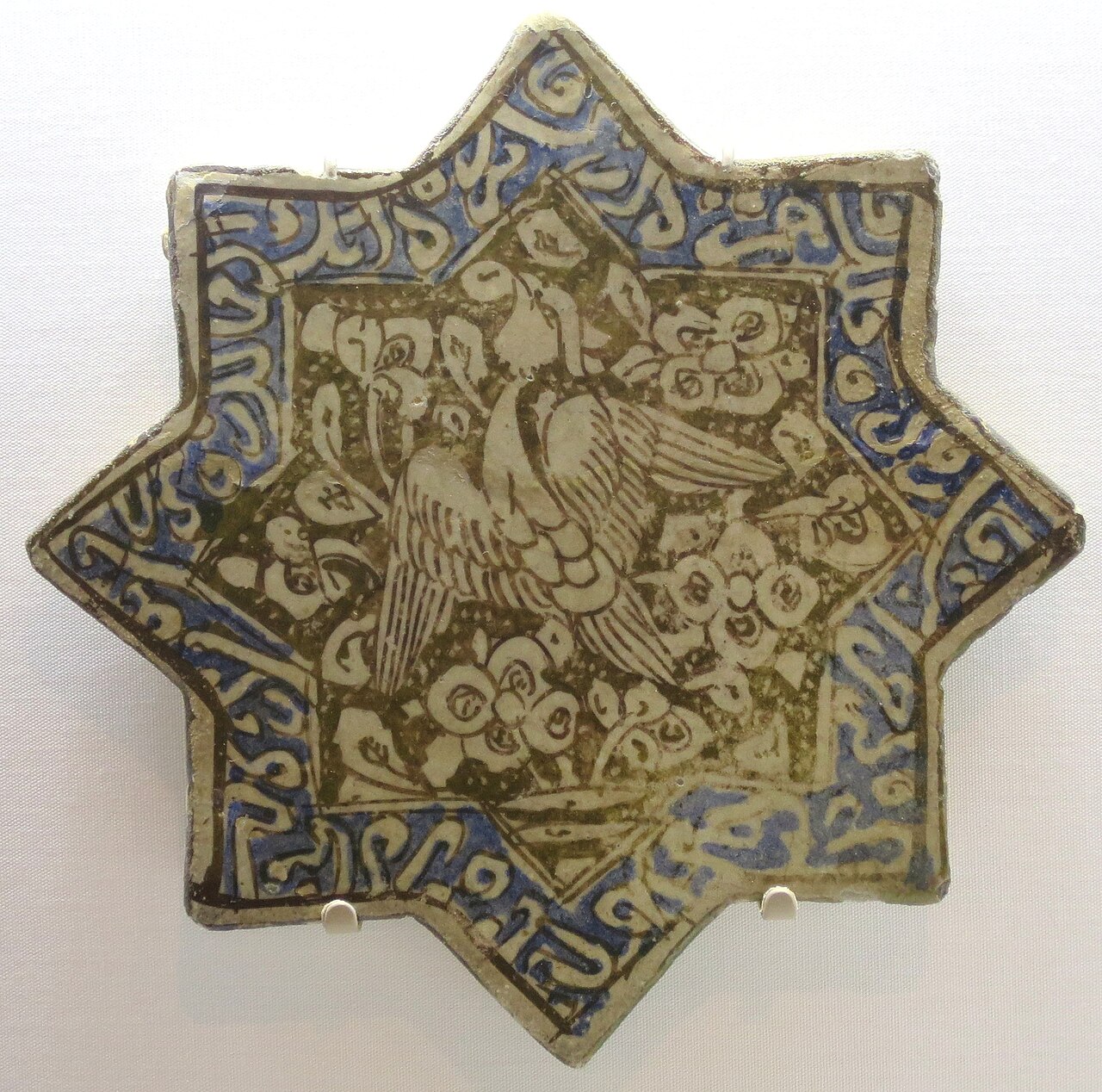
Star tile with phoenix, cobalt-blue glaze · Ilkhanid period · Stonepaste; cobalt and turquoise glaze; Doris Duke Foundation for Islamic Art · Iran
Hiart · CC0 · Wikimedia Commons record
One catalogued Iranian example whose museum medium line names this material; not a defining specimen.
Origin
Mineral cobalt ores; modern supplies are refined.
Properties
- Strong blue
- Fires reliably
- Can blur if overloaded
Preparation
Grind and paint onto the body before glazing.
Care & preservation
Stable once fired.
General guidance only. For valuable or fragile pieces, consult a qualified conservator before cleaning or treatment.
Cobalt as a ceramic colourant
Cobalt oxide produces blue in glazes and underglaze painting even in very small amounts. Iranian potters used cobalt in several periods, including twelfth- and thirteenth-century fritware, Ilkhanid tiles and the large Safavid blue-and-white production. Kashan's historical writer Abu'l-Qasim (1301) mentions a cobalt source near Qamsar, a reference often cited in studies of local supply. Whether a given object used Iranian or imported cobalt can only be suggested by scientific analysis.
Underglaze, in-glaze and overglaze blue
Cobalt may be painted onto a body under a transparent glaze, mixed into the glaze itself for a monochrome blue, or used within enamel colours on top of a fired glaze. These are different techniques with different visual effects: underglaze blue can blur if the glaze runs, while monochrome cobalt glazes pool darker in recesses. Describe the technique observed rather than calling every blue object 'lajvardina' or 'Safavid'.
Blue-and-white and the China connection
Chinese porcelain and Iranian blue-and-white influenced each other: cobalt from the Iranian world was exported for Yuan and Ming porcelain, and Safavid potters, especially under Shah Abbas I, made fritware imitating Chinese designs. Iranian blue-and-white is usually a soft frit body rather than true porcelain. A Chinese-style motif does not make an Iranian piece a copy, and a Persian-looking design does not make a vessel Iranian.
Handling glazed blue wares
Cobalt blue itself is very stable, but the glaze and body can craze, flake or carry old repairs. Inspect under raking light for overpaint that hides restoration; ultraviolet examination by a specialist can reveal fills. Do not soak repaired ceramics or put them in a dishwasher, and lift vessels by the body rather than rims or handles.
Practical questions
- Is Iranian blue-and-white porcelain? Usually not; most is fritware.
- Does a Chinese motif mean a copy? No; it reflects documented exchange.
| Observation | Useful description | Not established |
|---|---|---|
| Blue under clear glaze | Underglaze painting | Safavid date |
| Dragon or cloud motif | Chinese-inspired design | Chinese manufacture |
| Glassy soft body | Possible fritware | Cobalt source |
References and further reading
- [1] H. E. Wulff, The Traditional Crafts of Persia, MIT Press, 1966.Historical process context; not evidence for an individual object.
- [2] Canadian Conservation Institute — Caring for cultural objects ↗General preventive care; treatment requires assessment of the actual object.
These sources provide context, not authentication or provenance for an individual object. Editorial interpretations remain under review.
Used in these crafts
Stonepaste wares painted in cobalt blue under a clear glaze, produced in Iran with strong dialogue with Chinese porcelain, especially in the Timurid and Safavid periods.
Square polychrome tiles painted with several overglaze colours and fired together, allowing large architectural schemes to be produced faster than cut tile mosaic.
A technique of architectural revetment in which monochrome glazed tiles are cut into small individual pieces to a template and set together, glaze face down, into a mortar bed to form complex polychrome patterns and inscriptions.