
 AI illustration
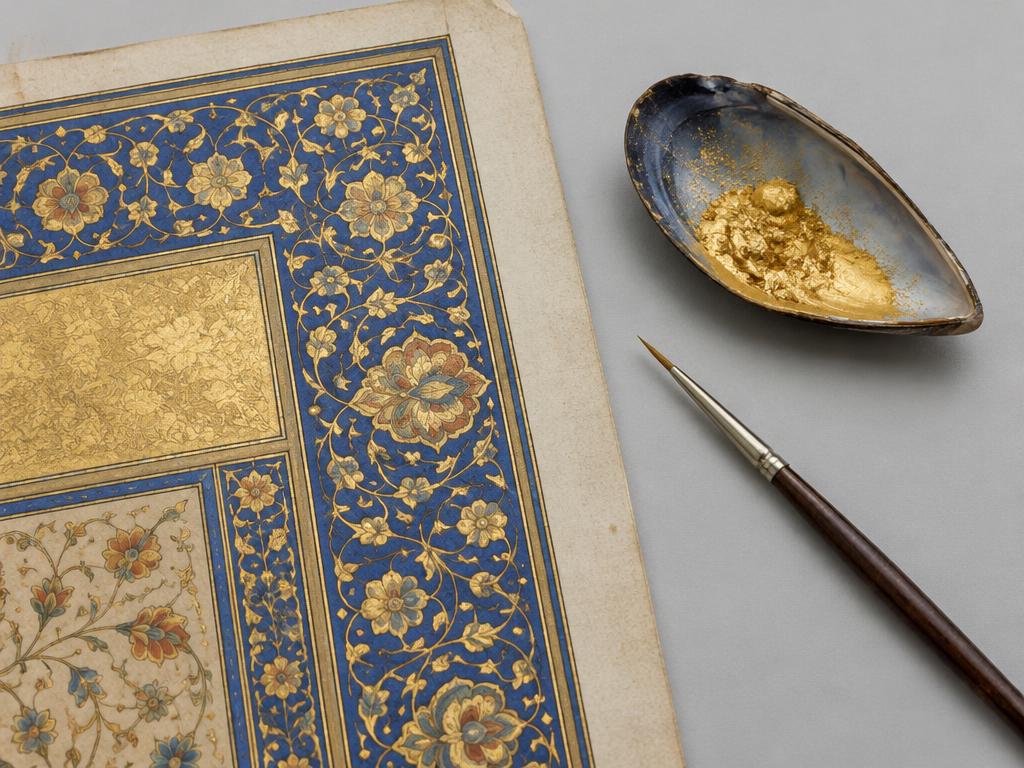
Shell gold — powdered gold bound in gum and kept in a shell — brushed into an illuminated border.
AI-generated illustration — not a photograph of a real object, place or person, and not evidence of any piece's origin. Shown because no suitable real photograph has been found yet.
Origin
Ground gold combined with gum; recipes vary.
Properties
- Brushable
- Can be burnished
- Expensive
Preparation
Grind, mix with binder and paint thin lines or fills.
Care & preservation
Handle pages by the margins and keep them flat.
General guidance only. For valuable or fragile pieces, consult a qualified conservator before cleaning or treatment.
Painted gold
Shell gold (talā-ye hall) is gold leaf ground with honey or salt, washed and mixed with gum arabic, so it can be applied with a brush. The name comes from the mussel shells in which it was stored. In tazhib it is used for grounds, outlines and fine highlights, and may be burnished with an agate tool.
Imitations
Gold-coloured paints based on brass or mica powders are common in commercial work and tarnish or look flatter over time. Only analysis such as XRF confirms gold.
Care
The binder is water-soluble and the layer fragile: never wipe, moisten or touch painted gold.
Practical questions
- Why 'shell' gold? It was stored in shells.
- Is gold paint always real gold? No.
Gold as a paint
Shell gold is gold leaf ground by hand with gum arabic or a similar binder until it becomes a fine paint, traditionally stored in a mussel shell — hence the name. In Persian illumination (tazhib) and painting it is applied with a brush for rulings, fillings and fine details, then often burnished with an agate to bring up the shine.
It is different from gold leaf, which is laid as a sheet, and from cheaper metallic paints, which use brass or bronze powder and tarnish green or brown.
Looking at gold on a page
Under raking light, burnished shell gold looks smooth and bright in polished areas and matte where it was left unburnished. Brass-based paints dull and may show greenish edges. Gold leaf usually shows straight seams or overlaps where sheets met.
- Brush marks within the gold: applied as paint.
- Straight seams: leaf rather than shell gold.
- Green or brown tarnish: likely a base-metal substitute.
Evidence status
Museum records for Iranian manuscripts usually say 'gold' without saying whether it was leaf or ground gold. We found no Iran-catalogued open-access record that specifies shell gold, so this page has no lead photograph; the gold-leaf and illumination pages show related real examples.
| Observation | Useful description | Not established |
|---|---|---|
| Brushed gold lines | Painted gold | Genuine gold |
| Burnished shine | Burnishing | Age |
| Darkened gold areas | Possible base metal | Later retouch |
| What to look at | What it helps with | What it does not prove |
|---|---|---|
| Layout, scale and repeat | Comparing design families | Where or when the piece was made |
| Material and technique | How the design was executed | Iranian handmade origin on its own |
| Dated or signed museum record | A documented reference point | The date or maker of a different object |
References and further reading
- [1] H. E. Wulff, The Traditional Crafts of Persia, MIT Press, 1966.Historical process context; not evidence for an individual object.
- [2] Encyclopaedia Iranica ↗Peer-reviewed entries on crafts and materials.
- [3] The Metropolitan Museum of Art, Islamic Art collection search (filter: Iran) ↗
- [4] Cleveland Museum of Art open-access collection (Islamic art, Iran) ↗
These sources provide context, not authentication or provenance for an individual object. Editorial interpretations remain under review.
Used in these crafts
The decoration of manuscript pages and album leaves with gold and coloured pigments in geometric and floral designs framing text or painting.
The Iranian tradition of small-scale painting made for manuscripts and albums, built from fine line, flat luminous colour and layered spatial convention rather than single-point perspective.