
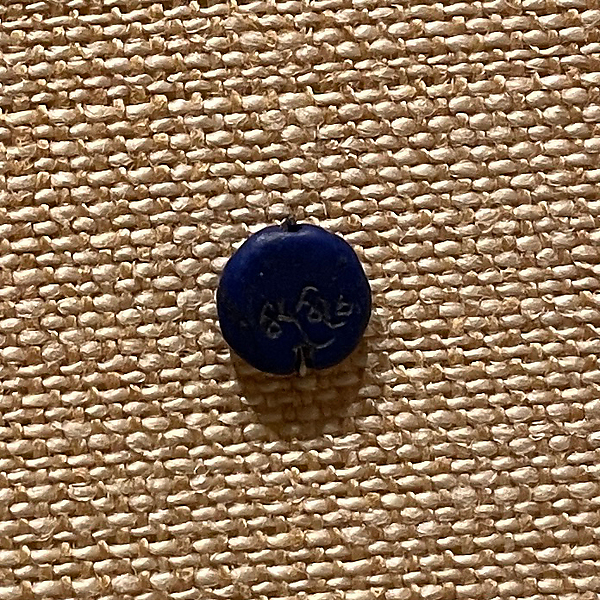
Seal Stone · 10th–11th century · Lapis lazuli · Iran
The Metropolitan Museum of Art, 38.40.98 · CC0 · Museum record
One catalogued Iranian example whose museum medium line names this material; not a defining specimen.
Origin
Historically traded from Badakhshan; modern pigments may be synthetic.
Properties
- Intense blue
- Stable to light
- Costly when natural
Preparation
Grind and purify the stone, then bind with gum.
Care & preservation
Keep painted pages away from moisture and rubbing.
General guidance only. For valuable or fragile pieces, consult a qualified conservator before cleaning or treatment.
A stone, a pigment and a colour name
Lapis lazuli is a rock whose blue comes mainly from the mineral lazurite. Historically, much of the stone used in the Iranian world is associated with the Badakhshan mines in present-day Afghanistan, so Persian use of lapis normally implies long-distance trade rather than local quarrying. The Persian word lājvard can mean the stone, the pigment or simply a deep blue, and in ceramics it can also describe cobalt-blue glazes. Record which meaning a source intends before drawing conclusions.
Ultramarine in manuscripts
Grinding lapis alone gives a greyish blue; the intense pigment used in illumination and painting requires separating lazurite from other minerals, a laborious process described in several historical traditions. Natural ultramarine was therefore costly and reserved for important areas such as skies, grounds of illuminated panels and garments. Synthetic ultramarine became available in the nineteenth century. Only pigment analysis by a qualified laboratory can distinguish natural from synthetic ultramarine with confidence; appearance cannot.
Inlay, beads and dyed imitations
In jewellery and inlay, lapis may be cut as cabochons, beads or thin plaques. Gold-coloured pyrite flecks and white calcite are common in natural stone, but dyed stone, reconstituted material and glass are also sold as lapis. Colour rubbing off on a cloth can signal dye, yet a buyer should not perform acetone or scratch tests on a valuable object. Ask for a gemmological report where the stone matters to value, and keep the stone identity separate from the object's place of making.
Care of lapis surfaces
Lapis is relatively soft compared with many gemstones and can be scratched or dulled by abrasives, acids and ultrasonic cleaning. Painted ultramarine in manuscripts is a powdery layer held by binder; it must never be wiped. Store jewellery separately in soft pouches, and keep manuscripts flat, shaded and handled only by clean, dry hands or by trained staff.
Practical questions
- Was lapis mined in Iran? The main historical source is usually given as Badakhshan, outside modern Iran.
- Does 'lajvard' always mean lapis? No; it can name cobalt-blue glaze or a colour.
| Observation | Useful description | Not established |
|---|---|---|
| Deep blue in a manuscript | Blue pigment present | Natural ultramarine |
| Gold flecks in a stone | Possible pyrite | Genuine untreated lapis |
| 'Lajvard' in a listing | Blue colour claimed | Stone material |
References and further reading
- [1] H. E. Wulff, The Traditional Crafts of Persia, MIT Press, 1966.Historical process context; not evidence for an individual object.
- [2] Canadian Conservation Institute — Caring for cultural objects ↗General preventive care; treatment requires assessment of the actual object.
These sources provide context, not authentication or provenance for an individual object. Editorial interpretations remain under review.
Used in these crafts
The decoration of manuscript pages and album leaves with gold and coloured pigments in geometric and floral designs framing text or painting.
The Iranian tradition of small-scale painting made for manuscripts and albums, built from fine line, flat luminous colour and layered spatial convention rather than single-point perspective.