
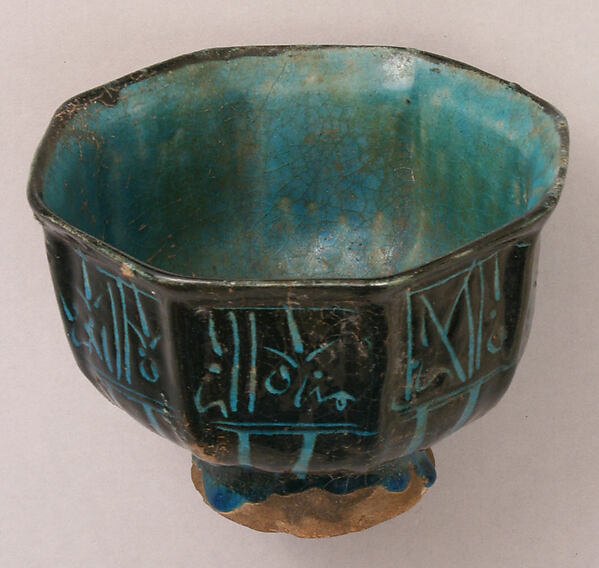
Stonepaste Bowl with Blue and Black Underglaze Painting · late 12th century · Stonepaste; glazed and incised · Iran
The Metropolitan Museum of Art, 45.153.4 · CC0 · Museum record
One catalogued Iranian example whose museum medium line names this material; not a defining specimen.
Origin
Developed in medieval Iran and neighbouring lands.
Properties
- White
- Hard but brittle
- Takes bright glazes
Preparation
Mix quartz, frit and clay, shape and fire.
Care & preservation
Old frit wares may be fragile; handle with two hands.
General guidance only. For valuable or fragile pieces, consult a qualified conservator before cleaning or treatment.
Stonepaste ceramics
Fritware (stonepaste) is a ceramic body made mostly of ground quartz with small amounts of glass frit and fine clay. Developed in the Islamic world by the twelfth century and used widely in Iran, it fires white and allows thin walls, close to the look of Chinese porcelain. Abu'l-Qasim of Kashan described a recipe in 1301.
Recognition
Fritware breaks to a white, slightly sugary or granular fracture and is softer than true porcelain. Earthenware is usually red or buff. Examine unglazed foot rings in photographs rather than chipping a piece.
Care
Fritware is porous where unglazed and can absorb salts and stains; avoid soaking.
Practical questions
- Is fritware porcelain? No; it is quartz-based and softer.
- Why white? Quartz body without iron-rich clay.
| Observation | Useful description | Not established |
|---|---|---|
| White granular foot | Possible fritware | Kashan origin |
| Thin translucent wall | Fine body | Porcelain |
| Red body | Earthenware | Region |
References and further reading
- [1] H. E. Wulff, The Traditional Crafts of Persia, MIT Press, 1966.Historical process context; not evidence for an individual object.
- [2] Encyclopaedia Iranica ↗Peer-reviewed entries on crafts and materials.
These sources provide context, not authentication or provenance for an individual object. Editorial interpretations remain under review.
Used in these crafts
A historic overglaze-enamelled stonepaste ware produced mainly in Iran during the twelfth and early thirteenth centuries, decorated with figural and courtly scenes painted in multiple colours applied after glazing and fixed by a low second firing.
A ceramic decoration in which metallic oxides are painted onto a glazed surface and fired in a reducing kiln to produce a metallic sheen, associated especially with Kashan.
Stonepaste wares painted in cobalt blue under a clear glaze, produced in Iran with strong dialogue with Chinese porcelain, especially in the Timurid and Safavid periods.