
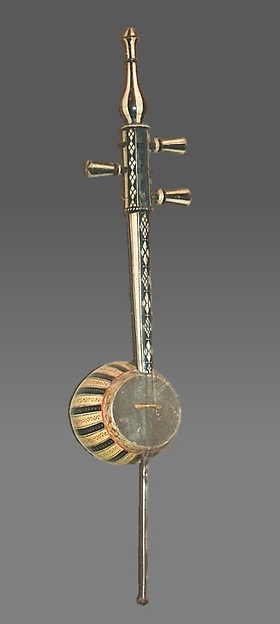
Kāmanche (کمچ) · late 19th century · Wood, paint, fish skin, metal · Iran (Persia)
The Metropolitan Museum of Art, 89.4.1806 · CC0 · Museum record
One catalogued Iranian example whose museum medium line names this material; not a defining specimen.
Origin
Lamb or fish skin prepared by makers.
Properties
- Thin
- Tension-sensitive
- Humidity-sensitive
Preparation
Soak, stretch and glue over the frame.
Care & preservation
Avoid heat and sharp changes in humidity.
General guidance only. For valuable or fragile pieces, consult a qualified conservator before cleaning or treatment.
Membranes and strings
Iranian instruments use animal membranes as soundboards: lamb or kid skin on the tar and kamancheh, and goat or other skins on frame drums such as the daf and on the tombak. Gut strings were historically common before metal and synthetic strings.
Choices today
Many players now use synthetic heads for stability, especially on tombak. Natural skin responds to humidity, changing pitch. A synthetic head does not make an instrument less handmade.
Care
Skins split if over-dried or struck with rings. Store away from heat and pests; skins attract insects.
Practical questions
- Is a synthetic head inauthentic? No.
- Why does pitch drift? Natural skin reacts to humidity.
| Observation | Useful description | Not established |
|---|---|---|
| Translucent skin top | Natural membrane | Animal species |
| Uniform white head | Possible synthetic | Factory instrument |
| Split membrane | Damage | Poor making |
References and further reading
- [1] H. E. Wulff, The Traditional Crafts of Persia, MIT Press, 1966.Historical process context; not evidence for an individual object.
- [2] Encyclopaedia Iranica ↗Peer-reviewed entries on crafts and materials.
These sources provide context, not authentication or provenance for an individual object. Editorial interpretations remain under review.
Used in these crafts
The workshop making of Iranian instruments such as the tar, setar, kamancheh, santur and oud, combining woodwork, skin membranes and inlaid decoration.