
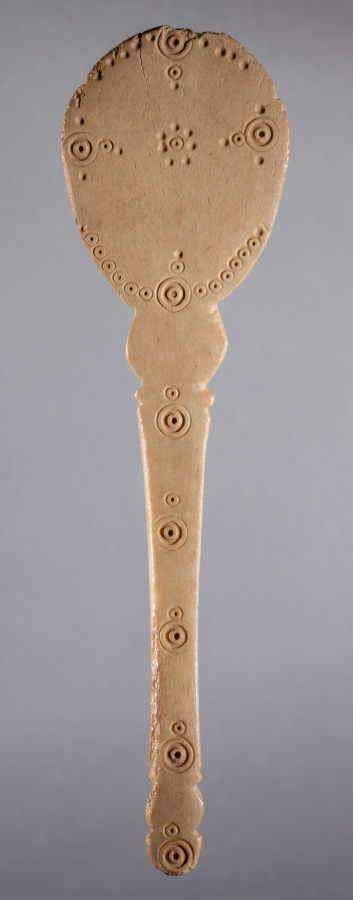
Bone Object · 700s–900s · Bone, incised · Iran, early Islamic period
Cleveland Museum of Art, 1962.147 · CC0 · Museum record
One catalogued Iranian example whose museum medium line names this material; not a defining specimen.
Origin
Camel bone is common today; old pieces may contain ivory.
Properties
- Pale and fine-grained
- Can yellow
- Legal limits apply to ivory
Preparation
Cut into thin strips or tiny elements for inlay.
Care & preservation
Ivory trade is regulated: check local law before buying antiques.
General guidance only. For valuable or fragile pieces, consult a qualified conservator before cleaning or treatment.
Why substitutes
Ivory once appeared in Iranian inlay, khatam, pen boxes and painted plaques. International restrictions on elephant ivory mean contemporary makers use bone, camel bone, resin or plastic instead. Substitutes are legitimate when declared.
Telling them apart
Elephant ivory shows Schreger lines on cross-sections; bone shows dark pores; resins may show moulding seams and uniform colour. Identification on small inlay pieces is uncertain without a specialist. Older objects claimed as ivory may need legal documentation for sale or export.
Care
Bone and ivory both crack with dryness and heat; resins can yellow. Keep away from sunlight and radiators.
Practical questions
- Is a substitute a fake? Not if declared.
- Can I legally sell ivory? Rules vary; check before buying.
| Observation | Useful description | Not established |
|---|---|---|
| Cross-hatched lines | Possible ivory | Legal status |
| Dark pores | Possible bone | Species |
| Uniform white | Possible resin | Age |
References and further reading
- [1] H. E. Wulff, The Traditional Crafts of Persia, MIT Press, 1966.Historical process context; not evidence for an individual object.
- [2] Encyclopaedia Iranica ↗Peer-reviewed entries on crafts and materials.
These sources provide context, not authentication or provenance for an individual object. Editorial interpretations remain under review.
Used in these crafts
A Persian inlay art in which fine rods of wood, bone and metal are bundled into star units, sliced into thin sheets and applied to a wooden surface to form dense geometric tessellation.
The carving of bone and, historically, ivory into figurines, plaques, combs and inlay elements, also used as a component in khatam.