
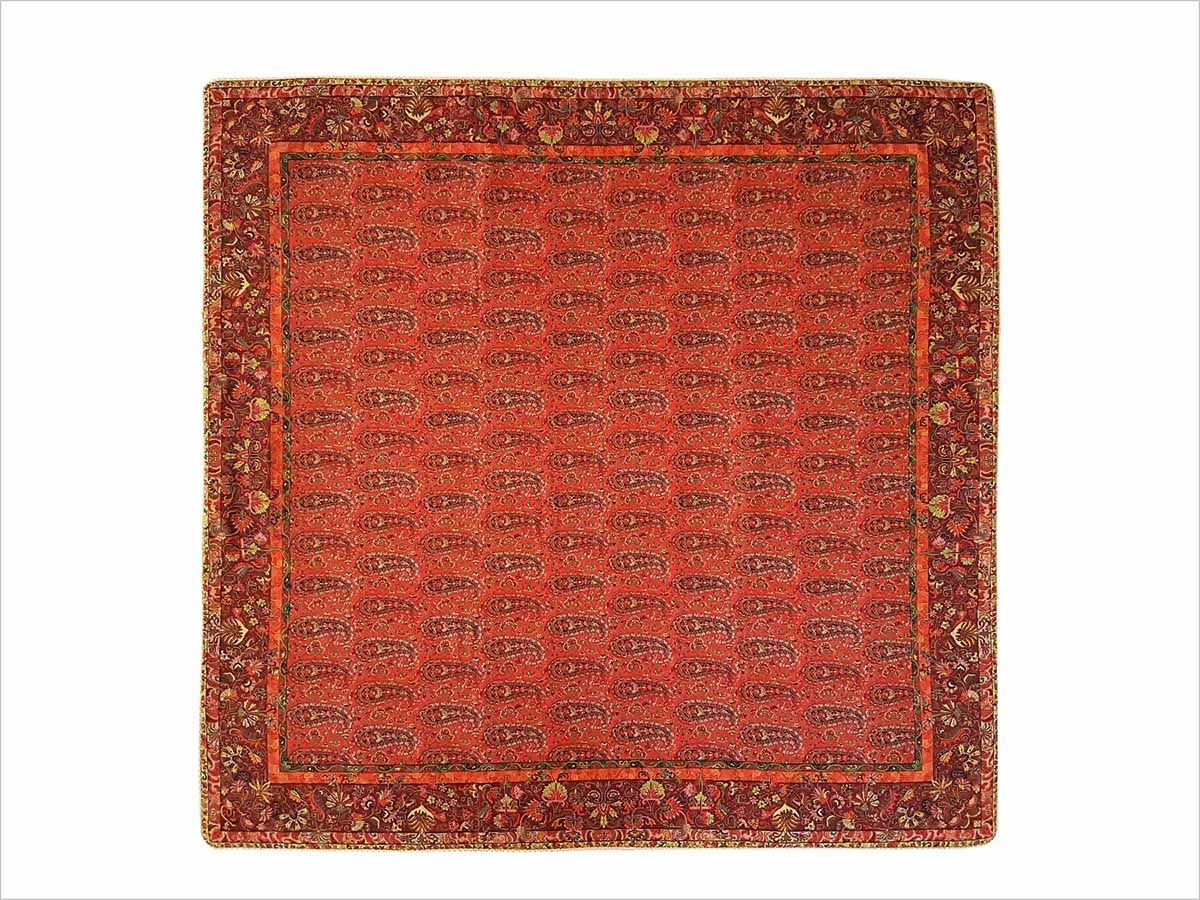
Boteh-patterned termeh: a motif comparison, not proof of a universal symbolic meaning or hand weaving.
Listing image, date unverified · Craftestan (photographer not stated) · Permission status not reviewed · Photo source ↗
Spelling and pronunciation
- Persian: بته
- Transliteration: boteh
- English usage: Boteh (paisley)
Spellings vary between dealers, museums and regions. Usage notes are under review.
How the term is used
The teardrop or paisley motif found in carpets, termeh and embroidery.
Common confusions
Its meaning is debated; ‘flame’ and ‘cypress’ are interpretations, not established facts.
Arrangement before symbolism
Boteh can appear alone or repeat across fields and borders. Contour, curled tip, orientation and internal ornament are useful observations before interpretation. English paisley is a related trade label, not a universal explanation.
The form travels across cloth, carpets and embroidery. Its presence establishes no single region, religion or meaning. Cypress, flame and leaf readings should be attributed interpretations, not facts applied to every example.
Compare the evidence
| Object or term | What to examine | Limit of the evidence |
|---|---|---|
| Single motif | Contour and tip | Not a universal symbol. |
| Repeated field | Rhythm and scale | Not region evidence alone. |
| Paisley label | Trade usage | Not a fixed historical interpretation. |
Practical questions
- Can boteh identify a rug's region?
- Not alone. Combine motif description with structure and provenance.
Sources and further reading
- Encyclopaedia Iranica · Carpets
Weaving vocabulary and historical context; not object authentication or valuation.
Editorial draft awaiting specialist review. References provide context, not verification of every statement, object attribution or current workshop access.
Used in these crafts
A patterned Iranian brocade woven with supplementary wefts, historically in silk and wool, associated above all with Yazd and Kerman.
A hand-knotted pile textile woven across Iran in city workshops, village looms and pastoral camps, distinguished by regional structure, palette and design vocabulary.