
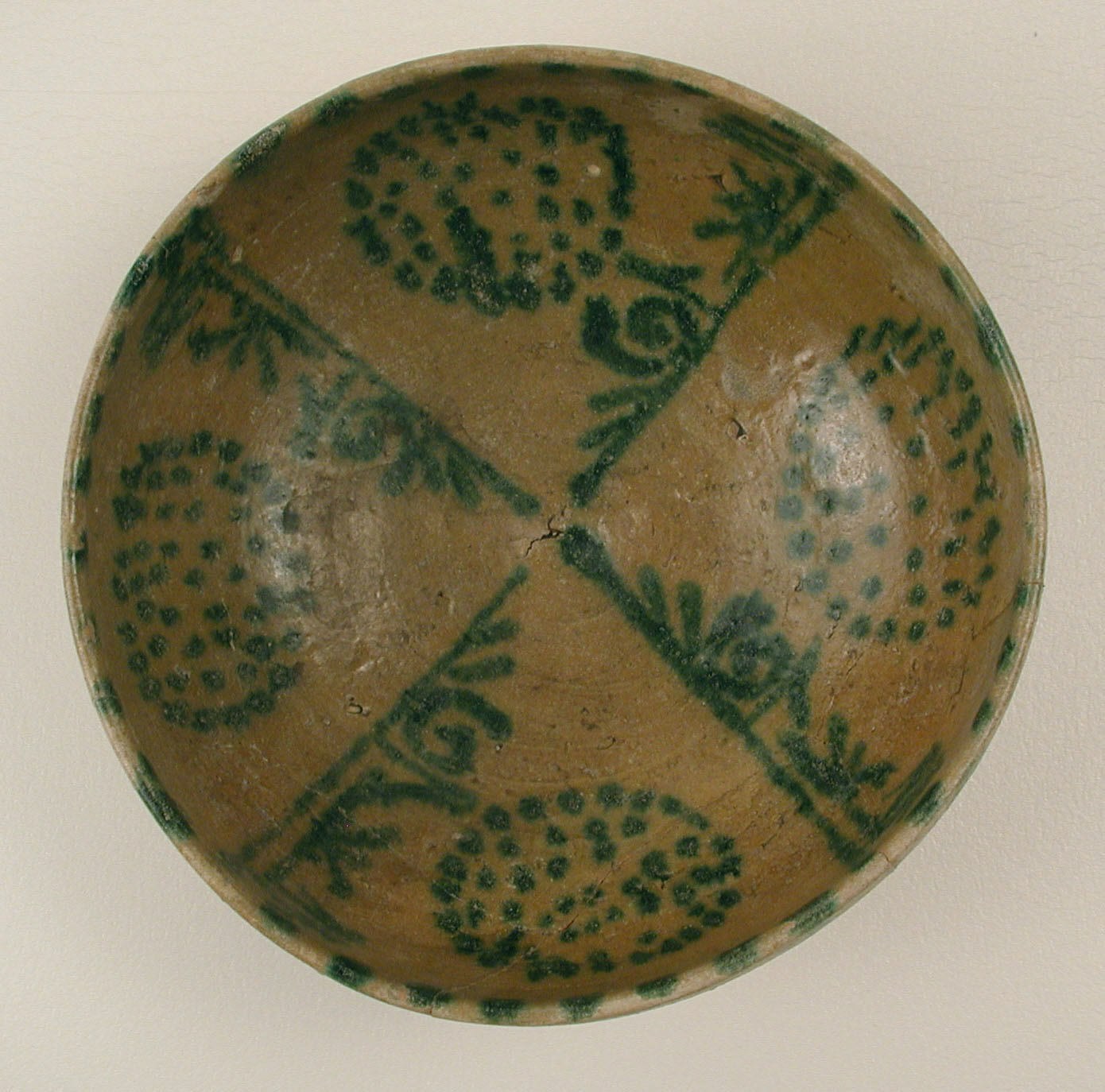
Bowl with Green Pseudo-Inscriptions and Clusters of Spots, 39.40.52; Iran, 9th–10th century
9th–10th century · CP-LIB-MET-449585 · The Metropolitan Museum of Art · CC0 (museum open access; resized JPEG) · Photo source ↗
Meaning
A liquid clay suspension used in ceramic making or surface decoration. A slip layer and a vitreous glaze are not the same material.
Spelling and pronunciation
- Persian: دوغاب سفالی
- Transliteration: dughab-e sofali
- English usage: Slip (ceramic surface)
Spellings vary between dealers, museums and regions. Usage notes are under review.
Clay suspension and vitreous coating
Slip is a liquid suspension of clay used in ceramic processes and decoration. A slip layer may change the visible ground on which ornament is applied. Glaze is a different surface system, forming a vitreous coating in firing. A light-coloured ground therefore should not automatically be called white glaze.
The Nishapur bowl’s catalogue describes yellow slip and green decoration beneath transparent glaze. Another Iranian bowl in the library is described as painted on opaque white glaze. Retaining the exact wording makes the comparison more useful than grouping both as the same painted pottery.
A surface description is not a kiln recipe
The medium field does not provide every firing temperature, ingredient or workshop stage. A photograph can show colour and arrangement but cannot independently identify a body’s mineral composition or a colourant. Avoid making a manufacturing recipe from a catalogue sentence.
Damaged or restored surfaces can complicate visible layers. Existing chips should not be enlarged to look for slip, and no scraping test should be attempted. A condition report, technical catalogue or specialist examination is the appropriate source for detailed layer identification. Contemporary maker documentation can explain a current process without being transferred to a medieval object.
Compare the evidence
| Object or term | What to examine | Limit of the evidence |
|---|---|---|
| Slip | Clay-based layer or application | Not automatically glaze. |
| Glaze | Vitreous coating as documented | Shine does not identify chemistry. |
| Fill or coating | Treatment documentation | A pale patch may be restoration. |
Practical questions
- Can colour distinguish slip from glaze?
- Not reliably on its own. Retain the catalogue medium and seek technical evidence for a particular object.
Sources and further reading
- The Metropolitan Museum of Art: Bowl with Green Pseudo-Inscriptions and Clusters of Spots (39.40.52)
Object-specific catalogue comparison; not proof of another object’s identity or provenance.
Editorial draft awaiting specialist review. References provide context, not verification of every statement, object attribution or current workshop access.
Used in these crafts
Earthenware decorated with coloured slips under a clear or tinted glaze, including early Islamic Nishapur-type wares and later village production such as Lalejin.