
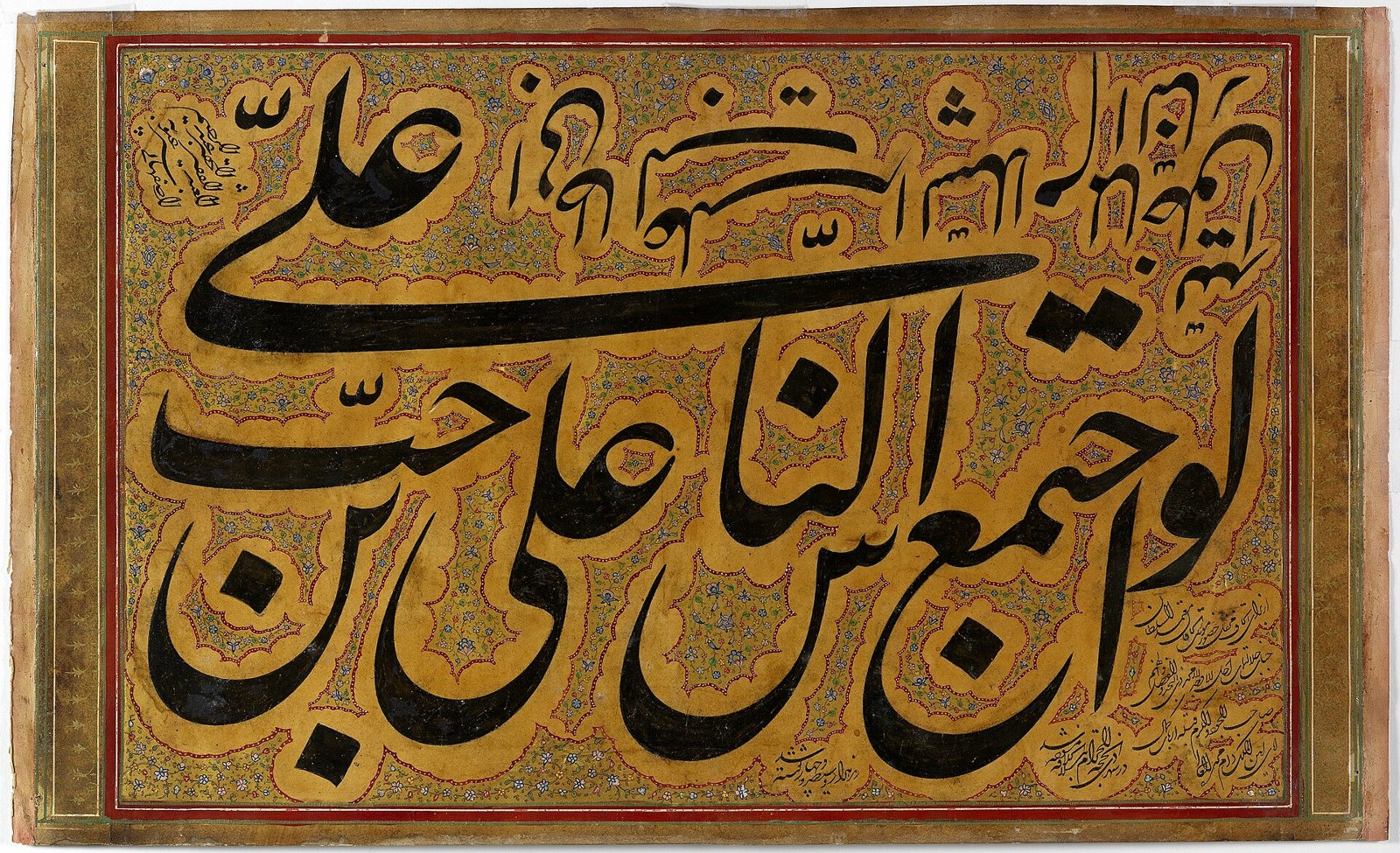
Subject comparison from the cited registry. Date, attribution and rights qualifications remain below; not authentication or maker certification.
1304 AH · Abdorrahim Afsar Esfahani · Public domain · Photo source ↗
Spelling and pronunciation
- Persian: نستعلیق
- Transliteration: nastaʿliq
- English usage: Nastaliq script
Spellings vary between dealers, museums and regions. Usage notes are under review.
How the term is used
The elegant hanging script widely used for Persian poetry.
Common confusions
Often confused with shekasteh, a faster and more broken cursive script.
Script, text and attribution
Sloping lines and the balance of compact forms and extended strokes organise nastaliq. Identifying the script differs from reading the words, assigning a hand or dating the sheet.
Transliteration of the script name does not pronounce the text. Dates and signatures require informed reading. A skilled copy can imitate a composition; retain attribution qualifiers and mounting history.
Origins and masters
Nastaliq took shape in Iran in the late 14th and early 15th centuries; Mir Ali Tabrizi is traditionally credited with codifying it. Under the Timurids and Safavids it became the principal script for Persian poetry, with masters such as Sultan Ali Mashhadi and, above all, Mir Emad Hasani (d. 1615), whose style remains a model. In the 19th century Mirza Gholamreza Esfahani and Mirza Mohammad Reza Kalhor shaped its modern forms.
Its proportions are measured in rhombic dots made by the reed pen, and its long, slightly sloping horizontal strokes give Persian verse its familiar visual rhythm. It remains the most widely practised calligraphic script in Iran, taught through the Iranian Calligraphers Association.
Compare the evidence
| Object or term | What to examine | Limit of the evidence |
|---|---|---|
| Script | Letter relationships | Not authorship. |
| Transcription | Actual text | Not translation alone. |
| Attribution | Evidence and qualifiers | Style is not a certificate. |
| Single calligraphy sheet (qeta') | Ink quality, signature, margins added later | Borders are often later additions |
| Siah-mashq practice sheet | Overlapping repeated letters | Practice pieces are collected as art in their own right |
Practical questions
- Can appearance date nastaliq securely?
- Not alone. Copying, inscriptions, paper and remounting complicate dates.
- Who is the most famous nastaliq master?
- Mir Emad Hasani is widely regarded as the classic master; many later calligraphers copied his work.
Sources and further reading
- The Metropolitan Museum of Art · The arts of the book in the Islamic world
Collaborative manuscript production and page arts; not authentication of a particular sheet.
- The Metropolitan Museum of Art · The arts of the book in the Islamic world
Context for calligraphic practice and manuscript production.
Editorial draft awaiting specialist review. References provide context, not verification of every statement, object attribution or current workshop access.
Used in these crafts
A hanging cursive script developed in Iran for Persian poetry, distinguished by its sloping baseline, sharply contrasted thick and thin strokes, and sweeping final letters.