
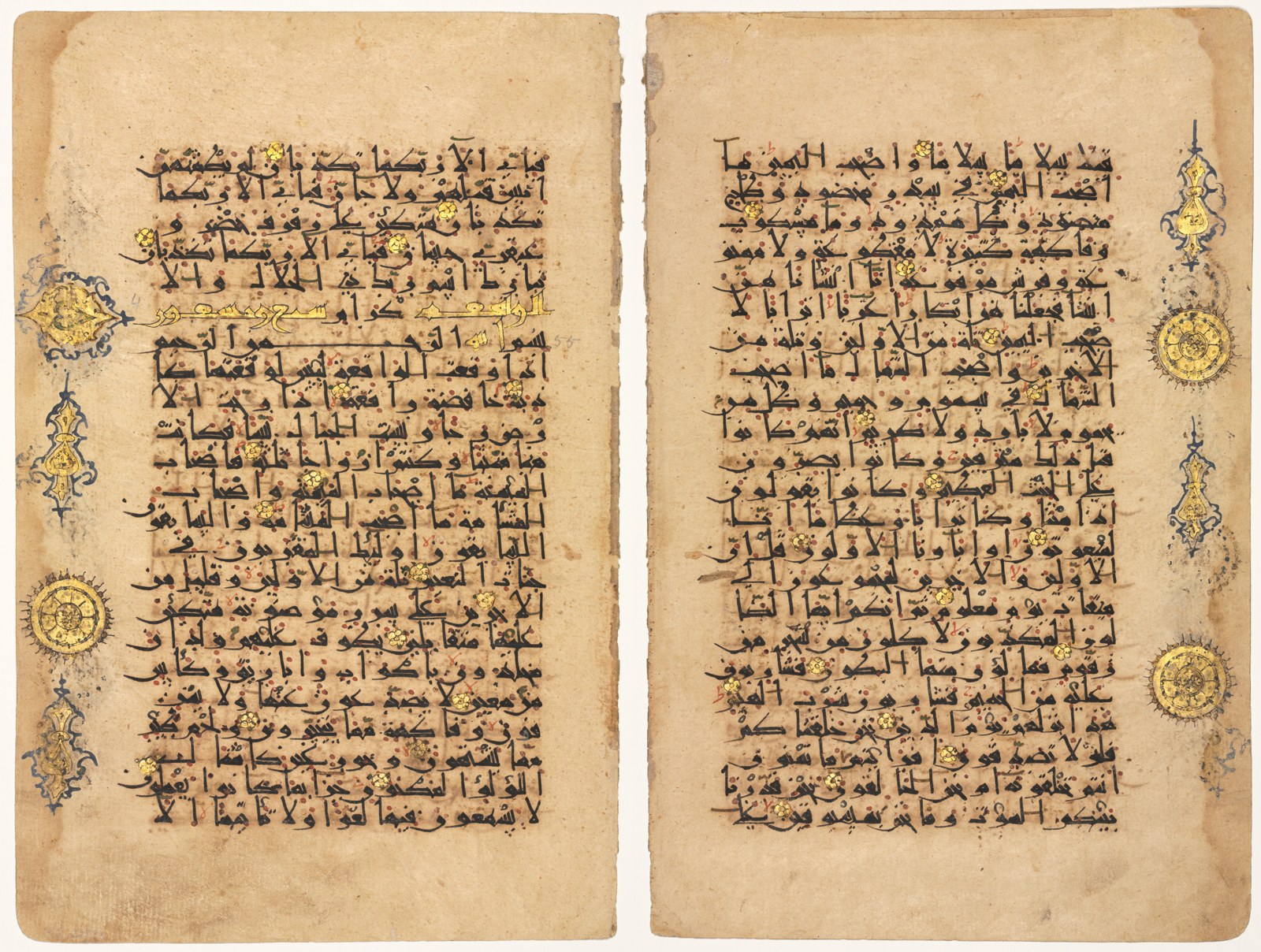
Folio from a Qur'an, 1933.488; Iran, 1100s
1100s · CP-LIB-CMA-1933-488 · Cleveland Museum of Art · CC0 (museum open access; resized JPEG) · Photo source ↗
Meaning
The two faces of a leaf. Keep the institution’s face designations when recording photographs, text and decoration.
Spelling and pronunciation
- Persian: رو و پشت برگ
- Transliteration: ru va posht-e barg
- English usage: Recto and verso
Spellings vary between dealers, museums and regions. Usage notes are under review.
Keep face designations tied to the catalogue
Recto and verso label the faces of a leaf. In detached or remounted material, a modern catalogue’s face designation may not reveal how the leaf sat in its original binding. Preserve the institution’s label when linking a transcription or photograph, rather than assuming the more decorated side must be recto.
A composite photograph may place faces side by side. That arrangement is an image presentation, not evidence that the leaf was originally unfolded or displayed in that manner. The Cleveland folio used here has face-specific catalogue entries; those entries are the correct starting point for discussing its text.
Separate face, orientation and content
A face can contain writing, painting, ownership marks or later backing. These are content observations, not reasons to change its name. Orientation may also be affected by later album mounting. Record whether an image is rotated and whether the source gives a reading direction.
Never detach backing or force open a mounting to inspect the other face. Published records and qualified conservation examination are safer ways to recover information. If the reverse has not been seen, state that limit instead of describing it as blank.
Compare the evidence
| Object or term | What to examine | Limit of the evidence |
|---|---|---|
| Recto | Catalogue face label | Not necessarily the decorated side. |
| Verso | Separate text and marks | Unseen does not mean blank. |
| Composite image | Photographic arrangement | Not original binding evidence. |
Practical questions
- Can I identify the recto from ornament alone?
- No. Use the catalogue designation and codicological evidence rather than the amount of decoration.
Sources and further reading
- Cleveland Museum of Art: Folio from a Qur'an (1933.488)
Object-specific catalogue comparison; not proof of another object’s identity or provenance.
Editorial draft awaiting specialist review. References provide context, not verification of every statement, object attribution or current workshop access.
Used in these crafts
The decoration of manuscript pages and album leaves with gold and coloured pigments in geometric and floral designs framing text or painting.
A hanging cursive script developed in Iran for Persian poetry, distinguished by its sloping baseline, sharply contrasted thick and thin strokes, and sweeping final letters.