
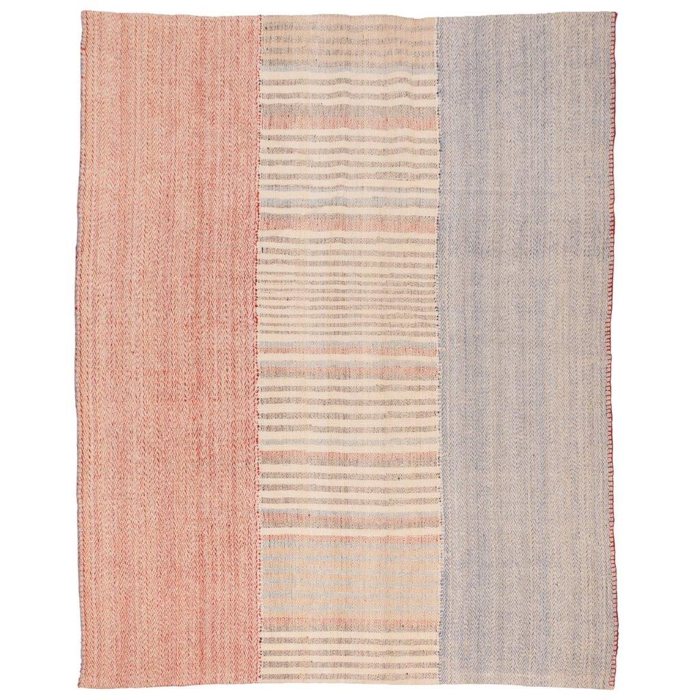
Subject comparison from the cited registry. Date, attribution and rights qualifications remain below; not authentication or maker certification.
Example photograph, date unverified · Shop / studio (photographer not stated) · Permission status not reviewed · Photo source ↗
Spelling and pronunciation
- Persian: جاجیم
- Transliteration: jājim
- English usage: Jajim
Spellings vary between dealers, museums and regions. Usage notes are under review.
How the term is used
Means a warp-faced flatweave woven in narrow strips that are sewn together, used as a blanket or cover.
Common confusions
Different from gelim, whose pattern is weft-faced. Jajim patterns come from the warp.
Pattern carried by the warp
Jajim is associated with warp-faced strip weaving. Narrow lengths can be sewn into a broader cloth, so seams may be integral rather than repairs. Record strip widths, joins and finished ends.
A striped blanket is not automatically jajim. Compare yarn direction and interlacement: print and weft-faced bands can imitate similar designs. Trade spellings and regional categories can overlap, making structure more useful than a stripe alone.
How a jajim is made and used
Jajim is a warp-faced flatweave: the coloured warps carry most of the pattern, so stripes run lengthwise and small geometric motifs are formed by warp floats or supplementary threads. Weavers typically work on narrow ground or horizontal looms, producing long strips that are cut and sewn edge to edge into a larger cover. Wool is usual, sometimes with cotton or silk accents.
In village and nomadic households jajim served as bedding covers, wraps for stacked bedding (rakhtekhab-pich), blankets and floor covers. Production is associated with Ardabil and Gilan, the Bakhtiari and Qashqai areas, Lorestan and parts of Khorasan, among others.
Compare the evidence
| Object or term | What to examine | Limit of the evidence |
|---|---|---|
| Warp-faced strip | Warp dominates face | Stripe alone is insufficient. |
| Kilim | Coloured weft dominates | Different yarn organisation. |
| Printed stripe | Surface-applied pattern | Not woven ornament. |
| Jajim | Lengthwise stripes, warp-faced surface, sewn seams between strips | Region rarely identifiable from look alone |
| Gelim (kilim) | Weft-faced, slits or interlocked colour joins | Often sold under the same 'kilim' label |
Practical questions
- Are the seams original?
- They may be construction, repair or alteration. Compare edge preparation and provenance without unpicking.
- Why does a jajim have seams?
- Narrow looms produce strips that are sewn together; visible seams are normal and part of the structure.
Sources and further reading
- Encyclopaedia Iranica · Carpets
Weaving vocabulary and historical context; not object authentication or valuation.
- Encyclopaedia Iranica · Jājim
Structure, uses and regional production.
Editorial draft awaiting specialist review. References provide context, not verification of every statement, object attribution or current workshop access.