
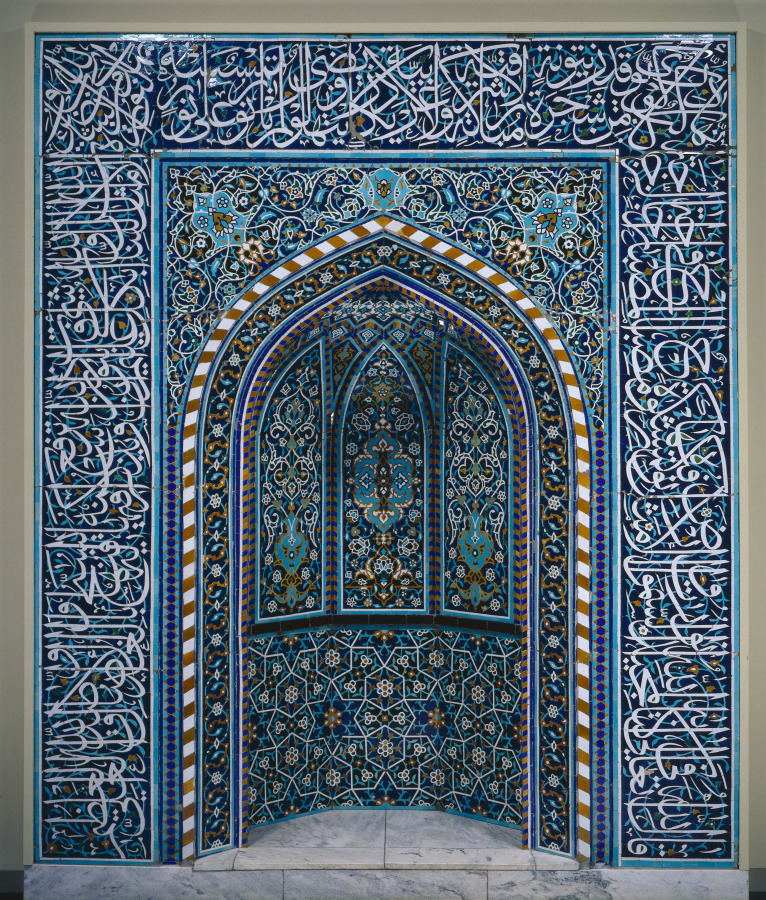
Catalogued ceramic mosaic comparison with qualified dating in the source. Not an illustration of wood marquetry.
Prayer niche (mihrab), ceramic mosaic, c. 1500s or mid-1900s, acc. 1962.23 · Cleveland Museum of Art · CC0 (museum open access) · Photo source ↗
Spelling and pronunciation
- Persian: معرق
- Transliteration: moʿarraq
- English usage: Moarraq (cut-piece inlay)
Spellings vary between dealers, museums and regions. Usage notes are under review.
How the term is used
Used for both cut-tile mosaic (kashi-ye moarraq) and wood marquetry (moarraq-e chub). The meaning depends on the material.
Common confusions
Not the same as haft-rang tile or khatam. Moarraq fits separately cut pieces together.
Always specify the material
Moarraq can refer to cut-piece assembly in wood or ceramic. Tile mosaic fits separately glazed pieces into a design; wood marquetry arranges cut shapes on a support. The shared word names an assembly principle rather than one material or workshop.
Compare visible joins with pattern boundaries. Grout, restoration and coatings can hide or simulate joins. Stars and floral designs are not evidence of cutting, age or Iranian origin. Keep catalogue medium and source qualifications attached to any illustration.
Compare the evidence
| Object or term | What to examine | Limit of the evidence |
|---|---|---|
| Tile mosaic | Fitted ceramic pieces | Panel grout alone is insufficient. |
| Wood marquetry | Cut wooden shapes | Not rod-bundle khatam. |
| Painted tile | Colours within one body | Not cut-piece assembly. |
Practical questions
- Does moarraq mean khatam?
- No. Khatam typically repeats slices from patterned rod bundles; moarraq assembles separately cut pieces.
Sources and further reading
- Canadian Conservation Institute · Caring for cultural heritage
Preventive care context; not a glossary etymology source or individual treatment assessment.
Editorial draft awaiting specialist review. References provide context, not verification of every statement, object attribution or current workshop access.
Used in these crafts
Square polychrome tiles painted with several overglaze colours and fired together, allowing large architectural schemes to be produced faster than cut tile mosaic.
A Persian inlay art in which fine rods of wood, bone and metal are bundled into star units, sliced into thin sheets and applied to a wooden surface to form dense geometric tessellation.