
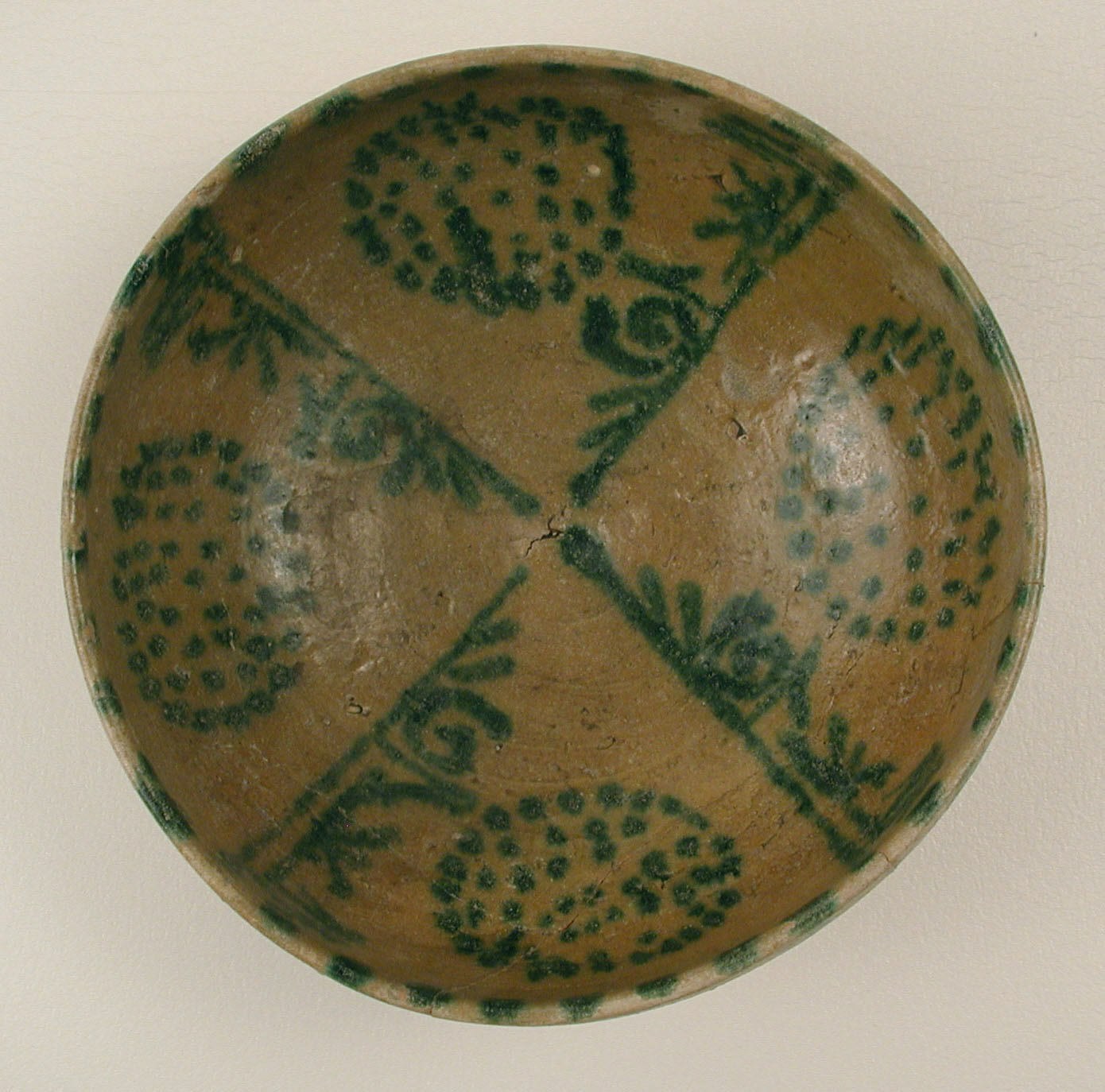
Bowl with Green Pseudo-Inscriptions and Clusters of Spots, 39.40.52; Iran, 9th–10th century
9th–10th century · CP-LIB-MET-449585 · The Metropolitan Museum of Art · CC0 (museum open access; resized JPEG) · Photo source ↗
Meaning
Letter-like decoration described as evoking writing without a securely readable inscription; not a licence to invent a transcription.
Spelling and pronunciation
- Persian: نقش شبهکتیبه
- Transliteration: naqsh-e shebh-e katibe
- English usage: Pseudo-inscription
Spellings vary between dealers, museums and regions. Usage notes are under review.
Letter-like ornament is not a ready-made translation
Pseudo-inscription is a descriptive label used for ornament that resembles writing without a securely established reading. The Met uses it in the title of the Nishapur bowl shown here. Preserve that qualification; replacing it with a guessed blessing or signature invents evidence.
Begin by describing arrangement, direction and repeating forms. If a specialist proposes a reading, cite the proposal and its uncertainty. A visual resemblance to script does not establish the language, author or workshop. Even a readable inscription requires separate interpretation of whether it names a maker, owner or quoted text.
Compare decoration without claiming literacy or meaning
A museum’s term describes the object, not the education or intention of an unknown craftsperson. Do not infer that the maker was unable to write, copied incorrectly or deliberately hid a message. Those are historical claims requiring evidence beyond letter-like forms.
On a market object, keep the seller’s stated reading separate from your own observations and the museum comparison. A similar border cannot inherit the bowl’s locality or date. High-resolution views and specialist reading are useful next steps; they are not guarantees that every ornamental sequence contains decipherable text.
Compare the evidence
| Object or term | What to examine | Limit of the evidence |
|---|---|---|
| Readable inscription | Qualified transcription | Reading is not maker attribution. |
| Pseudo-inscription | Letter-like arrangement | No invented translation. |
| Seller description | Basis for the stated reading | A claim needs evidence. |
Practical questions
- Does pseudo-inscription mean a fake object?
- No. It describes the ornament’s relationship to writing, not the object’s authenticity.
Sources and further reading
- The Metropolitan Museum of Art: Bowl with Green Pseudo-Inscriptions and Clusters of Spots (39.40.52)
Object-specific catalogue comparison; not proof of another object’s identity or provenance.
Editorial draft awaiting specialist review. References provide context, not verification of every statement, object attribution or current workshop access.
Used in these crafts
Earthenware decorated with coloured slips under a clear or tinted glaze, including early Islamic Nishapur-type wares and later village production such as Lalejin.