
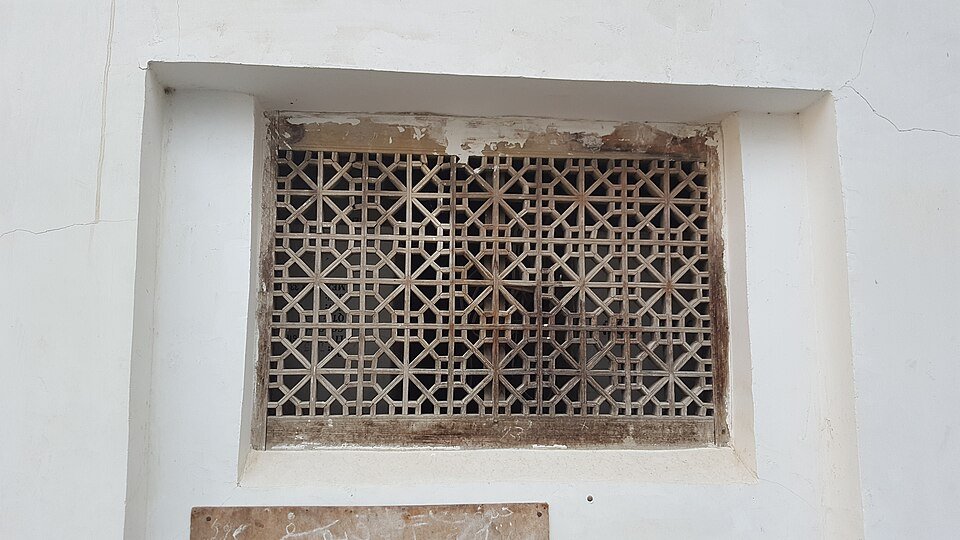
Subject comparison from the cited registry. Date, attribution and rights qualifications remain below; not authentication or maker certification.
Wooden gereh-chini lattice window; see source file page · MOHAMMADREZA PARIROKH · CC BY-SA 4.0 (attribution and share-alike; local JPG re-encoded) · Photo source ↗
Spelling and pronunciation
- Persian: گرهچینی
- Transliteration: gereh-chini
- English usage: Gereh-chini (geometric lattice)
Spellings vary between dealers, museums and regions. Usage notes are under review.
How the term is used
Means a geometric knot or star pattern, as in gereh-chini (wood lattice) and girih tiles.
Common confusions
Not the carpet knot (gereh-farsh), although both use the same word.
Shared vocabulary, different structures
Gereh or girih can name geometric pattern organisation; gereh-farsh names a pile knot. Gereh-chini woodworking assembles a lattice. A textile star depicts geometry without becoming wooden lattice construction.
State medium, assembly and motif separately. The same interlaced-looking pattern can be carved, printed, painted or fitted. Geometry proves neither a timber species nor a workshop or construction system.
Compare the evidence
| Object or term | What to examine | Limit of the evidence |
|---|---|---|
| Pattern | Motif organisation | Not a physical assembly. |
| Lattice | Fitted elements and joins | Needs construction evidence. |
| Carpet knot | Pile unit | Different use of the word. |
Practical questions
- Does a star prove gereh-chini?
- No. It may be carved or printed on a solid surface. Actual assembly needs evidence.
Sources and further reading
- Canadian Conservation Institute · Caring for cultural heritage
Preventive care context; not a glossary etymology source or individual treatment assessment.
Editorial draft awaiting specialist review. References provide context, not verification of every statement, object attribution or current workshop access.
Used in these crafts
A Persian inlay art in which fine rods of wood, bone and metal are bundled into star units, sliced into thin sheets and applied to a wooden surface to form dense geometric tessellation.