
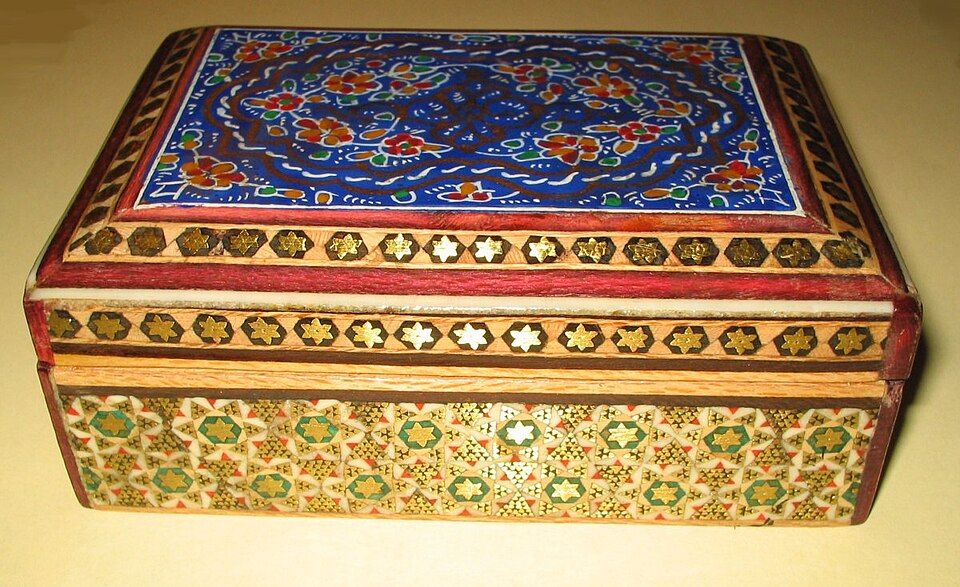
Subject comparison from the cited registry. Date, attribution and rights qualifications remain below; not authentication or maker certification.
2006-05 · Fabienkhan (Wikimedia Commons) · Public domain (per Wikimedia Commons) · Photo source ↗
Spelling and pronunciation
- Persian: خاتم
- Transliteration: khātam
- English usage: Khatam (micro-mosaic inlay)
Spellings vary between dealers, museums and regions. Usage notes are under review.
How the term is used
Used for the micro-mosaic inlay itself and, loosely, for objects decorated with it. ‘Khatam-kari’ names the craft, and ‘khatam-kar’ the craftsman.
Common confusions
Often confused with moarraq (wood marquetry) and with printed ‘khatam-style’ souvenirs. Real khatam is built from tiny geometric pieces.
Read the pattern at two scales
Khatam repeats a bundled cross-sectional pattern, while borders and fields organise those units across a wooden object. Carcass, inlay veneer and finish are different construction stages. A lid or corner reveals how units are fitted; a frontal photo may conceal this relationship.
Printed stars, cut wood marquetry and rod-bundle inlay can resemble one another but are different processes. Inspect existing joins without scratching. Tight-looking repetition cannot establish handwork, origin or age. White pieces may be bone or substitutes; colour alone is not material evidence.
Compare the evidence
| Object or term | What to examine | Limit of the evidence |
|---|---|---|
| Bundle inlay | Repeating cross-sections | Not proof of origin. |
| Marquetry | Separately cut shapes | Not the same process. |
| Reproduction method | Visual similarity is not inlay. |
Practical questions
- Can colour identify the materials?
- Not reliably. Retain maker or catalogue statements; never scratch, burn or dissolve pieces as a test.
Sources and further reading
- Canadian Conservation Institute · Caring for cultural heritage
Preventive care context; not a glossary etymology source or individual treatment assessment.
Editorial draft awaiting specialist review. References provide context, not verification of every statement, object attribution or current workshop access.
Used in these crafts
A Persian inlay art in which fine rods of wood, bone and metal are bundled into star units, sliced into thin sheets and applied to a wooden surface to form dense geometric tessellation.