
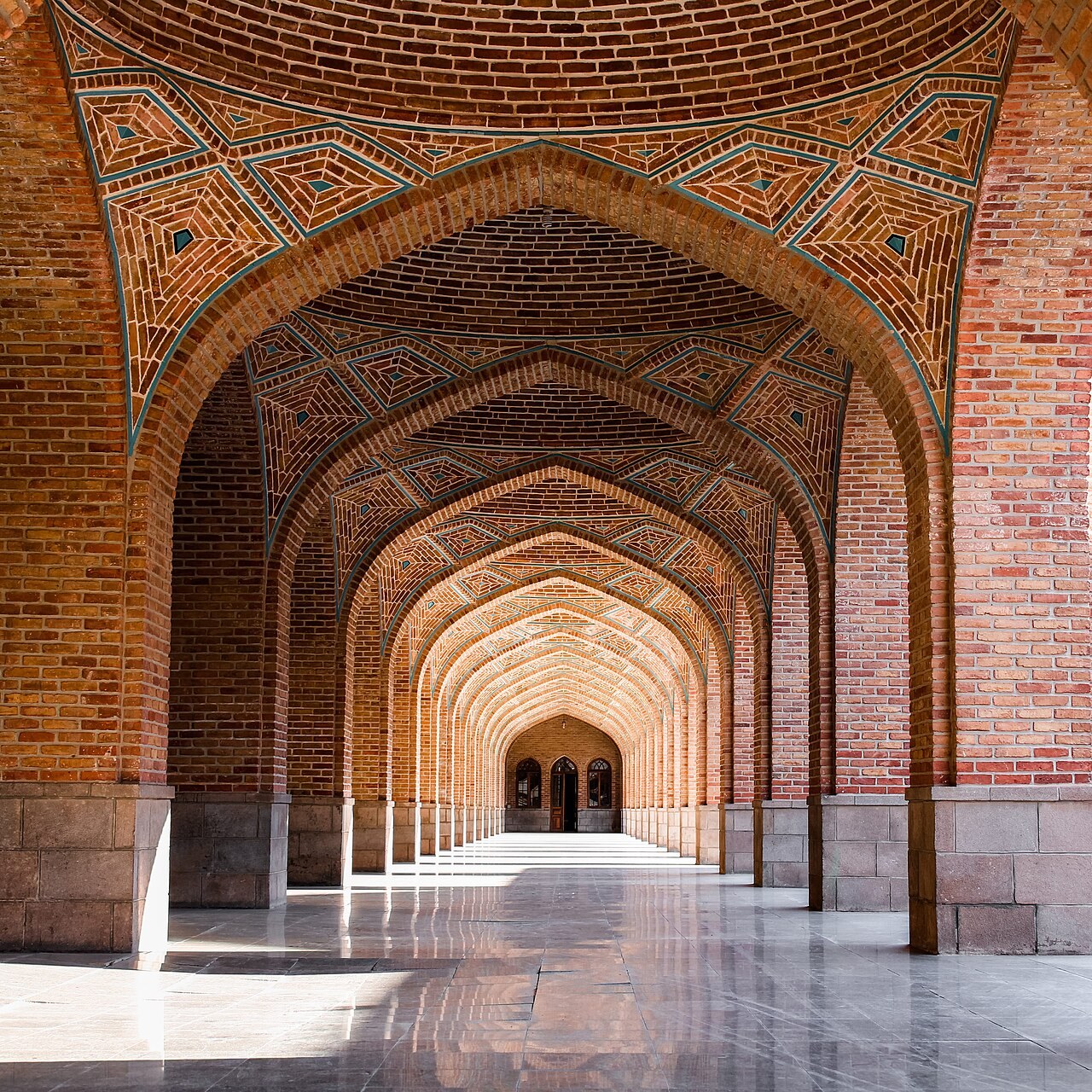
Kabood (Blue) mosque, Tabriz, Iran · Town setting only, not evidence of local manufacture or current visitor access.
Hameddaeipic · CC BY-SA 4.0 (Wikimedia Commons; resized/re-encoded JPEG)
Taken on 2 October 2020 · Source metadata and photograph visually checked 24 October 2026; no visible watermark.
Photograph source · Wikimedia CommonsA field observation record
- 01
Observe
Record material, structure, joins and wear before interpreting a pattern or city label.
- 02
Document
With permission, photograph the whole object, reverse, edges and any maker mark; retain repairs in the frame.
- 03
Separate claims
Keep maker, production location, point of sale and proposed age as separate statements, with their evidence.
Setting
Tabriz lies in a broad valley below the Sahand massif, at about 1,350 m, with cold winters. The historic bazaar is a linked network of vaulted halls, caravanserais and timcheh (trading courts) rather than a single street.
Why this place matters for craft
Tabriz has been a trading and weaving centre for centuries, and a nineteenth-century export boom is usually credited with the fine, tightly knotted commercial carpet style associated with the city. Attribution of individual antique carpets to Tabriz is a matter of expert judgement and is frequently contested.
A bazaar is a network, not a single producer
Tabriz's covered market brings together trading halls, storage, workshops and movement between trades. The UNESCO listing documents the significance of that historic complex, but it should not be read as an endorsement of the origin or quality of goods sold within it. A carpet hall can contain textiles made across a large region and objects that have returned through the international market.
Separate the building history from the history of a purchase. The place of weaving, the place of collection and the present dealer's address may all differ. For a contemporary rug, an identified workshop and a description of production are more useful than a vague reference to the Silk Road. For an older rug, retain earlier catalogues and repair reports where available.
Design, knotting and the reverse
Tabriz is a broad carpet attribution, not one fixed combination of knot count and motif. Look at the organisation of a medallion, border corners and colour changes, then compare those observations with the reverse and foundation. Dense knotting may allow detailed drawing, but fineness alone cannot identify the city or determine value. Material, condition and the success of the composition are separate questions.
Measure a small supported area only with the owner's permission. State whether a count means knots per unit length or per unit area; those figures cannot be compared without conversion. A photograph taken at an angle can distort a grid. Ask for square-on close views and avoid scraping, pulling pile or sharply bending a brittle foundation to expose knots.
Metal engraving in the bazaar economy
Engraving benches offer a different view of the bazaar economy from finished carpets. A photograph of an engraver documents a person and a working arrangement at the time it was taken. Observe how the object is supported and how the tool approaches its surface. A still image cannot establish the sequence of every production stage, identify the alloy or explain which goods elsewhere in the market came from this bench.
Hand engraving may be applied to a vessel shaped with machinery. Describe the shaping and decoration independently rather than presenting every stage as handmade. Etching, chasing and engraving can produce superficially related effects; close inspection and a maker's explanation are stronger than a single front photograph. Do not assume a maker seen in a published photograph is available for visits today.
Recording trade language and condition
Write down the seller's exact attribution and proposed date. Expressions such as fine Tabriz, workshop quality or signed carpet have no universal certification meaning. A woven name may identify a designer, workshop, retailer or later addition, and its interpretation should remain open until checked. Ask what supports the attribution beyond a recognisable design.
Inspect both ends, side bindings, low pile and repairs before agreeing on transport. A rug may be attractive while substantially restored; that condition belongs in the invoice. Confirm current bazaar access independently, obtain consent for workshop photography and keep historical references distinct from practical travel information.
Objects, evidence and attribution limits
| Object or claim | What to examine | What it cannot prove |
|---|---|---|
| Tabriz-attributed rug | Foundation, border drawing, repairs and workshop statement | Fine knotting is not a city-of-origin test. |
| Woven signature | Reading, placement and relation to surrounding construction | A name does not necessarily identify the weaver. |
| Engraved metal | Separate vessel shaping from surface cutting | A workshop photo does not authenticate unrelated stock. |
Common questions
- Can I compare two rugs by knot count alone?
- No. Counts need consistent units, and material, drawing, condition and production evidence remain separate considerations.
- Does the historic bazaar guarantee a handmade purchase?
- No. The heritage designation concerns the complex, not every item offered within it.
Sources and further reading
- UNESCO · Tabriz Historic Bazaar Complex
Historical market organisation and architectural significance.
- Encyclopaedia Iranica · Carpets
Historical and structural context for Iranian weaving; not authentication of an individual market textile.
- Canadian Conservation Institute · Caring for textiles and costumes
Preventive care and handling principles; older or unstable objects require individual conservation advice.
Editorial draft, not independently checked by a named craft specialist. References provide context, not authentication or confirmation of current visitor access.
Quarters, bazaars and workshops
| Area | What is there |
|---|---|
| Mozaffariyeh timcheh | Carpet trading hall inside the bazaar, historically the rug wholesalers' court. |
| Amir bazaar | Gold and silver trade; jewellery workshops in adjoining lanes. |
| Shoemakers' and felt lanes | Smaller trades survive in side passages away from the carpet halls. |
What to look for on an object
- Tabriz pile carpet — A firm, thin handle and a very regular knot grid on the back; look at how the pattern resolves in the corners of the border.
- Flatweave — Design formed by wefts only, with no pile visible when the surface is bent back.
These notes are for learning to look, not for authentication. No description here certifies an object, its age or its origin.
Practical notes
- The bazaar is large enough to lose direction in; the carpet halls are a distinct section and easiest to find by asking for the timcheh by name.
- Wholesale trade dominates, so single-piece buyers should expect less display and more stacking.
- Workshop addresses, bazaar hours and market days change; confirm locally before travelling.
Season: Late spring to early autumn. Winter is snowy and cold, though the covered bazaar stays usable.
Used in these crafts
The workshop carpet tradition of Tabriz in East Azerbaijan, characterised by drawn cartoons, a distinctive hook-knife weaving method and a wide range of fineness grades.
A hand-knotted pile textile woven across Iran in city workshops, village looms and pastoral camps, distinguished by regional structure, palette and design vocabulary.
A flat, pileless woven textile made across Iran by interlocking or slit-weaving coloured weft threads over a warp, used as floor covering, storage bag, saddle cover and tent divider depending on region.
The Iranian tradition of decorating copper, brass and silver vessels with small chisels struck by hammer, working the metal into line, ground and relief.
Iranian jewellery ranges from gold and gem-set court ornaments to silver tribal adornment, often combining enamel, turquoise, pearls and coloured stones.
Decoration of brass, bronze or steel vessels by setting silver, copper or gold into cut recesses, producing figurative scenes, inscriptions and ornament in contrasting colour.