
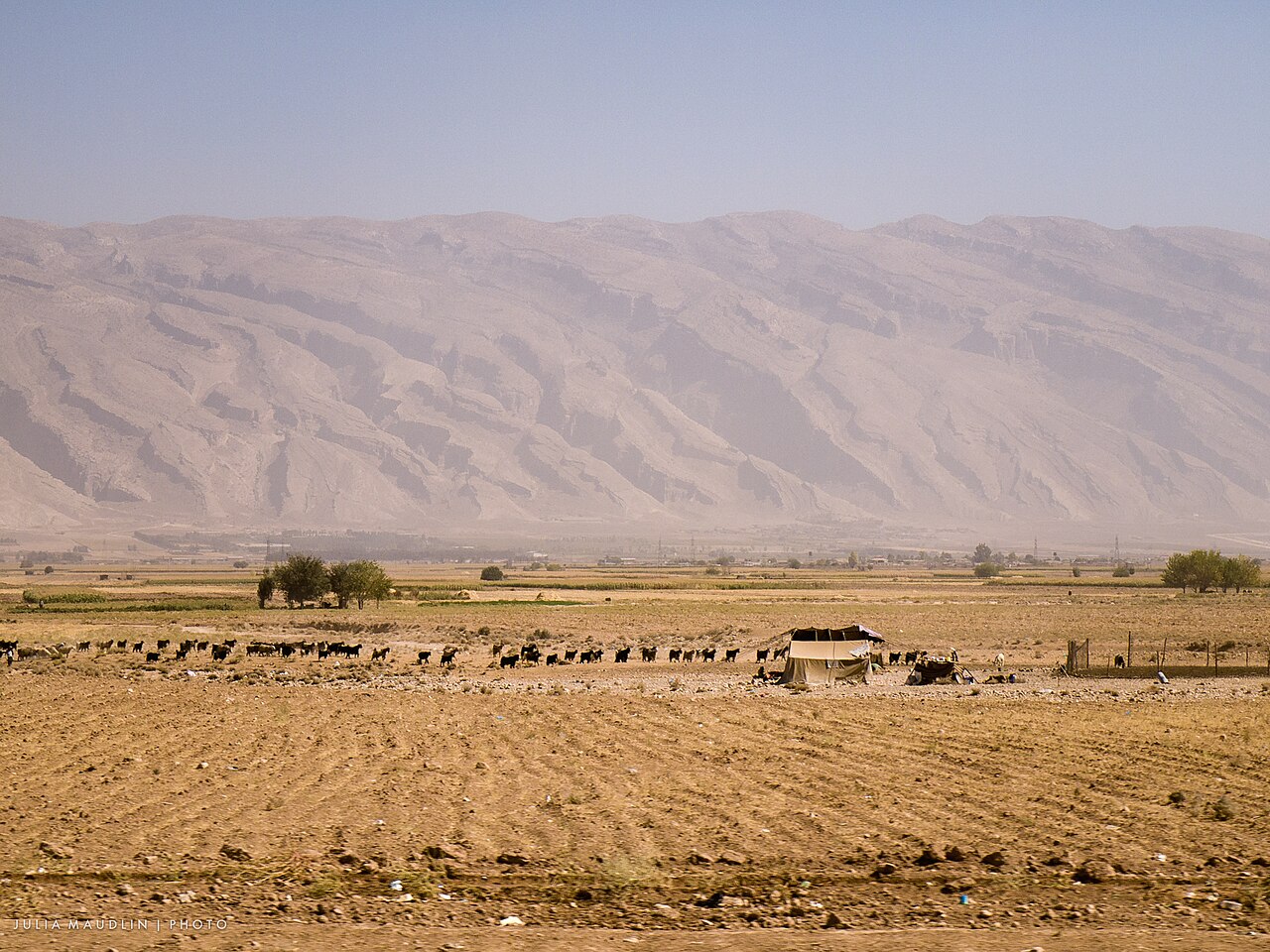
Desert flock on the plain outside Firuzabad · Town setting only, not evidence of local manufacture or current visitor access.
Julia Maudlin from Lake Oswego, Oregon, USA · CC BY 2.0 (Wikimedia Commons; resized/re-encoded JPEG)
Source metadata and photograph visually checked 25 October 2026; no visible watermark.
Photograph source · Wikimedia CommonsA field observation record
- 01
Observe
Record material, structure, joins and wear before interpreting a pattern or city label.
- 02
Document
With permission, photograph the whole object, reverse, edges and any maker mark; retain repairs in the frame.
- 03
Separate claims
Keep maker, production location, point of sale and proposed age as separate statements, with their evidence.
Setting
Firuzabad lies in a plain enclosed by hills south of Shiraz, near the Sasanian remains of Gur, with seasonal pasture in the surrounding ranges.
Why this place matters for craft
The Qashqai confederation's migration routes pass through this district, and weaving associated with those groups — gabbeh, pile rugs, bags and flatweaves — is often attributed to it. Nomadic attribution is inherently approximate, since looms move with the herds.
A place near weaving communities, not a showroom
Firuzabad provides a geographical entry point to parts of Fars where household weaving is discussed alongside pastoral histories. That context should not turn private homes or mobile households into tourist attractions assumed to be open on demand. Community identity, residence and weaving practice can change over a person's life; a published photograph captures only one moment.
Published photographs of Qashqai floor looms near Firuzabad document particular households at particular moments. They do not identify every textile sold under a Qashqai label, demonstrate that all makers use the same equipment or guarantee current access to the people shown. Retain the source's location wording rather than assigning a more precise village or household without evidence.
Reading a floor-loom photograph
Observe the relationship between loom frame, warp direction, working position and the textile already formed. A still image can help locate the activity within a household setting, but it cannot independently identify every fibre or establish the complete construction sequence. The reverse of a finished textile and a maker's explanation supply information that the photograph lacks.
Pile, flatweave and supplementary patterning require different descriptions. Do not identify a structure from a community label or a geometric pattern alone. Ask how the design is made and whether the object was woven by the person discussing it. A maker may also sell relatives' work or textiles supplied through a market network.
Design and attribution without stereotypes
Motifs move between households, generations and markets. Small animals, stepped forms or a bold palette can be useful visual observations, but cannot prove a Qashqai attribution. Community names should not be treated as quality grades or a guarantee of natural dyes. A direct maker account and structural documentation offer a stronger basis for describing a new textile.
For older work, keep collection history, proposed weaving origin and later dealer attribution separate. A bag face removed from its back may lose evidence about closure and use. Photograph the complete object where it survives and state missing parts explicitly. Wear may help explain use, but cannot independently date the textile.
Consent and an accurate maker record
Agree on visits through a current local contact and obtain consent for photographs, names and recorded explanations. Permission to take a photograph is not automatically permission to publish a personal biography. Let a maker describe their work without forcing it into a romantic story of unchanged nomadic life.
For a purchase, retain maker, production location, technique, fibres and the date of the account. Photograph both faces, ends and joins, and ask about repairs or added lining. The source image remains a historical/documentary illustration, not proof of current sale availability. Transport and conservation decisions should follow the textile's actual condition.
Objects, evidence and attribution limits
| Object or claim | What to examine | What it cannot prove |
|---|---|---|
| Floor-loom photograph | Source location, visible setup and date qualifications | A still image does not establish a complete process or current access. |
| Qashqai-attributed weaving | Maker account, structure and collection history | Motifs and colour do not prove community identity. |
| Household bag | Back, closures, joins and later conversion | A detached face loses evidence of its original function. |
Common questions
- Can I visit weavers near Firuzabad?
- The source does not establish current access. Arrange any visit independently with informed consent.
- Does Qashqai attribution guarantee natural dyes?
- No. Dye claims need evidence for the specific textile and should remain qualified.
Sources and further reading
- Encyclopaedia Iranica · Carpets
Historical and structural context for Iranian weaving; not authentication of an individual market textile.
- Canadian Conservation Institute · Caring for textiles and costumes
Preventive care and handling principles; older or unstable objects require individual conservation advice.
Editorial draft, not independently checked by a named craft specialist. References provide context, not authentication or confirmation of current visitor access.
Quarters, bazaars and workshops
| Area | What is there |
|---|---|
| Town market | Local trade; weaving is household and seasonal. |
What to look for on an object
- Qashqai-attributed weaving — Wool-on-wool structure, uneven selvedges and small design shifts where the weaver improvised.
These notes are for learning to look, not for authentication. No description here certifies an object, its age or its origin.
Practical notes
- Weaving is in camps and villages, not on display in town; a local contact is necessary.
- Shiraz remains the practical market.
- Workshop addresses, bazaar hours and market days change; confirm locally before travelling.
Season: Spring and autumn, around migration periods.
Used in these crafts
A thick, coarsely knotted pile rug woven mainly by pastoral and village weavers of the Zagros, with open fields, few motifs and a directly personal design language.
A flat, pileless woven textile made across Iran by interlocking or slit-weaving coloured weft threads over a warp, used as floor covering, storage bag, saddle cover and tent divider depending on region.
A narrow-strip flatwoven textile, usually made in warp-faced bands on a portable loom and then sewn together into a wider cloth, traditionally used as bedding cover, floor spread or door hanging by village and pastoral households.
A hand-knotted pile textile woven across Iran in city workshops, village looms and pastoral camps, distinguished by regional structure, palette and design vocabulary.
A non-woven wool textile made by matting and pressing raw wool fibres with moisture, heat and friction rather than by weaving, traditionally produced across Iran for floor coverings, cloaks and protective mats.