
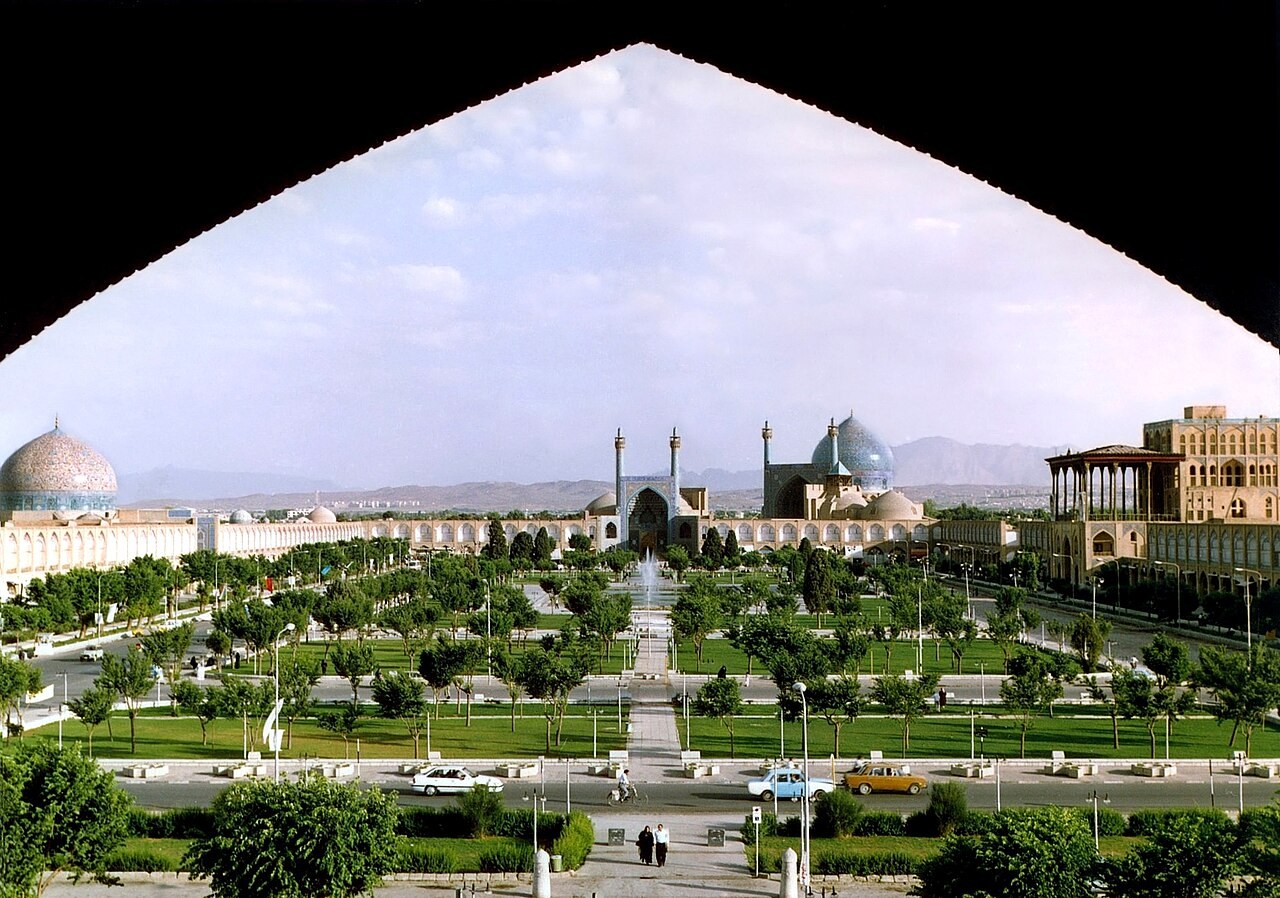
Naghshe Jahan Square Isfahan modified · Town setting only, not evidence of local manufacture or current visitor access.
en:User:Arad · CC BY-SA 3.0 (Wikimedia Commons; resized/re-encoded JPEG)
Photo date not stated · Source metadata and photograph visually checked 24 October 2026; no visible watermark.
Photograph source · Wikimedia CommonsA field observation record
- 01
Observe
Record material, structure, joins and wear before interpreting a pattern or city label.
- 02
Document
With permission, photograph the whole object, reverse, edges and any maker mark; retain repairs in the frame.
- 03
Separate claims
Keep maker, production location, point of sale and proposed age as separate statements, with their evidence.
Setting
Isfahan sits on the Zayandeh Rud in the centre of the Iranian plateau, at roughly 1,570 m. The historic core is walkable: the Naqsh-e Jahan square, the covered Qeysarieh bazaar running north from it, and the older Jameh mosque quarter beyond.
Why this place matters for craft
Isfahan became a court capital under the Safavids in the late sixteenth century, and the workshop economy that grew around the court is the usual explanation for the density of crafts still practised here. Many present-day workshops describe their lineage in those terms; such family histories are rarely documented in writing and should be treated as oral tradition.
Court patronage and today's workshop economy
The Safavid capital brought buildings, manuscripts, textiles and luxury objects into a shared environment of patronage. An architectural inscription and a painted album leaf can therefore illuminate different parts of Isfahan's cultural history. They do not demonstrate that a present-day shop has an uninterrupted family connection to a royal workshop. Keep the history of a technique, the biography of a maker and the provenance of an object in separate parts of a collecting record.
The square and bazaar are also distribution networks. A retailer may commission work from several makers or purchase finished objects from another city. That arrangement is not inherently misleading; the important question is whether a seller describes it accurately. Record where manufacture occurred and who completed the named stages, rather than translating a point of sale into a city-of-origin claim.
Comparing inlay, engraving and painted surfaces
Khatam joins tiny elements into patterned units before they are applied to a support. Examine edges, lid joins and any area where the surface meets a hinge. A photograph of the pattern alone cannot show whether the construction is inlay, a printed covering or a mixed technique. Ask for views of the interior and underside, along with a material statement that distinguishes wood, metal and any animal-derived components.
Engraved metal and painted enamel need different questions. For engraving, examine the relationship between cuts, relief and the underlying vessel. For enamel, record the metal support and whether decoration is fired or simply painted on the surface. Neither a small flaw nor a highly regular finish is a standalone handmade test. Tool traces, materials and a maker's documented account should be considered together.
Reading a historical painting reference
Safavid album paintings such as the white-eared bulbul attributed to Reza Abbasi (about 1620) are historical references to the city's court workshops, not proof that a modern miniature is original or made locally. Observe the controlled contour, the spacing around the subject and the relationship between small details and the overall composition. An isolated album painting should not be described as a page from a complete illustrated narrative without evidence about its original format.
Modern works can be original compositions, hand-painted versions of historical designs, printed reproductions or mixed-media pieces. Those categories must not be merged. For an original work, ask about the artist, date, support and pigments, and retain any signature photograph with the invoice. A signature is evidence to investigate, not an automatic certificate. The archive does not accept reproductions as genuine handmade product examples.
An object record before a purchase
Make an overall photograph, then record joins, reverse, maker mark and any damage. For fragile enamel and miniature painting, avoid rubbing or using water to improve visibility. Agree on photography before recording a maker at work, and clarify whether their explanation can be published. A demonstration shows the particular action being performed; it does not establish that every displayed object was made at that bench.
Packing should follow the object's weak points: protect projecting metalwork, keep painted surfaces from abrasion and avoid adhesives on decorated supports. Confirm travel and export rules independently for older objects. An appealing historical story should not substitute for a condition report, a precise invoice or lawful ownership documentation.
Objects, evidence and attribution limits
| Object or claim | What to examine | What it cannot prove |
|---|---|---|
| Khatam box | Edge construction, joins, underside and material statement | A star pattern alone does not establish inlay or Isfahan manufacture. |
| Engraved vessel | Cut depth, support metal and maker's process account | Visible tool traces cannot establish an unbroken workshop lineage. |
| Original miniature | Support, artist record, signature and paint surface | A historical composition can also appear in a reproduction. |
Common questions
- Does purchase near the square prove local manufacture?
- No. Ask for the maker and production location separately from the shop address.
- Is a Safavid album painting a guide to a modern miniature's origin?
- No. It is a historical reference; a modern work needs its own artist, date and production record.
Sources and further reading
- UNESCO · Meidan Emam, Esfahan
The Safavid square and its architectural setting; not current shop or workshop verification.
- The Met · The Art of the Safavids
Court arts and historical patronage; individual works need their own catalogue evidence.
Editorial draft, not independently checked by a named craft specialist. References provide context, not authentication or confirmation of current visitor access.
Quarters, bazaars and workshops
| Area | What is there |
|---|---|
| Naqsh-e Jahan square arcades | Retail rooms around the square, most oriented to visitors; a minority have a working bench at the back. |
| Qeysarieh bazaar | Covered lanes north of the square, traditionally organised by trade, with engravers and inlay workers in separate stretches. |
| Bazaar-e Honar lanes | Small units where hammering, cutting and polishing can often be heard from the street. |
What to look for on an object
- Khatam inlay — A repeating star grid whose lines continue across the lid join; printed paper imitations show no depth in raking light.
- Engraved brass or copper — Tool marks of slightly varying depth and a design that runs round curves; acid-etched work looks uniformly shallow.
- Enamel on copper — Small kiln pits and a faint colour halo at the edges of hand-drawn lines.
These notes are for learning to look, not for authentication. No description here certifies an object, its age or its origin.
Practical notes
- Most craft shopping is concentrated within a few hundred metres of the main square, so a single half-day covers several trades.
- Ask whether a piece was made in the shop or bought in; both are normal, and the answer changes the price conversation.
- Workshop addresses, bazaar hours and market days change; confirm locally before travelling.
Season: Spring and autumn are usually described as most comfortable; summer afternoons are hot and many workshops close in the middle of the day.
Used in these crafts
A Persian inlay art in which fine rods of wood, bone and metal are bundled into star units, sliced into thin sheets and applied to a wooden surface to form dense geometric tessellation.
The Iranian tradition of decorating copper, brass and silver vessels with small chisels struck by hammer, working the metal into line, ground and relief.
A decorative technique in which powdered coloured glass is fused by heat onto the surface of gold, silver or copper objects, producing a smooth, glossy coloured surface, historically practised in Isfahan on vessels, jewellery and decorative panels.
The Iranian tradition of small-scale painting made for manuscripts and albums, built from fine line, flat luminous colour and layered spatial convention rather than single-point perspective.
Square polychrome tiles painted with several overglaze colours and fired together, allowing large architectural schemes to be produced faster than cut tile mosaic.
A technique of architectural revetment in which monochrome glazed tiles are cut into small individual pieces to a template and set together, glaze face down, into a mortar bed to form complex polychrome patterns and inscriptions.
A decorative technique, associated particularly with Mashhad, in which small chips of turquoise are set edge to edge with adhesive onto a metal object's surface to create a dense mosaic-like covering, most often seen on vessels, jewellery and decorative plates.
A relief wood-carving technique in which solid panels, furniture and architectural elements are carved directly with chisels to produce raised or recessed floral, arabesque and geometric ornament, distinct from inlay techniques that build a surface from separate pieces.
A figured silk weaving technique in which supplementary wefts, often including gold- or silver-wrapped thread, create pictorial or floral designs on a silk ground.
A resist-dyed and block-printed cotton textile, historically associated with Isfahan, in which carved wooden blocks stamp repeating floral and figural patterns onto cloth in successive colour stages.