
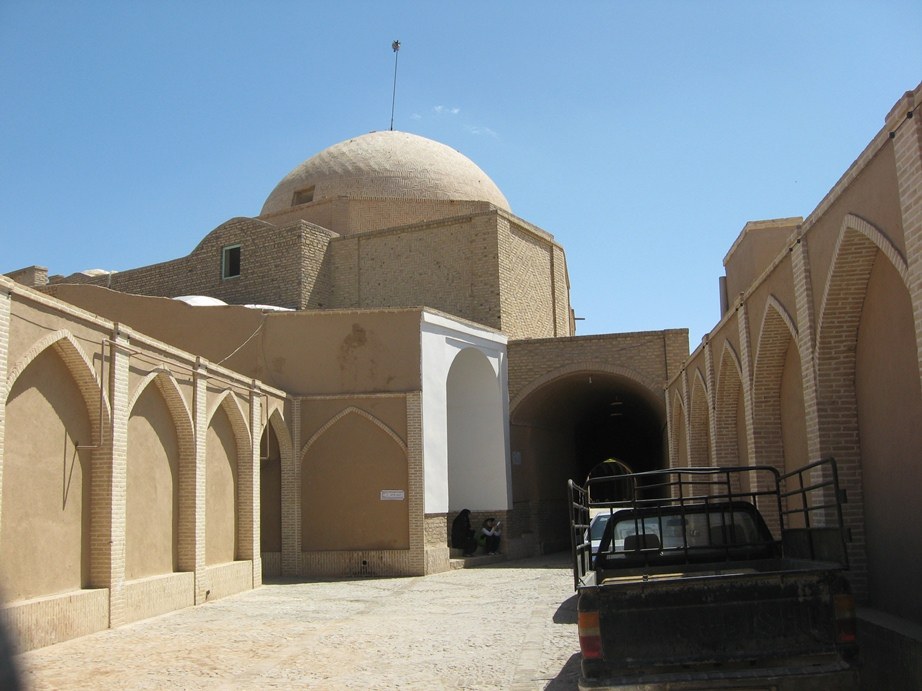
Historic area of Ardakan · Town setting only, not evidence of local manufacture or current visitor access.
Behzad.Elahi · CC BY-SA 3.0 (Wikimedia Commons; resized/re-encoded JPEG)
2012-03-31 11:18:44 · Source metadata and photograph visually checked 24 October 2026; no visible watermark.
Photograph source · Wikimedia CommonsA field observation record
- 01
Observe
Record material, structure, joins and wear before interpreting a pattern or city label.
- 02
Document
With permission, photograph the whole object, reverse, edges and any maker mark; retain repairs in the frame.
- 03
Separate claims
Keep maker, production location, point of sale and proposed age as separate statements, with their evidence.
Setting
Ardakan stands on the desert plain just north of Meybod, roughly 60 km north-west of Yazd, with wind towers and a mud-brick old quarter.
Why this place matters for craft
The town shares the Yazd textile tradition and has been named in reports on zilu and cotton weaving in the district. Pistachio and desert agriculture dominate the economy.
Adobe and regional weaving
Ardakan belongs to the Yazd region's landscape. Proximity to Meybod does not make a zilu photo an Ardakan workshop record. Keep source locality intact.
Architectural fabric, surface coating and repairs are separate; textile sale and making are separate. A neighbouring centre's reputation does not identify an individual object.
Cotton zilu and other cloth
Zilu is patterned cotton flatweave, distinct from wool pile and termeh. Examine both faces and edges. Blue and white alone cannot classify it.
Use maker statements for loom and production stages. A related printed pattern is not weaving evidence. Do not infer method from a small photograph.
Regional purchase and care
Ask where woven and whether new, old or repaired. Cotton cloth, dense patterned weave and pile require different condition accounts. Colourfastness is not visible certainty.
Support during transport and avoid aggressive cleaning. Confirm current building and workshop access. The guide is not certification of a local loom.
Objects, evidence and attribution limits
| Object or claim | What to examine | What it cannot prove |
|---|---|---|
| Zilu | Cotton structure and maker | Palette is not process. |
| Termeh | Patterned weave | Not the same structure as zilu. |
| Neighbouring image | Original source locality | Not an Ardakan workshop. |
Common questions
- Can a Meybod image establish Ardakan making?
- No. It can only be an explicitly labelled comparison.
Sources and further reading
- Encyclopaedia Iranica · Carpets
Weaving terminology and regional history; not certification of a seller's attribution.
- Canadian Conservation Institute · Caring for cultural heritage
Material-specific preventive care; not an assessment or treatment prescription for an individual object.
Editorial draft, not independently checked by a named craft specialist. References provide context, not authentication or confirmation of current visitor access.
Quarters, bazaars and workshops
| Area | What is there |
|---|---|
| Old quarter | Adobe lanes with occasional weaving rooms. |
What to look for on an object
- Cotton flatweave — Heavy reversible weave with stepped patterning; look for a loom-finished end rather than a hemmed edge.
These notes are for learning to look, not for authentication. No description here certifies an object, its age or its origin.
Practical notes
- Usually visited with Meybod on the way to or from Kashan.
- Workshop addresses, bazaar hours and market days change; confirm locally before travelling.
Season: Autumn to spring.
Used in these crafts
A pileless, reversible cotton floor covering associated especially with Meybod near Yazd, woven on a vertical loom with ground heddles and pattern harnesses that control its geometric, often two-colour design.
A patterned Iranian brocade woven with supplementary wefts, historically in silk and wool, associated above all with Yazd and Kerman.
A hand-knotted pile textile woven across Iran in city workshops, village looms and pastoral camps, distinguished by regional structure, palette and design vocabulary.