
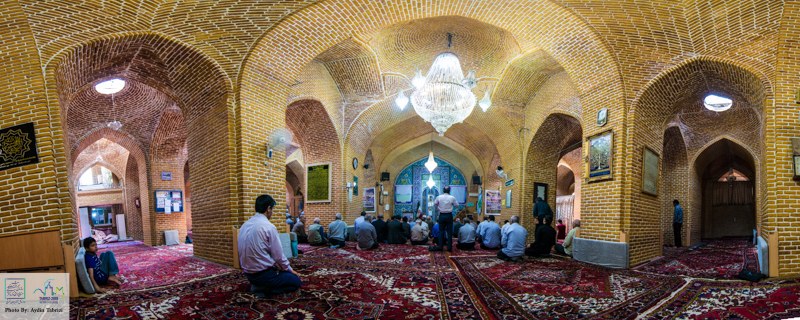
Sarab jami mosque · Town setting only, not evidence of local manufacture or current visitor access.
aydin tabrizi · CC BY-SA 4.0 (Wikimedia Commons; resized/re-encoded JPEG)
Taken on 1 July 2018, 12:29:36 · Source metadata and photograph visually checked 24 October 2026; no visible watermark.
Photograph source · Wikimedia CommonsA field observation record
- 01
Observe
Record material, structure, joins and wear before interpreting a pattern or city label.
- 02
Document
With permission, photograph the whole object, reverse, edges and any maker mark; retain repairs in the frame.
- 03
Separate claims
Keep maker, production location, point of sale and proposed age as separate statements, with their evidence.
Setting
Sarab lies on a high plain below Bozgush, with cold winters and a small regional bazaar.
Why this place matters for craft
Sarab runners appear in dealer literature as a recognisable regional type, typically long and narrow with repeated medallions on an undyed camel-tone ground. Documentation of the workshops themselves is thin.
The runner as an architectural object
Sarab is often encountered through long, narrow carpets marketed for corridors. Format matters: a sequence of medallions creates rhythm over a long field, while side borders must remain readable at a relatively small width. Study the entire runner rather than only its central motif. A shortened carpet can lose part of that rhythm, and a missing end may be disguised by a newly sewn finish.
Measure the width at several points and note the spacing of repeated motifs. Variation can reflect hand weaving, stretching or later treatment; it is not a reliable handmade test by itself. Ask for photographs that include the complete ends and reverse before considering a runner for a particular room.
Camel colour is not a fibre identification
The camel-toned field familiar from dealer descriptions does not prove that a textile contains camel hair. Brown sheep wool, dyed wool and mixed fibres can give similar visual effects. Fibre identification requires more than a photograph and should not be attempted with an improvised burn test on an object offered for sale.
Record whether the seller is claiming a colour, a material or both. Abrash describes visible colour variation, not a guarantee of natural dyes. Dirt, fading and old washes also alter the appearance of a light field. Comparing a protected area with an exposed area can suggest change, but a conservator should interpret differences on a valuable older runner.
Connecting the market to the district
The city name can operate as a regional trade category. Collection through Tabriz or another market does not mean the rug was woven in that city, while purchase in Sarab does not establish local manufacture. Request a village attribution only when the seller can explain what supports it; a confident story without documentation remains a story.
For a collecting record, keep dimensions, front and back images, the seller's attribution, repair disclosure and any earlier ownership information together. Do not collapse these into a single certainty score. When visiting, confirm current access independently and avoid expecting an open loom workshop merely because the district appears in historical carpet literature.
Objects, evidence and attribution limits
| Object or claim | What to examine | What it cannot prove |
|---|---|---|
| Complete runner | Both ends, border sequence and changing width | A narrow format is shared by many weaving regions. |
| Camel-toned ground | Written fibre claim and condition differences | Colour cannot identify camel hair or a dye source. |
| Shortened runner | Interrupted motifs, new end finishes and repair report | Alteration may be difficult to judge in a front-only photo. |
Common questions
- Does a brown ground prove camel hair?
- No. Treat camel colour and camel fibre as separate statements, and request evidence for any material claim.
- Can a runner be cut to fit my corridor?
- Cutting permanently alters the textile and can destabilise the ends. Choose a suitable size or seek specialist display advice rather than trimming an older rug.
Sources and further reading
- Encyclopaedia Iranica · Carpets
Reference context for Iranian weaving regions; not documentation of a particular runner.
Editorial draft, not independently checked by a named craft specialist. References provide context, not authentication or confirmation of current visitor access.
Quarters, bazaars and workshops
| Area | What is there |
|---|---|
| Town bazaar | Small local market; weaving is village-based. |
What to look for on an object
- Sarab runner — Narrow format with repeating medallions; the ground colour is often an undyed natural brown-beige.
These notes are for learning to look, not for authentication. No description here certifies an object, its age or its origin.
Practical notes
- A stop rather than a destination; most trade passes through Tabriz.
- Workshop addresses, bazaar hours and market days change; confirm locally before travelling.
Season: Summer and early autumn.
Used in these crafts
A hand-knotted pile textile woven across Iran in city workshops, village looms and pastoral camps, distinguished by regional structure, palette and design vocabulary.
A flat, pileless woven textile made across Iran by interlocking or slit-weaving coloured weft threads over a warp, used as floor covering, storage bag, saddle cover and tent divider depending on region.
A non-woven wool textile made by matting and pressing raw wool fibres with moisture, heat and friction rather than by weaving, traditionally produced across Iran for floor coverings, cloaks and protective mats.