
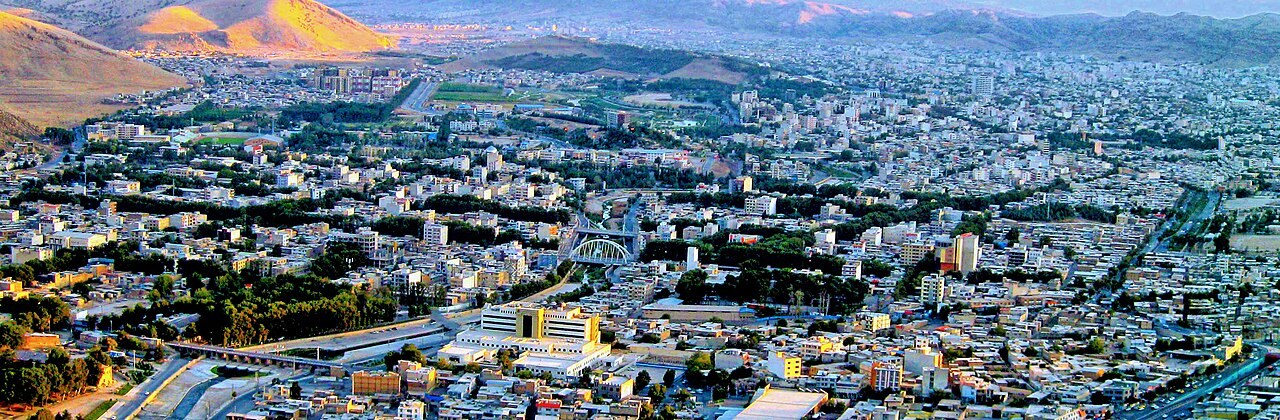
Khorramabad Panorama · Town setting only, not evidence of local manufacture or current visitor access.
Meysam · CC BY-SA 3.0 (Wikimedia Commons; resized/re-encoded JPEG)
2014-07-24 23:12:32 · Source metadata and photograph visually checked 24 October 2026; no visible watermark.
Photograph source · Wikimedia CommonsA field observation record
- 01
Observe
Record material, structure, joins and wear before interpreting a pattern or city label.
- 02
Document
With permission, photograph the whole object, reverse, edges and any maker mark; retain repairs in the frame.
- 03
Separate claims
Keep maker, production location, point of sale and proposed age as separate statements, with their evidence.
Setting
Khorramabad sits in a valley below the Falak-ol-Aflak citadel, in high pastoral country.
Why this place matters for craft
Lori and Bakhtiari weaving — pile rugs, flatweaves, saddlebags and felt — is the craft identity of the province. Lorestan is also famous for excavated ancient bronzes, a field where fakes and legal restrictions are both significant.
Zagros market categories
Lori and Bakhtiari labels can refer to different communities or trading areas. They are not interchangeable and cannot be inferred from one design. Ask for the attribution's basis.
A Lorestan purchase can originate elsewhere. Community association does not automatically mean nomadic manufacture: contemporary workshops need distinct accounts.
Household function
Bag fronts, backs, straps and closures can combine structures. Record the whole before motifs. Cushions made from fragments need alteration disclosed against intact historical comparisons.
Distinguish pile, flatweave, warp-faced strips and felt. Linings may hide construction. Do not remove them for amateur tests; photograph accessible joins with support.
Use, condition and consent
Wear and stains do not prove original function or age. Ask which repairs are known and avoid romantic histories unsupported by provenance.
Support straps, protect wool from insects and request consent for people or domestic settings. Ethnographic names do not identify living makers or open workshops.
Objects, evidence and attribution limits
| Object or claim | What to examine | What it cannot prove |
|---|---|---|
| Community label | Attributed source | Not an inferred identity. |
| Bag | Complete assembly | Fragment may be repurposed. |
| Wear | Repair record | Not an age clock. |
Common questions
- Does wear prove pastoral use?
- No. Wear needs interpretation with the object's structure and provenance.
Sources and further reading
- Encyclopaedia Iranica · Carpets
Weaving terminology and regional history; not certification of a seller's attribution.
- Canadian Conservation Institute · Caring for cultural heritage
Material-specific preventive care; not an assessment or treatment prescription for an individual object.
Editorial draft, not independently checked by a named craft specialist. References provide context, not authentication or confirmation of current visitor access.
Quarters, bazaars and workshops
| Area | What is there |
|---|---|
| City bazaar | Regional weaving and felt. |
| Citadel museum | Regional collections useful for comparison. |
What to look for on an object
- Bakhtiari-type rug — Compartment or garden design in strong colours, wool foundation, robust handle.
These notes are for learning to look, not for authentication. No description here certifies an object, its age or its origin.
Practical notes
- Objects offered as ancient bronzes should be avoided; export of antiquities is prohibited.
- Workshop addresses, bazaar hours and market days change; confirm locally before travelling.
Season: Spring and autumn.
Used in these crafts
A hand-knotted pile textile woven across Iran in city workshops, village looms and pastoral camps, distinguished by regional structure, palette and design vocabulary.
A flat, pileless woven textile made across Iran by interlocking or slit-weaving coloured weft threads over a warp, used as floor covering, storage bag, saddle cover and tent divider depending on region.
A narrow-strip flatwoven textile, usually made in warp-faced bands on a portable loom and then sewn together into a wider cloth, traditionally used as bedding cover, floor spread or door hanging by village and pastoral households.
A non-woven wool textile made by matting and pressing raw wool fibres with moisture, heat and friction rather than by weaving, traditionally produced across Iran for floor coverings, cloaks and protective mats.
A thick, coarsely knotted pile rug woven mainly by pastoral and village weavers of the Zagros, with open fields, few motifs and a directly personal design language.