
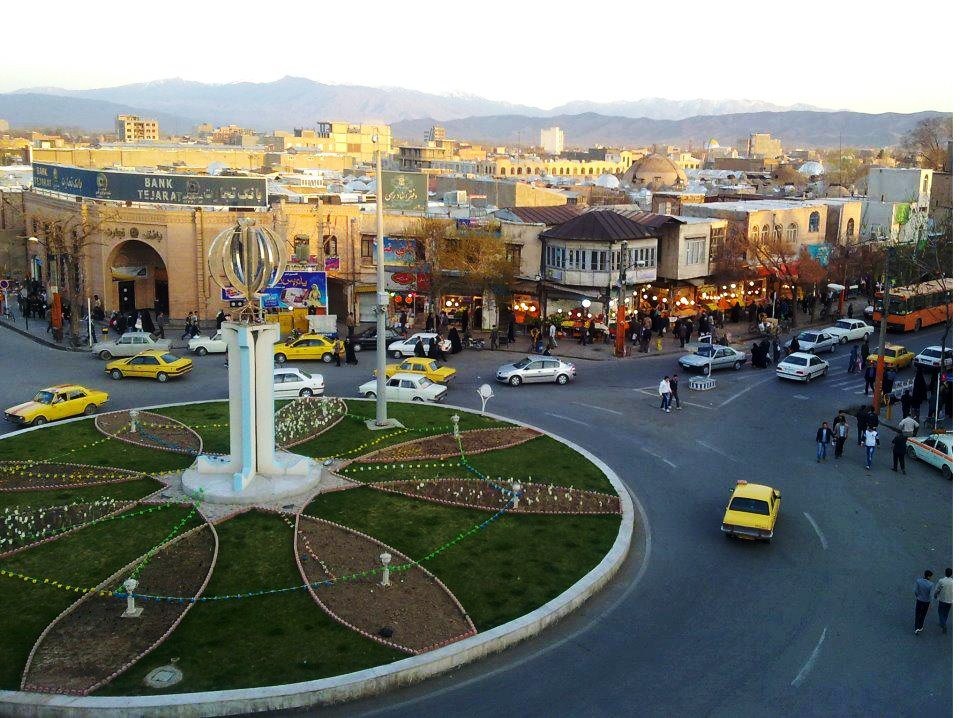
Khoy city center in iran country · Town setting only, not evidence of local manufacture or current visitor access.
Aminadrin · CC BY-SA 3.0 (Wikimedia Commons; resized/re-encoded JPEG)
2011-09-08 · Source metadata and photograph visually checked 24 October 2026; no visible watermark.
Photograph source · Wikimedia CommonsA field observation record
- 01
Observe
Record material, structure, joins and wear before interpreting a pattern or city label.
- 02
Document
With permission, photograph the whole object, reverse, edges and any maker mark; retain repairs in the frame.
- 03
Separate claims
Keep maker, production location, point of sale and proposed age as separate statements, with their evidence.
Setting
Khoy stands on a watered plain north of Urmia, historically an important stage on routes towards Van and Trabzon.
Why this place matters for craft
The city's craft interest is largely as a collection point for village weaving and felt from the surrounding districts. Its caravan history is well attested; craft-specific documentation is limited.
Caravan routes and textile movement
Khoy's historic position on north-western routes makes circulation important. A place of collection can differ from weaving village, trader residence or export port. A route explains why goods move, not where an unlabelled rug was woven.
Compare the seller's account with structural descriptions and earlier invoices. Where craft documentation is limited, this guide offers questions rather than a promised inventory. Do not invent a village attribution from one familiar motif.
Felt and flatweave
Felt consolidates fibres; flatweave interlaces yarns. Examine reverse and edges rather than deciding from softness. Stitched ornament should be distinguished from coloured fibres incorporated during felting.
For kilims, document colour joins and end finishing. Small slits can be structural, while enlarged splits can be damage. Never tug an opening or pull a yarn to demonstrate technique. Photograph existing features with support.
District labels and condition
A Khoy trade label may be a market category rather than precise manufacture. Ask what supports it and which details come from previous owners. Design comparison is useful only alongside construction and provenance.
Document thinning, moth damage, added fringes and patches. Felt thickness can hide loss and flatweaves may be extensively rewoven. Confirm present access; caravan history does not establish an open loom workshop.
Objects, evidence and attribution limits
| Object or claim | What to examine | What it cannot prove |
|---|---|---|
| Route attribution | Collection versus manufacture | Movement is not origin evidence. |
| Felt | Fibre and stitched additions | Softness is not a process test. |
| Kilim | Joins, ends and repairs | Not every opening is original. |
Common questions
- Can a route history authenticate a rug?
- No. It contextualises exchange; the rug still needs its own construction and provenance record.
Sources and further reading
- Encyclopaedia Iranica · Carpets
Weaving terminology and regional history; not certification of a seller's attribution.
- Canadian Conservation Institute · Caring for cultural heritage
Material-specific preventive care; not an assessment or treatment prescription for an individual object.
Editorial draft, not independently checked by a named craft specialist. References provide context, not authentication or confirmation of current visitor access.
Quarters, bazaars and workshops
| Area | What is there |
|---|---|
| Old bazaar | Regional goods, felt and rugs; modest scale. |
What to look for on an object
- Felt rug — Pattern laid in coloured fibre before felting, so edges are soft and slightly blurred.
These notes are for learning to look, not for authentication. No description here certifies an object, its age or its origin.
Practical notes
- A stop on a north-western circuit rather than a craft destination in itself.
- Workshop addresses, bazaar hours and market days change; confirm locally before travelling.
Season: Late spring to autumn.
Used in these crafts
A flat, pileless woven textile made across Iran by interlocking or slit-weaving coloured weft threads over a warp, used as floor covering, storage bag, saddle cover and tent divider depending on region.
A non-woven wool textile made by matting and pressing raw wool fibres with moisture, heat and friction rather than by weaving, traditionally produced across Iran for floor coverings, cloaks and protective mats.
A hand-knotted pile textile woven across Iran in city workshops, village looms and pastoral camps, distinguished by regional structure, palette and design vocabulary.