Definition
Nasta'liq is written with a reed pen cut to a fine oblique nib. Its proportions are taught as fixed ratios expressed in nib-widths, so a letter is judged against a measurable standard rather than by impression.
History
Tradition credits the script's formalisation to Mir Ali Tabrizi in the late fourteenth century, an attribution repeated in many sources but not securely documented. It became the standard hand for Persian poetry and remains closely tied to literary manuscripts.
Tools and materials
Reed pens, a knife and cutting block, soot-based ink, burnished and often sized paper, and a silk-padded inkwell liner that regulates ink flow.
Practice
Training proceeds through copying a master's exemplars, letter by letter, then in pairs and compounds, before composing full lines. Shekasteh, a broken and faster variant, developed for administrative and informal writing.
Gallery
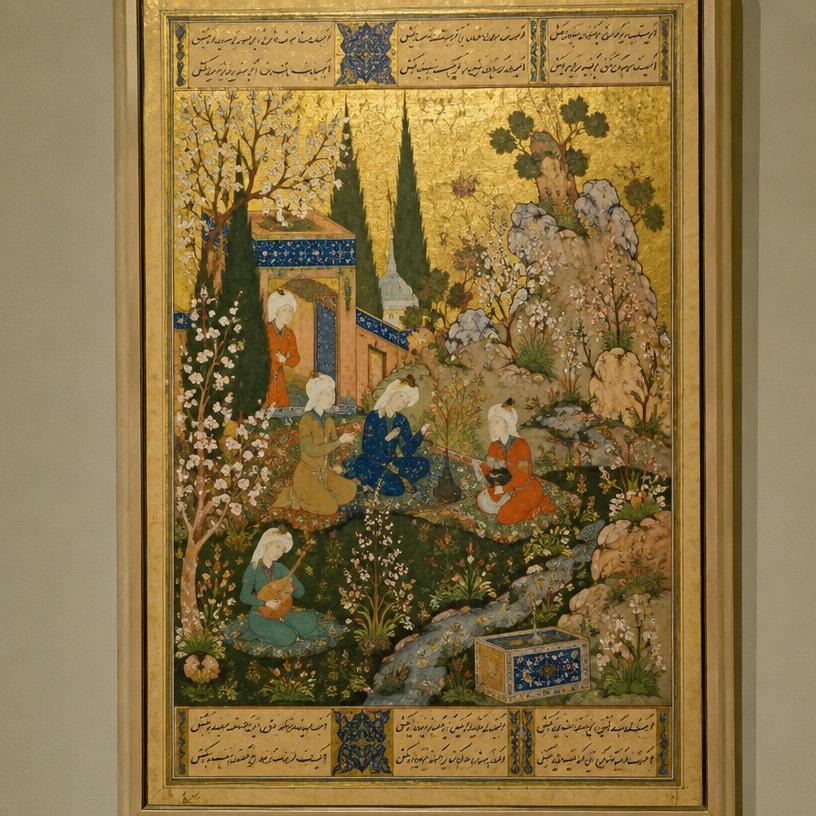
Images shown are documented examples and objects currently listed. Captions record what is known; where origin or date is an estimate it is labelled as such.
Marketplace
No objects of this craft are currently listed.
Sources & references
- Book: Blair, S. Islamic Calligraphy. Edinburgh University Press, 2006.
- Museum catalogue: Reza Abbasi Museum, calligraphy collection records.
Where origins, dates or symbolism are contested, this entry states the competing readings rather than choosing between them. Editorial analysis is not presented as documented fact.