Definition
A Persian carpet is built by tying pile yarn around warp threads on a loom, row by row, with wefts inserted between rows to lock the structure. What varies — and what defines the regional traditions — is knot type, density, foundation material, palette and how the design was arrived at.
Three production contexts are usually distinguished: city workshops weaving from a drawn cartoon, village looms working from memory and local convention, and pastoral weaving where the design is held entirely by the weaver.
History
Pile weaving in the region is very old; the Pazyryk carpet, preserved in permanent ice and dated to roughly the fifth to fourth century BCE, shows that the technique was already highly developed, though its place of manufacture is debated.
Organised workshop production is best documented from the Safavid period, when royal ateliers in Isfahan, Kashan and Tabriz produced large designed carpets on commission. Nineteenth-century export demand reshaped the industry again, introducing commercial workshops, standard sizes and, in some places, synthetic dyes.
Structure and quality
Knot density, usually given in knots per square decimetre, records fineness but not quality on its own. Wool character, dye preparation, evenness of weave and the coherence of the drawing matter as much.
- Asymmetric knot: allows fine curvilinear drawing; usual in city work
- Symmetric knot: robust, usual in village and pastoral weaving
- Cotton foundation: dimensionally stable, usual in workshop carpets
- Wool foundation: more flexible, usual in tribal weaving
- Abrash: visible dye-lot variation, expected in hand-dyed wool
Regional traditions
Tabriz is associated with technically ambitious drawn designs, Kashan and Qom with fine silk work, Kerman with soft palettes and open fields, Heriz with bold angular medallions, and the Qashqai and Baluch traditions with saturated colour and a strong internal design logic.
Buying considerations
Look at the back: hand-knotting shows individual knot nodes and slight irregularity, while machine-made pile shows perfectly uniform rows and usually a glued or serged edge. Check the fringe — it should be the warp ends of the carpet, not a band sewn on.
Ask for any documentation the seller has rather than for assurances. Age, origin and wool origin are frequently asserted without evidence; a seller who separates what is known from what is likely is more reliable than one who does not.
Preservation
Rotate the carpet so wear and light exposure even out, use a pad to reduce abrasion from the floor, and vacuum with the pile rather than against it. Address moth activity immediately, and have washing done by a specialist rather than by general carpet cleaners.
Gallery
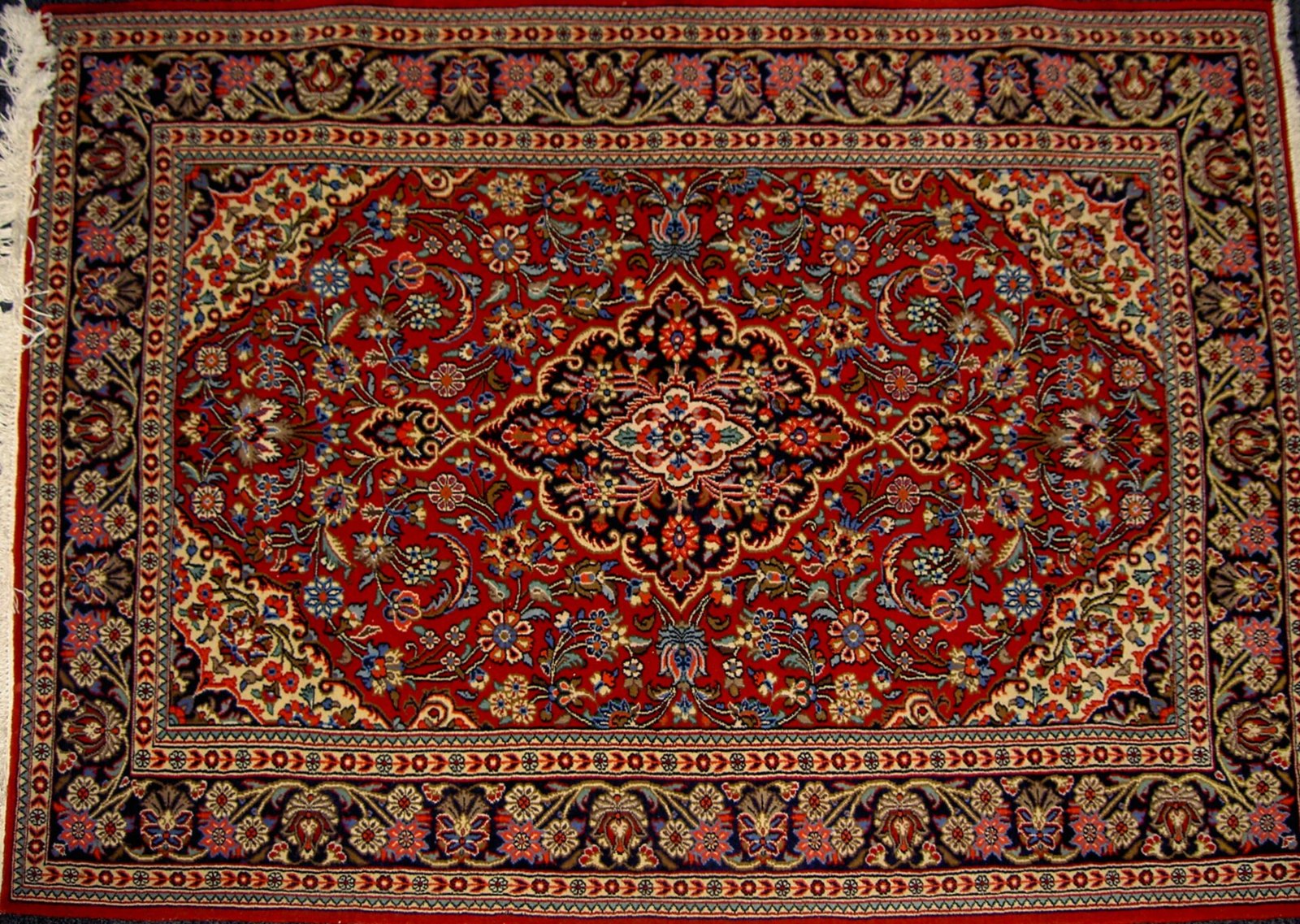
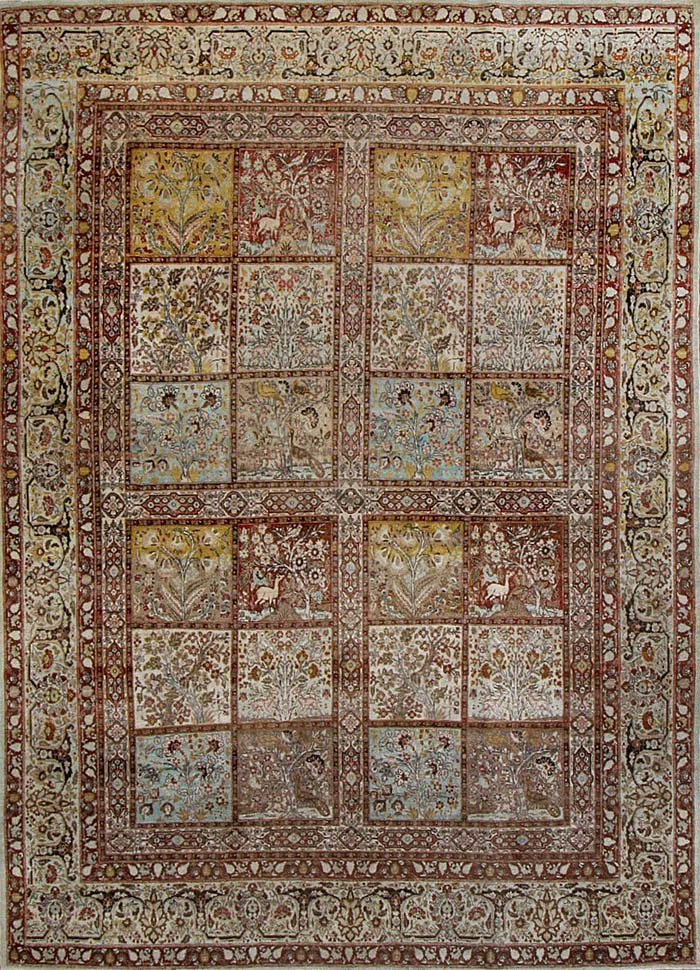
Images shown are documented examples and objects currently listed. Captions record what is known; where origin or date is an estimate it is labelled as such.
Marketplace
Sources & references
- Book: Edwards, A. C. The Persian Carpet. Duckworth, 1953.
- Museum catalogue: Metropolitan Museum of Art, Islamic Art department carpet records.
- Museum catalogue: Hermitage Museum, Pazyryk carpet documentation.
Where origins, dates or symbolism are contested, this entry states the competing readings rather than choosing between them. Editorial analysis is not presented as documented fact.