
The two crafts in photographs
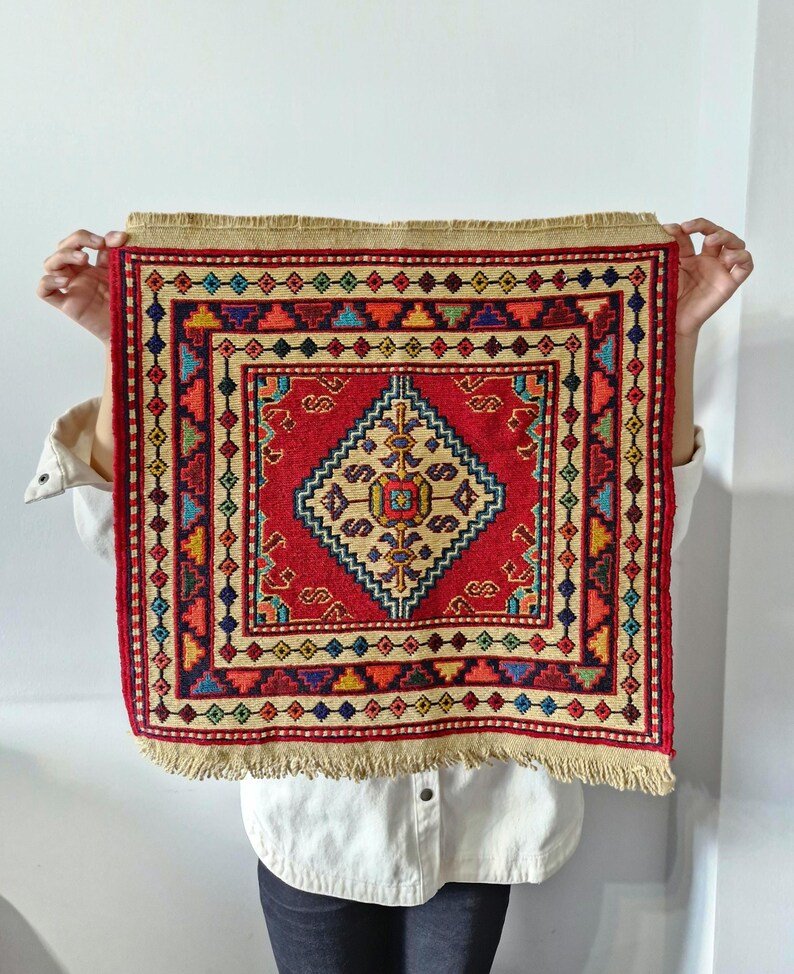
Kilim (Gelim)
Jajim
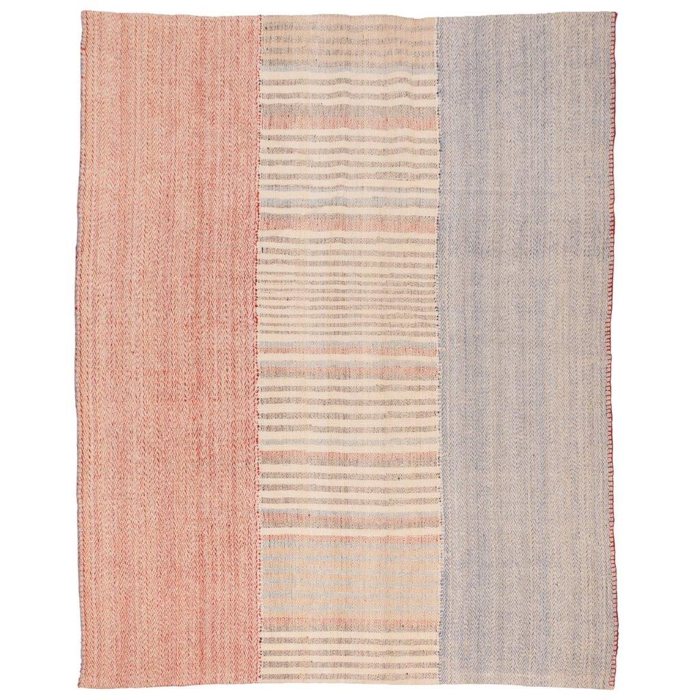
Photographs show documented examples of each craft for visual comparison; they do not prove what any other object is.
Side by side
| Kilim (Gelim) | Jajim | |
|---|---|---|
| Persian name | گلیم | جاجیم |
| Category | Textiles · Flatweave | Textiles · Flatweave |
| Materials | Wool, Cotton, Natural dyes | Wool, Cotton |
| Techniques | Weft-faced flatweaving | Warp-faced strip weaving, Supplementary weft brocade |
| Regions | Shiraz, Kerman, Sistan & Baluchestan, Yazd | Tabriz, Isfahan |
| Periods | Qajar, Pahlavi, Contemporary | Qajar, Pahlavi, Contemporary |
| Motifs | Gereh (geometric knot) | Gereh (geometric knot) |
| Current vitality | Living tradition | At risk |
What they share
- Materials: Wool, Cotton
- Motifs: Gereh (geometric knot)
- Periods: Qajar, Pahlavi, Contemporary
How to tell them apart
- The Kilim (Gelim) record lists Natural dyes, which the Jajim record does not.
- Kilim (Gelim) typically involves Weft-faced flatweaving.
- Jajim typically involves Warp-faced strip weaving, Supplementary weft brocade.
- A material listed for only one craft is a question to ask, not an identification test.
- The stated place of making is a useful clue, but never proof on its own.
Background on each craft
About Kilim (Gelim)
Definition
Gelim, commonly known in English as kilim, describes a family of flat-woven textiles produced without knotted pile. The design is created by interlocking coloured wefts directly against each other, or by slit-weaving where blocks of colour meet, leaving small vertical gaps at the colour boundaries that are a structural signature of the technique rather than a flaw.
Because the surface carries no pile, kilims are lighter, more flexible and typically reversible compared to knotted-pile carpets, and the same interlocking-weft logic underlies related utilitarian forms such as saddlebags, grain sacks and tent bands woven by pastoral and village weavers.
History
Flatweaving is among the oldest textile technologies practised in the Iranian plateau, closely tied to pastoral and semi-nomadic life where lighter, packable textiles suited seasonal movement. Documented regional kilim traditions associated with Fars, Kerman, Sistan and Khorasan describe distinct weaving groups, though precise dating of individual older pieces is rarely possible without technical or documentary evidence.
Through the Qajar and Pahlavi periods, kilims were woven primarily for household and pastoral use rather than for export, and only later entered wider decorative and collector markets alongside knotted-pile carpets, a shift that changed sizes and, in some workshops, colour choices to suit external buyers.
General background on the craft, not a statement about any individual object; dates and attributions summarise common positions in the literature and remain under review. Read the full Kilim (Gelim) entry.
About Jajim
Definition
Jajim is a lightweight warp-faced flatweave, distinguished from kilim by its typically narrower loom width and the resulting practice of weaving in strips that are later joined edge to edge to make a full-sized cover. The narrow-loom method suited weavers who moved seasonally and could not maintain a wide fixed loom.
The finished cloth is thinner and more supple than a kilim, and its structure — bands of colour running the length of the warp, often patterned with small supplementary-weft figures — gives jajim a characteristically striped appearance even where additional motifs are worked in.
History
Jajim weaving is documented among village and pastoral communities in northwestern and central Iran, particularly associated with Azerbaijani-speaking weaving groups, though the craft has historically been practised more widely under regional names. Its household function — bedding, storage wraps, and covers — meant it was rarely made for outside trade until relatively recently.
As synthetic blankets and manufactured textiles became widely available through the twentieth century, everyday demand for handwoven jajim declined sharply in many villages, and the skill is now reported by craft researchers and heritage bodies to survive mainly among older weavers in a smaller number of communities.
General background on the craft, not a statement about any individual object; dates and attributions summarise common positions in the literature and remain under review. Read the full Jajim entry.
Read more
Disclaimer
This comparison is educational and built from entries still under review. It cannot confirm what a particular object is.