
What documented Jajim looks like
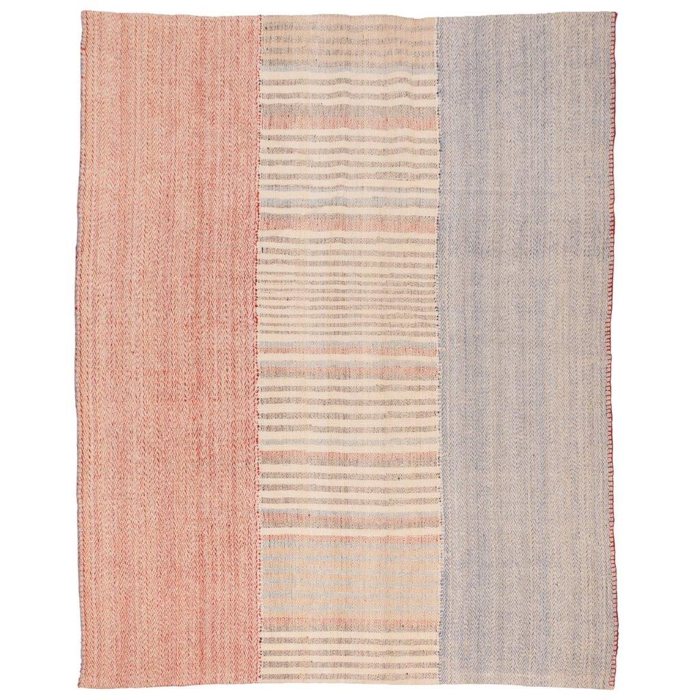
Reference photographs of documented Jajim pieces, credited to their sources. Compare construction, surface and wear with any piece you are offered — a resemblance is not proof of origin.
Jajim at a glance
| Persian name | جاجیم |
| Category | Textiles · Flatweave |
| Main techniques | warp-faced-weaving, supplementary-weft-brocade |
| Typical materials | wool, cotton |
| Places of making | tabriz, isfahan |
| Current vitality | At risk |
Understanding Jajim
What Jajim is and how it is made
Definition
Jajim is a lightweight warp-faced flatweave, distinguished from kilim by its typically narrower loom width and the resulting practice of weaving in strips that are later joined edge to edge to make a full-sized cover. The narrow-loom method suited weavers who moved seasonally and could not maintain a wide fixed loom.
The finished cloth is thinner and more supple than a kilim, and its structure — bands of colour running the length of the warp, often patterned with small supplementary-weft figures — gives jajim a characteristically striped appearance even where additional motifs are worked in.
History
Jajim weaving is documented among village and pastoral communities in northwestern and central Iran, particularly associated with Azerbaijani-speaking weaving groups, though the craft has historically been practised more widely under regional names. Its household function — bedding, storage wraps, and covers — meant it was rarely made for outside trade until relatively recently.
As synthetic blankets and manufactured textiles became widely available through the twentieth century, everyday demand for handwoven jajim declined sharply in many villages, and the skill is now reported by craft researchers and heritage bodies to survive mainly among older weavers in a smaller number of communities.
Materials
Wool is the traditional fibre, sometimes combined with cotton for lighter or more affordable pieces. Because the warp carries most of the visual weight in jajim's warp-faced structure, warp yarns are spun and set with particular care for evenness of colour and tension.
- Handspun or commercially spun wool for warp bands
- Cotton sometimes used for warp or as a supplementary weft
- Vegetable and, later, synthetic dyes depending on period
General background on the craft, not a statement about any individual object; dates and attributions summarise common positions in the literature and remain under review. Read the full Jajim entry.
Before you buy: what to inspect
- Jajim is woven in narrow strips on a small loom and then sewn together; look for the joining seams.
- Warp-faced patterns should be crisp on the face; check the back for floats and their length.
- Check the seams and ends for splitting and loose stitching.
Typical materials: wool, cotton.
Red flags: copies and 'Persian style' imports
- Single-width, machine-woven cloth sold as hand-woven jajim.
- No region or group of weaving given.
A genuine Jajim piece should come with a named place of making in Iran (often tabriz, isfahan) and a clear statement that it is handmade.
Questions to ask the seller
- Was it woven in strips and hand-sewn?
- What fibres were used (wool, cotton)?
- Which region does it come from?
What affects the price
| Age |
| Fineness and complexity of the patterning |
| Condition of the seams |
| Size |
Care and cleaning
- Vacuum on low suction without a beater bar, or shake small pieces gently.
- Use a non-slip underlay: flatweaves have no pile to cushion wear and can slide.
- Rotate floor pieces every six to twelve months.
- Have old or valuable pieces cleaned by a rug specialist rather than washed at home.
Storage
- Roll with the pile facing inward, never fold.
- Wrap in breathable cotton, not plastic.
- Protect against moths with regular airing and inspection.
Shipping
Rolled textiles travel well; ask for tube or rolled packing and tracked delivery.
Disclaimer
This guide is educational. It cannot confirm that any particular object is genuine, old or valuable. For important purchases, ask an independent specialist. Read the full Jajim entry.