
The two crafts in photographs
Jajim
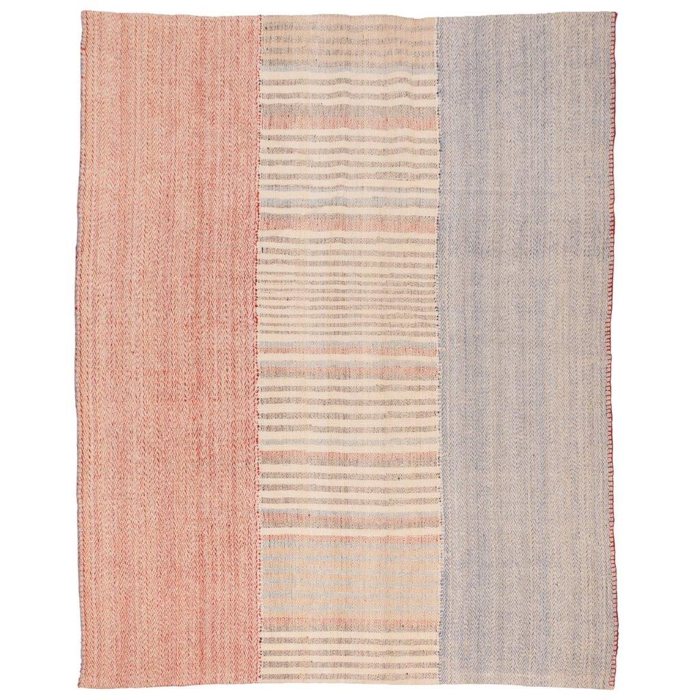
Nain carpet
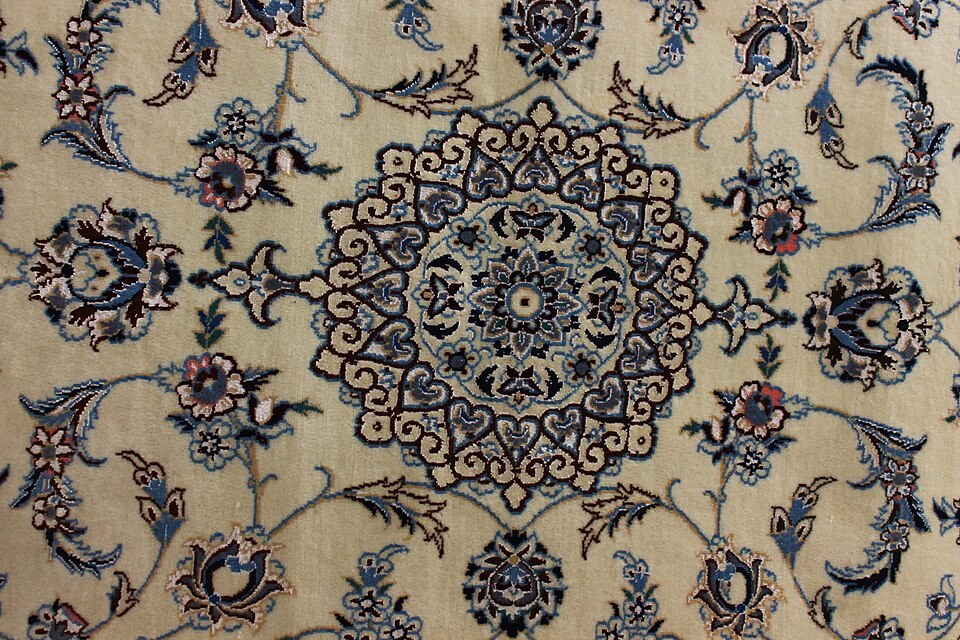
Photographs show documented examples of each craft for visual comparison; they do not prove what any other object is.
Side by side
| Jajim | Nain carpet | |
|---|---|---|
| Persian name | جاجیم | فرش نائین |
| Category | Textiles · Flatweave | Textiles · City carpet |
| Materials | Wool, Cotton | Wool, Silk, Cotton |
| Techniques | Warp-faced strip weaving, Supplementary weft brocade | Knotted pile weaving, Asymmetric (Persian) knot |
| Regions | Tabriz, Isfahan | Isfahan |
| Periods | Qajar, Pahlavi, Contemporary | Contemporary |
| Motifs | Gereh (geometric knot) | Shah Abbasi palmette, Lachak-toranj |
| Current vitality | At risk | Living tradition |
What they share
- Materials: Wool, Cotton
- Regions: Isfahan
- Periods: Contemporary
How to tell them apart
- The Nain carpet record lists Silk, which the Jajim record does not.
- Jajim typically involves Warp-faced strip weaving, Supplementary weft brocade.
- Nain carpet typically involves Knotted pile weaving, Asymmetric (Persian) knot.
- A material listed for only one craft is a question to ask, not an identification test.
- The stated place of making is a useful clue, but never proof on its own.
Background on each craft
About Jajim
Definition
Jajim is a lightweight warp-faced flatweave, distinguished from kilim by its typically narrower loom width and the resulting practice of weaving in strips that are later joined edge to edge to make a full-sized cover. The narrow-loom method suited weavers who moved seasonally and could not maintain a wide fixed loom.
The finished cloth is thinner and more supple than a kilim, and its structure — bands of colour running the length of the warp, often patterned with small supplementary-weft figures — gives jajim a characteristically striped appearance even where additional motifs are worked in.
History
Jajim weaving is documented among village and pastoral communities in northwestern and central Iran, particularly associated with Azerbaijani-speaking weaving groups, though the craft has historically been practised more widely under regional names. Its household function — bedding, storage wraps, and covers — meant it was rarely made for outside trade until relatively recently.
As synthetic blankets and manufactured textiles became widely available through the twentieth century, everyday demand for handwoven jajim declined sharply in many villages, and the skill is now reported by craft researchers and heritage bodies to survive mainly among older weavers in a smaller number of communities.
General background on the craft, not a statement about any individual object; dates and attributions summarise common positions in the literature and remain under review. Read the full Jajim entry.
About Nain carpet
History
Nain was a centre of fine wool weaving (for cloaks) before carpet weaving expanded in the 20th century, and it quickly became known for very fine rugs.
Technique
Fine asymmetrical knots, often graded by 'la', the number of plies twisted into each warp thread (4la is the finest, 6la fine and 9la coarser), with silk used to outline designs.
General background on the craft, not a statement about any individual object; dates and attributions summarise common positions in the literature and remain under review. Read the full Nain carpet entry.
Read more
Disclaimer
This comparison is educational and built from entries still under review. It cannot confirm what a particular object is.