
The two crafts in photographs
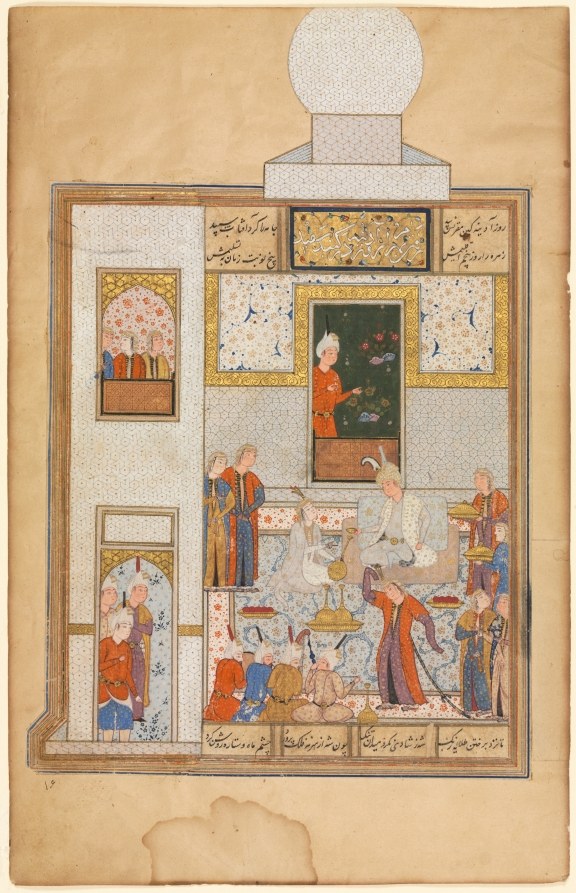
Persian miniature
Illumination (Tazhib)
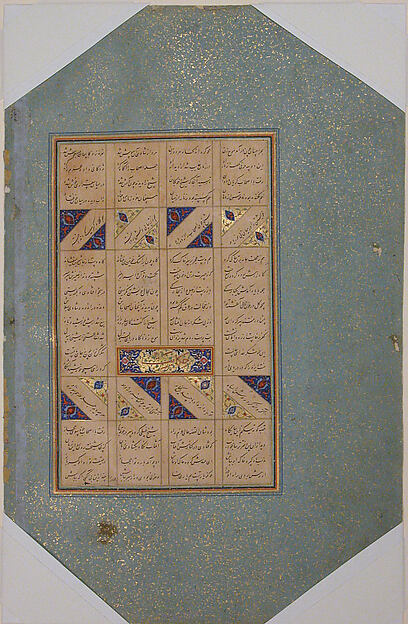
Photographs show documented examples of each craft for visual comparison; they do not prove what any other object is.
Side by side
| Persian miniature | Illumination (Tazhib) | |
|---|---|---|
| Persian name | نگارگری ایرانی | تذهیب |
| Category | Painting · Manuscript painting | Book arts · Manuscript illumination |
| Materials | Paper, Lapis lazuli (ultramarine), Shell gold | Paper |
| Techniques | Tazhib illumination | — |
| Regions | Isfahan, Shiraz, Tabriz | Isfahan, Tabriz, Mashhad |
| Periods | Ilkhanid, Timurid, Safavid, Qajar, Contemporary | Timurid, Safavid, Qajar, Contemporary |
| Motifs | Gol-o-morgh, Eslimi arabesque | Eslimi arabesque |
| Current vitality | Living tradition | Living tradition |
What they share
- Materials: Paper
- Regions: Isfahan, Tabriz
- Motifs: Eslimi arabesque
- Periods: Timurid, Safavid, Qajar, Contemporary
How to tell them apart
- The Persian miniature record lists Lapis lazuli (ultramarine), Shell gold, which the Illumination (Tazhib) record does not.
- Persian miniature typically involves Tazhib illumination.
- A material listed for only one craft is a question to ask, not an identification test.
- The stated place of making is a useful clue, but never proof on its own.
Background on each craft
About Persian miniature
Definition
Persian painting of this kind was an art of the book, produced in ateliers where calligrapher, painter, illuminator, gilder and binder each contributed. Space is organised by overlapping planes and raised ground lines; figures are scaled by role rather than distance.
History
Distinct schools are conventionally identified at Tabriz, Shiraz, Herat and later Isfahan, each with recognisable conventions of palette, figure type and landscape. Attribution to a named painter is possible for a small number of artists and remains contested for many well-known works.
General background on the craft, not a statement about any individual object; dates and attributions summarise common positions in the literature and remain under review. Read the full Persian miniature entry.
About Illumination (Tazhib)
History
Illuminated headpieces, medallions and borders are central to Timurid and Safavid manuscripts; contemporary illuminators work in both traditional and new formats.
Technique
Designs are drawn with compasses and rulers, then filled with gold (often shell gold) and mineral or organic pigments, outlined with fine brushes.
General background on the craft, not a statement about any individual object; dates and attributions summarise common positions in the literature and remain under review. Read the full Illumination (Tazhib) entry.
Read more
- Persian miniature entry · buying guide
- Illumination (Tazhib) entry · buying guide
- Persian miniature vs Nasta'liq calligraphy
- Persian miniature vs Persian lacquer painting
- Persian miniature vs Traditional bookbinding (Sahhafi)
- Illumination (Tazhib) vs Traditional bookbinding (Sahhafi)
- Paper marbling (Abr-o-bad) vs Illumination (Tazhib)
- Persian lacquer painting vs Illumination (Tazhib)
Disclaimer
This comparison is educational and built from entries still under review. It cannot confirm what a particular object is.