
The two crafts in photographs
Qalam-zani
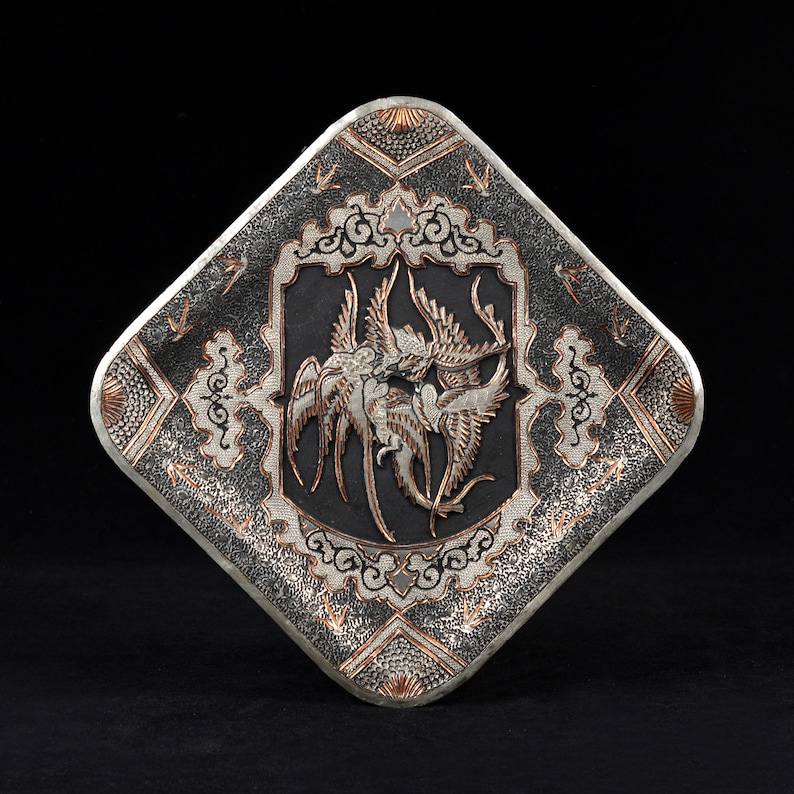
Inlaid metalwork
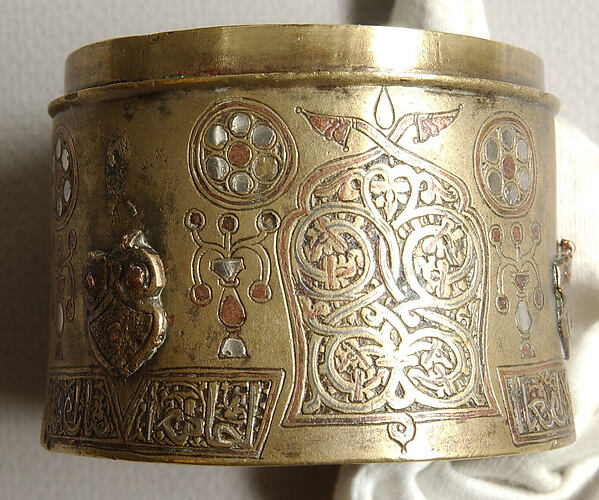
Photographs show documented examples of each craft for visual comparison; they do not prove what any other object is.
Side by side
| Qalam-zani | Inlaid metalwork | |
|---|---|---|
| Persian name | قلمزنی | فلزکاری ترصیعشده |
| Category | Metalwork · Engraving | Metalwork · Precious-metal inlay |
| Materials | Brass, Copper, Silver | Brass, Silver, Copper |
| Techniques | Chisel engraving (qalam-zani) | — |
| Regions | Isfahan, Tabriz | Isfahan, Tabriz |
| Periods | Seljuk, Safavid, Qajar, Contemporary | Seljuk, Ilkhanid, Timurid, Safavid |
| Motifs | Eslimi arabesque, Gol-o-morgh | Eslimi arabesque |
| Current vitality | At risk | At risk |
What they share
- Materials: Brass, Copper, Silver
- Regions: Isfahan, Tabriz
- Motifs: Eslimi arabesque
- Periods: Seljuk, Safavid
How to tell them apart
- Qalam-zani typically involves Chisel engraving (qalam-zani).
Background on each craft
About Qalam-zani
Definition
Qalam-zani covers a family of related operations: tracing an outline, sinking grounds, raising relief from the front, and texturing with named punches. The metal is displaced rather than largely cut away, so the reverse of a hand-worked vessel carries the impression of the design.
History
Persian inlaid and engraved metalwork of the Seljuk period is widely represented in museum collections and set standards later workshops referred back to. Safavid and Qajar Isfahan produced trays, bowls, ewers and boxes in quantity, and the Isfahan bazaar remains the main centre today.
General background on the craft, not a statement about any individual object; dates and attributions summarise common positions in the literature and remain under review. Read the full Qalam-zani entry.
About Inlaid metalwork
History
Inlaid brass and bronze are strongly associated with Khorasan and western Iran in the 12th–14th centuries; many surviving objects have lost part of their inlay.
Technique
The design is engraved and undercut into the base metal; thin sheet or wire of a contrasting metal is hammered into the recesses so that the undercut locks it in place, then chased and polished.
General background on the craft, not a statement about any individual object; dates and attributions summarise common positions in the literature and remain under review. Read the full Inlaid metalwork entry.
Read more
Disclaimer
This comparison is educational and built from entries still under review. It cannot confirm what a particular object is.