
The two crafts in photographs
Minakari enamel
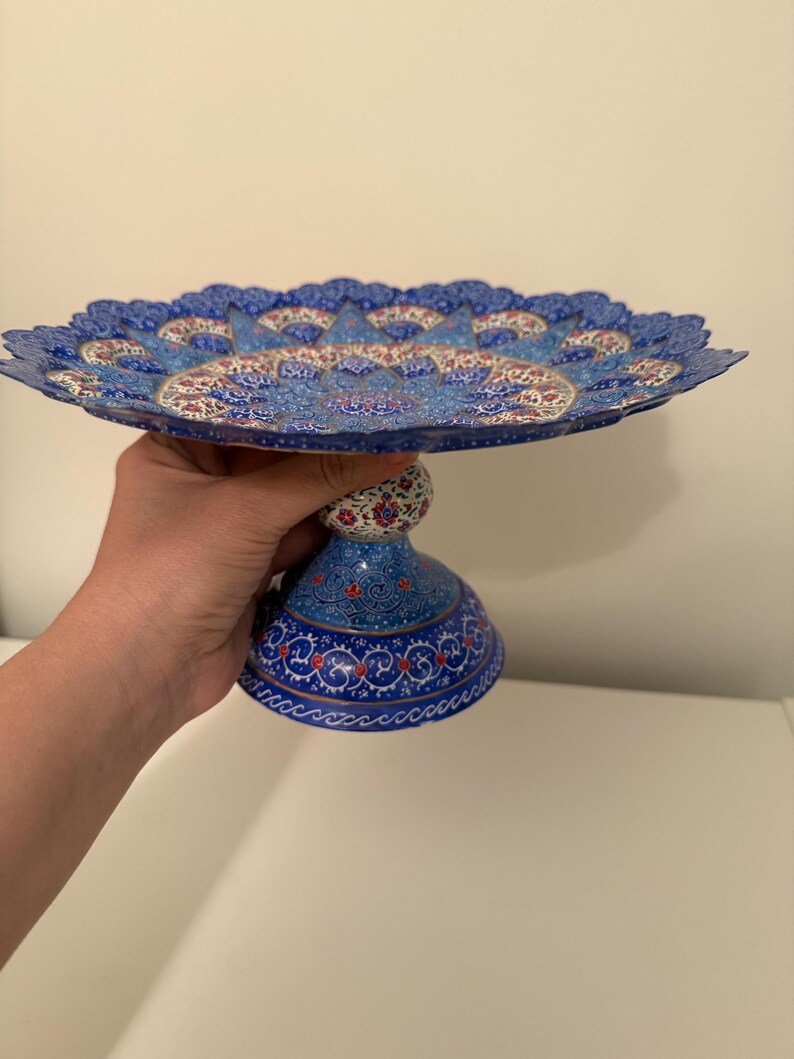
Inlaid metalwork
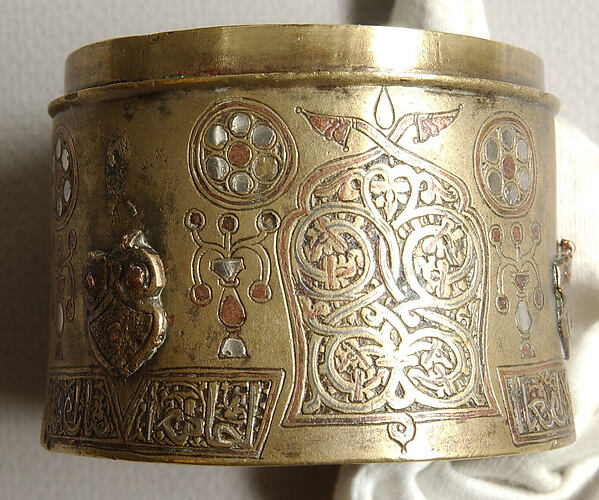
Photographs show documented examples of each craft for visual comparison; they do not prove what any other object is.
Side by side
| Minakari enamel | Inlaid metalwork | |
|---|---|---|
| Persian name | میناکاری | فلزکاری ترصیعشده |
| Category | Metalwork · Enamel | Metalwork · Precious-metal inlay |
| Materials | Copper, Silver, Vitreous enamel | Brass, Silver, Copper |
| Techniques | Enamelling on metal | — |
| Regions | Isfahan | Isfahan, Tabriz |
| Periods | Safavid, Qajar, Pahlavi, Contemporary | Seljuk, Ilkhanid, Timurid, Safavid |
| Motifs | Gol-o-morgh, Eslimi arabesque | Eslimi arabesque |
| Current vitality | Living tradition | At risk |
What they share
- Materials: Copper, Silver
- Regions: Isfahan
- Motifs: Eslimi arabesque
- Periods: Safavid
How to tell them apart
- The Minakari enamel record lists Vitreous enamel, which the Inlaid metalwork record does not.
- The Inlaid metalwork record lists Brass, which the Minakari enamel record does not.
- Minakari enamel typically involves Enamelling on metal.
- A material listed for only one craft is a question to ask, not an identification test.
- The stated place of making is a useful clue, but never proof on its own.
Background on each craft
About Minakari enamel
Definition
Minakari is the fusing of powdered glass, coloured with metal oxides, onto a metal surface through repeated firing, producing a smooth, durable and often brightly coloured decorative finish. The technique is applied to both flat panels and shaped vessels, and in its most refined form combines fired background colour with fine hand-painted figurative or floral decoration fired on top.
Isfahan is the city most closely associated with Iranian minakari, where workshops developed a characteristic palette, often built around a deep blue or turquoise ground, though enamelling on metal has a long, geographically wide history and Iranian minakari should be understood as one branch of that broader craft rather than an isolated invention.
History
Enamelling on metal is documented in Iran from at least the Safavid period, when Isfahan's court-supported metalworking workshops produced enamelled vessels and jewellery alongside other decorative arts. The precise origins and lines of technical transmission for Persian enamelling relative to other regional enamel traditions are not fully settled and are treated by scholars as part of a wider shared history of the craft across the region.
Production continued through the Qajar period with court and elite patronage, and in the twentieth century minakari expanded into a wider decorative and tourist market, applied to plates, bowls, jewellery and small decorative objects sold through Isfahan's bazaars and workshops, a shift that broadened output but also increased the range of quality found in the market.
General background on the craft, not a statement about any individual object; dates and attributions summarise common positions in the literature and remain under review. Read the full Minakari enamel entry.
About Inlaid metalwork
History
Inlaid brass and bronze are strongly associated with Khorasan and western Iran in the 12th–14th centuries; many surviving objects have lost part of their inlay.
Technique
The design is engraved and undercut into the base metal; thin sheet or wire of a contrasting metal is hammered into the recesses so that the undercut locks it in place, then chased and polished.
General background on the craft, not a statement about any individual object; dates and attributions summarise common positions in the literature and remain under review. Read the full Inlaid metalwork entry.
Read more
Disclaimer
This comparison is educational and built from entries still under review. It cannot confirm what a particular object is.