
Buying & care
Persian style rugs vs real Persian rugs: Key differences
Compare Persian-style rugs with genuine handmade Iranian rugs: understand origin, construction, design, value, and the evidence to request before buying.
Published 30 September 2026 · 8 min read
AI-written from our archive and public references; not expert reviewed. Prices, dates and attributions are indicative only — confirm with a specialist.
The difference between Persian-style rugs and real Persian rugs is that “Persian-style” describes a look, while a genuine handmade Persian rug was woven by hand in Iran. A Persian-style rug may be printed, machine-woven or handmade elsewhere; its medallions and floral borders alone establish neither Iranian origin nor traditional construction.
What does “Persian-style” actually promise?
Usually, it promises visual resemblance. A listing might use the term for a scrolling floral pattern, an angular medallion, a compartmented garden design or a deliberately faded surface. None of those features identifies a country of manufacture. The phrase can be perfectly clear when accompanied by an accurate origin and construction description; the problem begins when photographs, regional names or romantic storytelling encourage buyers to assume more.
“Persian” is the established historical and commercial term for carpets associated with Iran. However, Iran also produces machine-made floor coverings. For this comparison, real Persian rug means genuine handmade Iranian work, not simply any rug manufactured within Iran. Keeping appearance, geography and technique separate prevents most misunderstandings.
| Listing category | What it describes | What remains to establish |
|---|---|---|
| Handmade Persian rug | A claim of Iranian origin and handmade construction | Evidence for both claims, plus materials and condition |
| Persian-style hand-knotted rug | Hand-knotted construction with Persian-inspired design | Country of manufacture; it may not be Iran |
| Persian-style machine-woven rug | Mechanically woven construction and a design reference | Materials and accurate manufacturing origin |
| Printed Persian-style rug | A pattern applied to a textile surface | Base fabric and printing method; the image is not knotted pile |
| Machine-made rug from Iran | Iranian manufacture without handmade weaving | It does not meet the handmade definition used here |
Does handmade automatically mean Persian?
No. Excellent hand-knotted carpets are made in several countries, including India, Pakistan, Nepal and Turkey. Some draw closely on Iranian designs. Their craftsmanship and their origin are separate facts: acknowledging the work does not justify relabelling it Persian. If your aim is to own Iranian craft, an imported hand-knotted reproduction does not meet that aim, however accomplished its execution.
“Handmade” also covers different processes. Hand-knotting forms pile through individual knots around foundation threads. Hand-tufting inserts yarn into a backing, commonly secured with adhesive; it is not hand-knotting. Iranian kilims, or gelims, are genuine handmade flatweaves without a knotted pile. Their different structure is not evidence of imitation.
Can a Persian pattern prove Iranian origin?
No single pattern functions like a passport. Designs have circulated through trade, workshop drawings, published illustrations and modern manufacturing. A Heriz-inspired angular medallion may appear on a machine-woven import; a finely drawn floral composition may be reproduced outside Iran. Regional names in product titles sometimes describe a design family rather than the place where that particular rug was woven.
The reverse misunderstanding matters too: a real Persian rug need not look like the familiar red floral carpet. Iranian weaving includes restrained Gabbeh compositions, geometric village carpets and boldly patterned flatweaves. A contemporary Iranian weaver can also produce an original design. Neither visual simplicity nor modern styling makes handmade Iranian work less genuine.
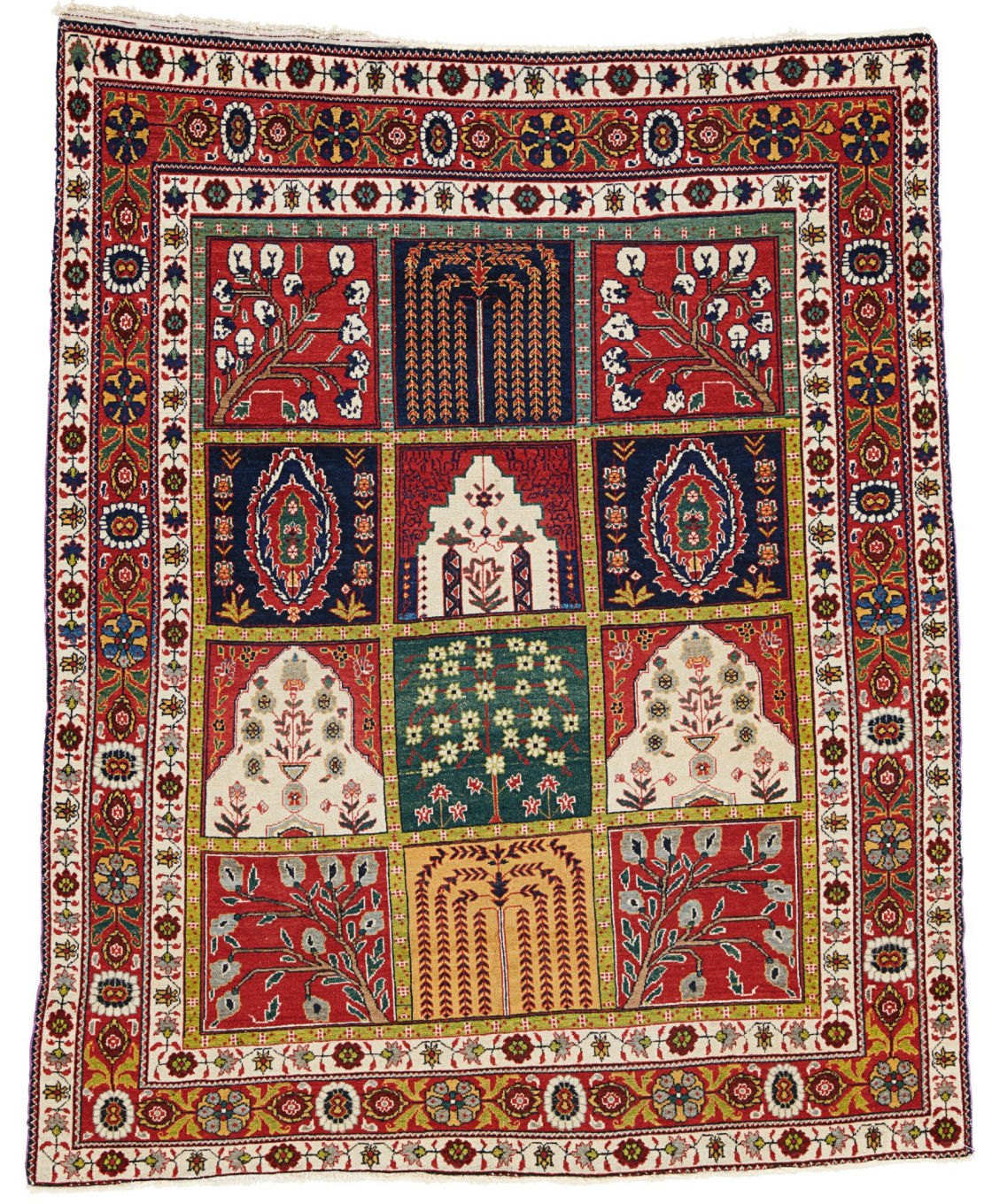
Treat these as descriptions, not proof
- “Heriz design” or “Tabriz pattern”: may identify inspiration rather than weaving location.
- “Oriental rug”: a broad market category, not a specific Iranian attribution.
- “Vintage look” or “antique finish”: describes an effect, not an established age.
- “Persian knot”: a structural term commonly used for the asymmetric knot, which is also used outside Iran.
- “Traditional motifs”: says nothing definite about the maker, date or country.
How does construction change the comparison?
Construction matters because it determines what you are actually comparing. A printed floral image, a machine-woven pile and a hand-knotted pile can look similar in a small listing photograph but behave differently under wear and repair. Still, establishing hand-knotting answers only the construction question. It cannot, by itself, distinguish an Iranian carpet from a hand-knotted carpet woven elsewhere.
| Observation | What it can help establish | What it cannot establish alone |
|---|---|---|
| Clear reverse showing the weaving structure | Whether construction is consistent with hand-knotting or another technique | Iranian origin or a particular workshop |
| Fringe continuing from the foundation | How the ends relate to the rug’s structure | Handmade status; some machine-woven rugs also have structural fringe |
| Applied backing or adhesive | Possible tufted construction, repair or later backing | A complete diagnosis without further examination |
| Very regular pattern and dimensions | Consistency of execution | Machine manufacture; skilled handweaving can be precise |
| Small variations in drawing or rows | Possible evidence consistent with handwork | Origin; irregularity is not exclusive to Iranian weaving |
| Pattern printed onto a surface | A printed design rather than a knotted rendition of that pattern | The full composition of the underlying textile |
Avoid turning these observations into a one-trick authenticity test. Fringe can be replaced; rugs can be backed after repairs; fine workshop weaving can be remarkably even. A useful comparison combines the whole rug, reverse, edges and condition history rather than treating one close-up as decisive.
What evidence supports a claim of Iranian origin?
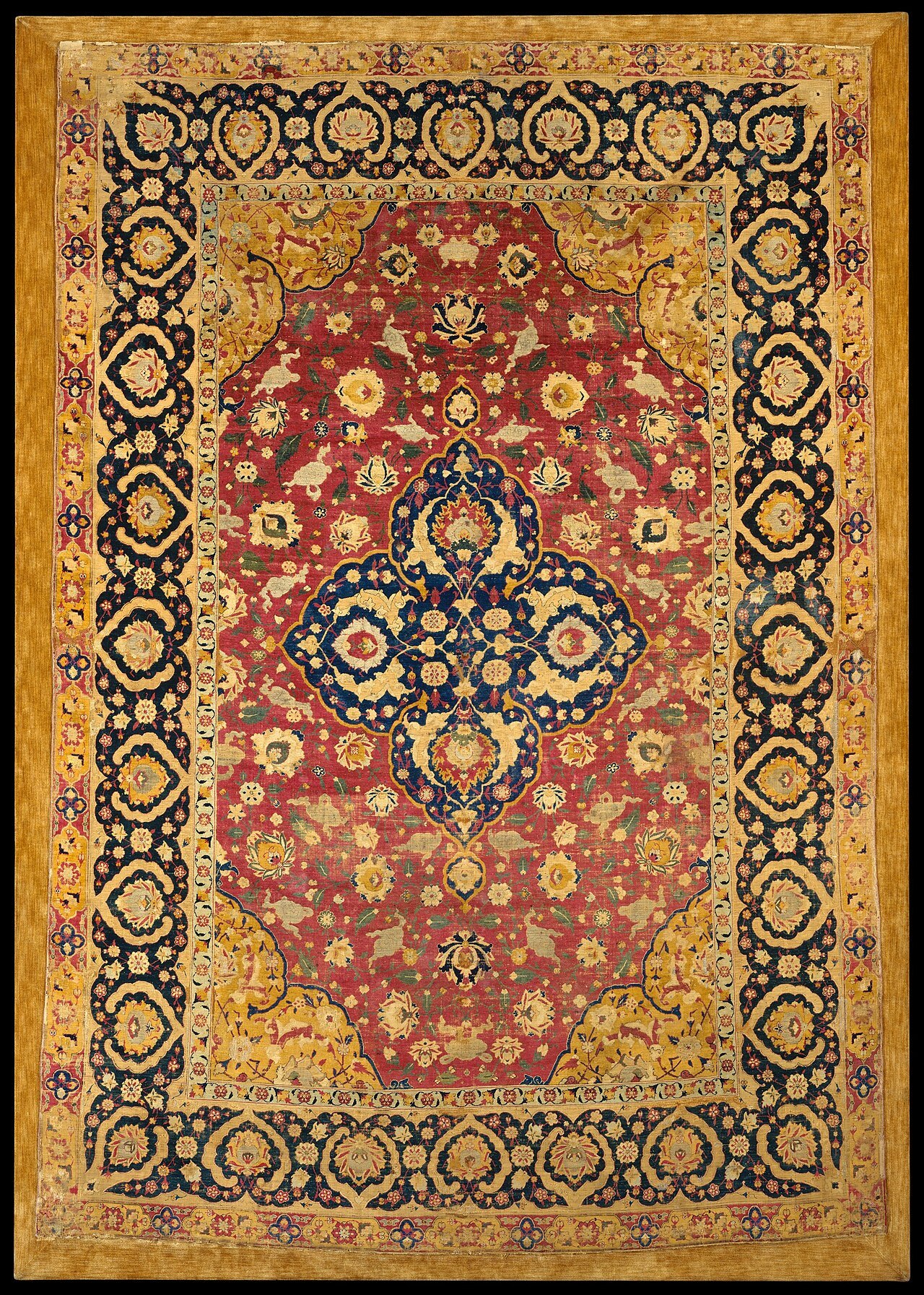
Origin is an attribution supported by evidence, not an impression created by colour. Useful evidence may include a credible acquisition history, supplier records, earlier invoices and an assessment connecting structure, materials and design. For newer work, information about the weaving workshop or production area can help. For older rugs, records are often incomplete, and responsible sellers should distinguish what is documented from what is inferred.
An invoice stating “hand-knotted in Iran” records the seller’s representation; it is not independent proof by itself. Likewise, a generic certificate or woven signature is not conclusive. Signatures can be copied, and attribution to a city may be less certain than attribution to Iran. Greater specificity should bring stronger supporting evidence, not merely more confident language.
Illustrative editorial scale for prioritising enquiries, not measured accuracy, authentication scores or probabilities. No item proves origin alone; records must relate to the specific rug.
Are wool, silk and natural dyes proof?
No. Wool is used in handmade and machine-made rugs worldwide, and silk does not identify a country. Genuine Iranian rugs may combine wool pile with cotton foundations, use wool foundations, or incorporate silk in different ways. Ask where each material occurs: “silk rug” can conceal the difference between an all-silk pile, silk highlights and a seller’s loose description of sheen.
Viscose and other regenerated cellulose fibres may be marketed with phrases such as “art silk” or “bamboo silk”; these are not substitutes for a clear fibre declaration. Natural dyes are not proof of Iranian origin, while synthetic dyes do not automatically make an Iranian handmade rug inauthentic. Colour variation, often called abrash, can have several causes and is not a reliable natural-dye test.
Does a real Persian rug always last longer or cost more?
Neither claim is dependable without qualification. A well-made wool Iranian rug in sound condition can provide long service and may be repairable by a specialist. But age, brittle fibres, moth damage, worn foundations and previous treatments can outweigh its original quality. A delicate silk carpet and a sturdy wool village rug are different practical choices, even when both are genuinely Iranian and hand-knotted.
Price reflects size, materials, labour, condition, age, attribution and market demand—not just whether a design looks Persian. A high price does not establish origin, and a modestly priced second-hand Iranian rug is not automatically suspect. Nor should handmade work be sold as a guaranteed investment. Repair costs and selling expenses can be substantial, and resale demand is uncertain.
Compare like with like
- Match dimensions and intended use before comparing prices.
- Separate sound examples from rugs needing structural repair.
- Compare wool with wool, and clarify the extent of any silk.
- Distinguish recent production from an older rug with documented age.
- Consider purchase price alongside cleaning, repairs and suitable underlay.
Which handmade Iranian options suit different tastes?
If you want Iranian craft rather than merely a Persian-looking surface, begin with the appearance and function you enjoy, then investigate suitable handmade examples. Regional associations are starting points, not rigid rules: production varies, designs overlap, and individual rugs should be judged on their own evidence.
Explore genuine Iranian weaving traditions
- For angular medallions and architectural drawing, explore handmade Heriz-area rugs.
- For detailed floral compositions, consider documented Iranian examples associated with Kashan, Isfahan or Tabriz.
- For spare compositions and expressive colour fields, explore Iranian Gabbeh weaving; the word Gabbeh alone does not guarantee Iranian origin.
- For a lighter, pile-free textile, consider a handmade Iranian kilim, checking its suitability for the intended space.
- For intricate silk work, investigate Iranian examples associated with Qom, with particular care over fibre descriptions and origin evidence.
How should you compare two listings?
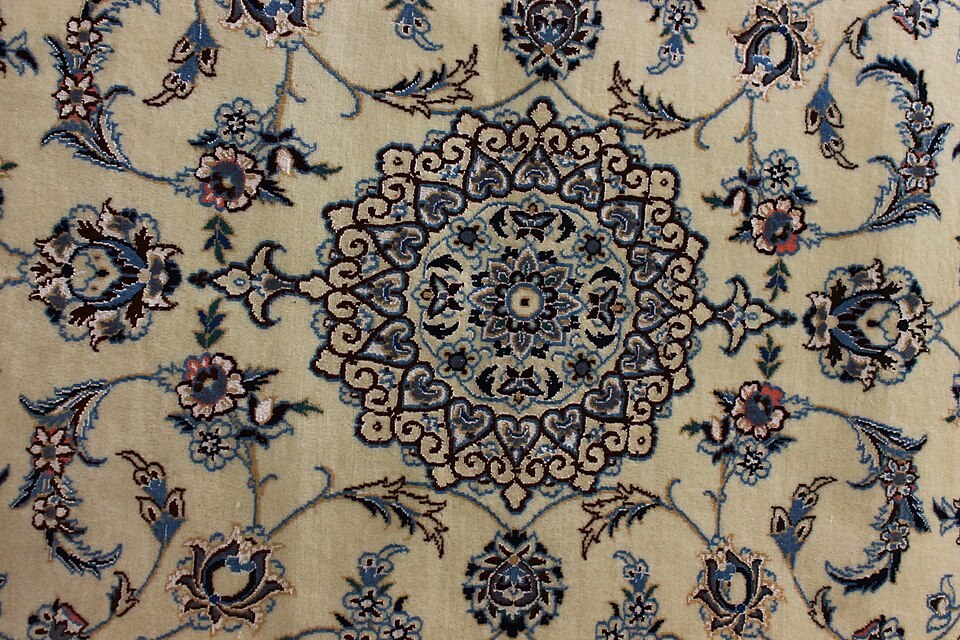
Instead of asking which photograph looks more authentic, create the same evidence checklist for both rugs. This exposes unequal comparisons: one seller may describe only style, while another specifies origin, technique and condition. A missing answer is an unresolved question, not permission to assume the most favourable interpretation.
A practical side-by-side comparison
- 1
Separate the claims
Write down design name, claimed weaving country, construction and materials in separate fields. Do not let “Persian” fill all four.
- 2
Request equivalent views
Ask for the full front and reverse, plus comparable photographs of corners, side edges, ends and any damaged areas.
- 3
Ask what supports origin
Request rug-specific records or an explanation of the attribution. Clarify whether a regional name identifies origin or inspiration.
- 4
Normalise the practical comparison
Check actual dimensions, pile condition, repairs and fibre composition. These differences may explain more than the product title does.
- 5
Confirm the written terms
Have origin and construction recorded on the invoice. Understand returns and obtain independent advice before a significant purchase.
What is the clearest buying decision?
If owning Iranian handmade craft matters to you, choose a rug whose Iranian origin and handmade construction are supported by credible, rug-specific evidence. If that evidence is missing, pause rather than paying for an assumption. Consider a smaller genuine Iranian rug, a sound second-hand example or an Iranian flatweave instead of treating a replica as an equivalent.
The essential distinction is not ornate versus simple, expensive versus affordable, or perfect versus irregular. It is design resemblance versus documented or responsibly attributed origin and construction. A good description tells you which is being offered—and leaves room for uncertainty where the evidence does not go further.
Frequently asked questions
Can a rug made in India be a real Persian rug?
A rug woven in India can be genuinely hand-knotted and highly skilled work, but it is not Iranian-made. If its design draws on Persian traditions, “Persian-style” or “Persian-design, made in India” is clearer. For a buyer seeking genuine handmade Iranian craft, both construction and weaving origin need to match that aim.
Are all rugs made in Iran handmade?
No. Iran produces machine-made rugs as well as handmade carpets and flatweaves. A country-of-origin statement therefore answers only one part of the question. Ask whether the rug is hand-knotted, handwoven flatweave, machine-woven or another construction, and request evidence appropriate to the claim rather than relying on “made in Iran” alone.
Does fringe prove a Persian rug is real?
No. Fringe can be part of the foundation, added decoratively or replaced during repair. Some machine-woven rugs also have structural fringe. Examining the ends can help explain construction, but fringe alone establishes neither hand-knotting nor Iranian origin. Consider it alongside the reverse, side finishes, overall structure and rug-specific records.
Is a Persian rug with synthetic dyes fake?
Not necessarily. Synthetic dyes have been used in genuine Iranian handmade weaving, and their presence does not determine origin or construction. Natural dyes likewise do not prove that a rug is Iranian. Dye quality, colourfastness and condition matter in their own right; they should not be confused with a simple real-versus-fake test.
Can you identify a real Persian rug from photos?
Good photographs can reveal useful construction details and sometimes support a tentative regional attribution. They cannot consistently establish fibre composition, hidden repairs or origin with confidence. Request full front and reverse views and detailed edge photographs, but combine them with written information. For a significant purchase, an independent in-person assessment may be worthwhile.
Is a Persian-style rug always a fake?
No. “Persian-style” can be an honest description of design inspiration when the actual origin and manufacturing method are clear. Misrepresentation arises when a product is presented as Iranian handmade work without a sound basis. The practical question is whether the listing accurately distinguishes style, country of manufacture, construction and materials.
Explore further on CraftPersia
- Persian carpet →
- How to tell a real hand-knotted Persian rug →
- Reading a Persian rug label or listing →
- Heriz rugs: geometric style, durability and dating →
- Gabbeh rugs: Qashqai and Luri origins, symbolism, real vs. copy →
- What is a Persian kilim? Flatweave structure, regions and buying tips →
- Persian silk rugs: Qom, Isfahan, Tabriz and checking real silk →
- Carpet terms every buyer should know →
Sources and further reading
- Encyclopaedia Iranica — Encyclopaedia Iranica Foundation
- Heilbrunn Timeline of Art History — The Metropolitan Museum of Art
- Middle East collections — Victoria and Albert Museum
- Intangible Cultural Heritage — Iran — UNESCO
- Wikimedia Commons (images) — Wikimedia Foundation
General reference collections; they do not endorse this article.
Topics: persian rugs · rug comparisons · iranian weaving · handmade rugs · authenticity