
Beginner guide · 11 min
What is a Persian kilim? Flatweave structure, regions and buying tips
Editorial team · updated 2026-09-29
What is a kilim?
A kilim (gelim in Persian) is a flat-woven rug with no pile. The pattern is made by passing coloured weft threads over and under the warps, packed tightly so the wefts hide the warps entirely. The result is thin, light and usually reversible.
How it is woven
Most Persian kilims use slit-tapestry weave: where two colours meet vertically, a small slit forms. This is why kilim designs favour diagonals, steps and geometric forms. Other techniques include dovetailing and weft-wrapping (soumak).
Main regions
Kilims are woven across Iran, largely by nomadic and village weavers:
- Qashqai and Fars — bold colours, bands and diamonds
- Senneh (Sanandaj) — very fine, detailed kilims
- Bijar and Kurdistan — sturdy wool, strong geometry
- Luri and Bakhtiari — dark palettes, lattice designs
- Khorasan and Baluch — deep reds and browns
Uses
Kilims were used as floor covers, bedding covers, bags, and dividers in tents. Today they work well as rugs, wall hangings and throws.
Buying tips
Check that the weave is tight and the slits are small and neat. Ask about wool and dyes. Many 'kilim-style' rugs are machine-made or printed; genuine kilims show slight irregularities and the pattern appears on both sides.
Care
Use a non-slip underlay on floors, vacuum without a beater bar and rotate regularly. Professional washing is safest for older pieces.
Related photographs
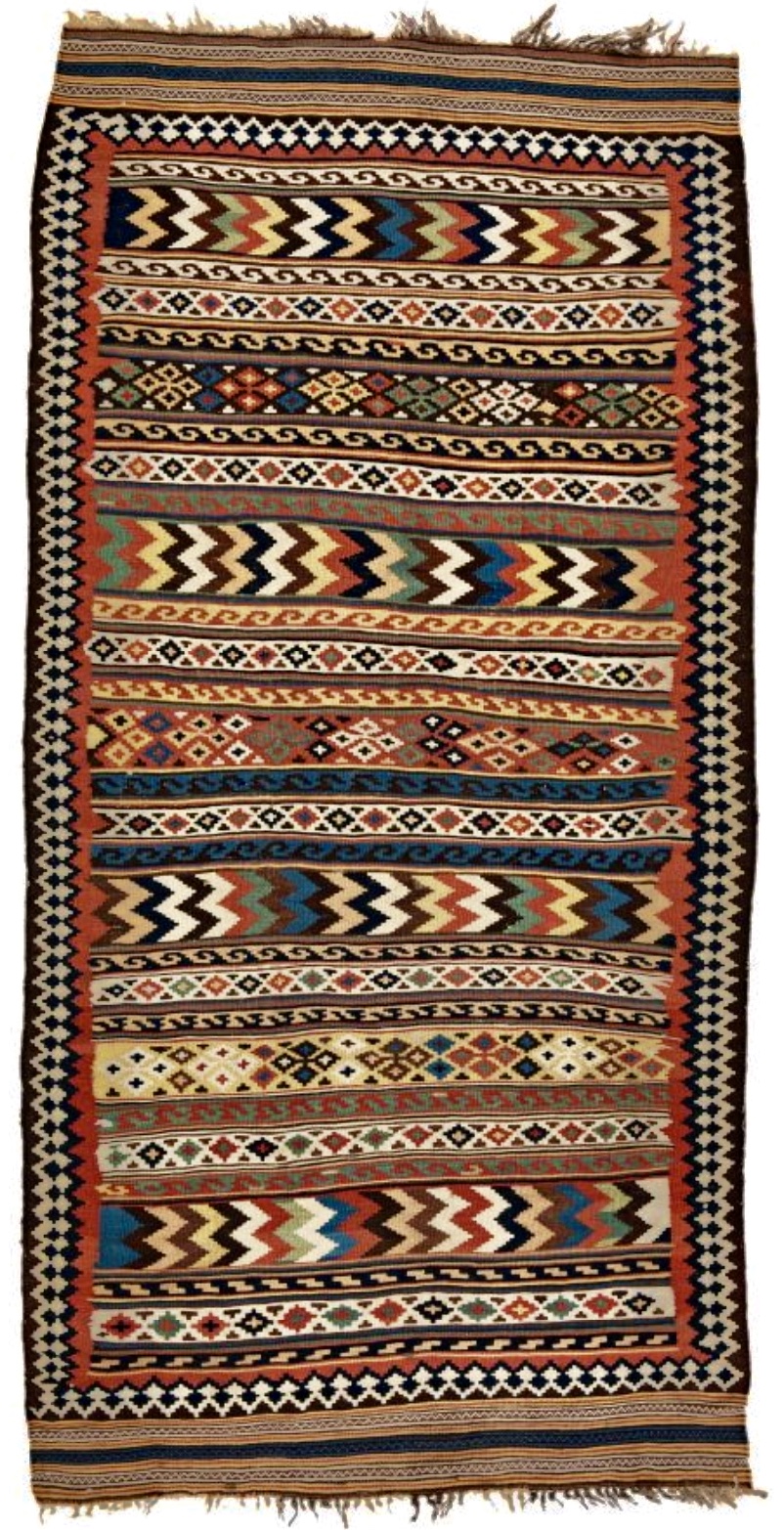
Representative photographs, not of any specific catalogued object. Sources on the credits page.