
Carpets & rugs
Hand Knotted Persian Rugs: Styles, Feel and Everyday Use
Explore hand knotted Persian rugs by texture, regional style and everyday use, with practical ways to assess Iranian origin, materials and lasting value.
Published 30 September 2026 · 8 min read
AI-written from our archive and public references; not expert reviewed. Prices, dates and attributions are indicative only — confirm with a specialist.
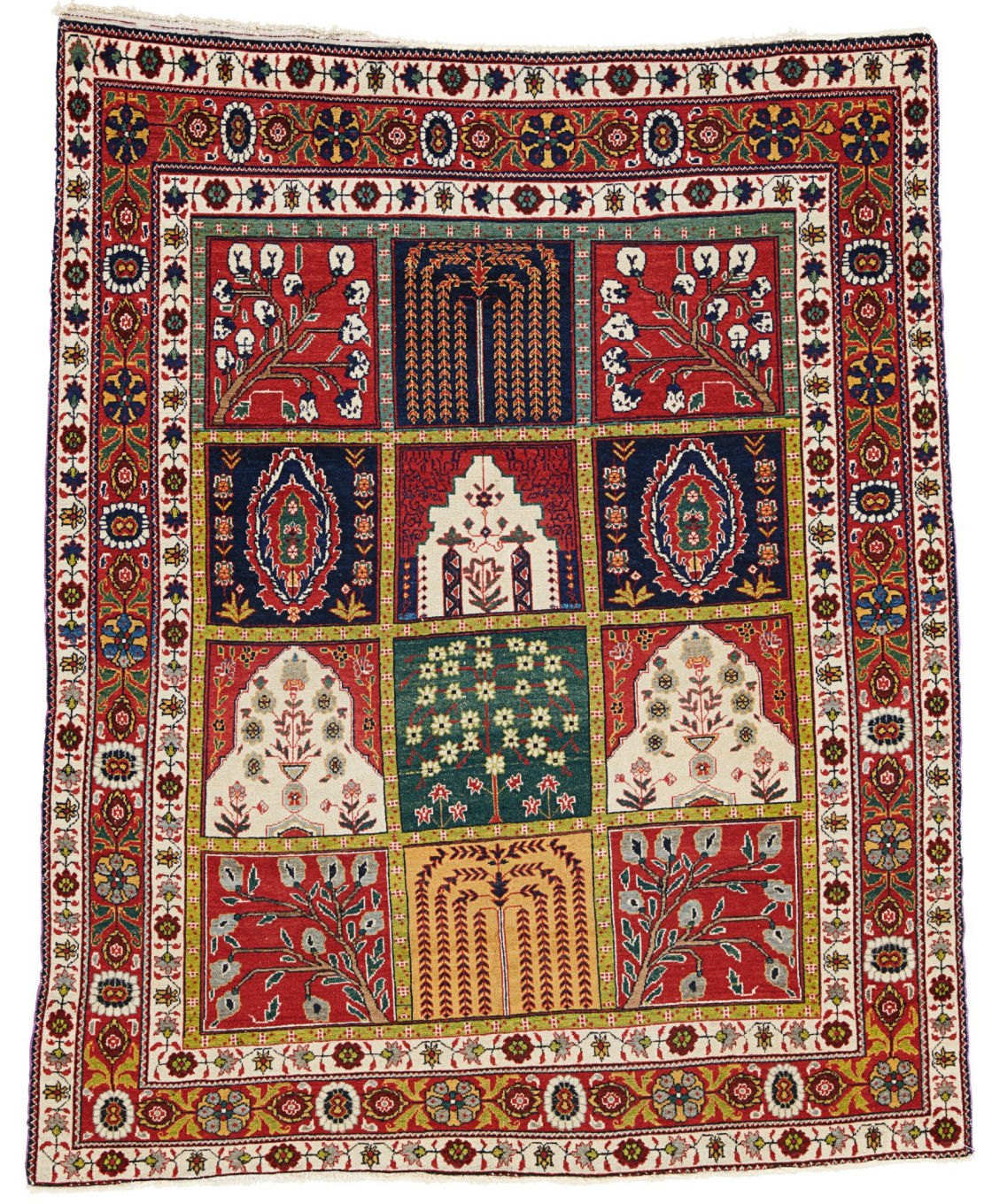
Hand knotted Persian rugs are pile rugs woven by hand in Iran, with yarn knotted around foundation threads rather than tufted into a backing or produced on a power loom. The best choice depends on how you want a rug to feel and function: a substantial wool Gabbeh, a structured Heriz and a finely drawn Nain offer very different experiences. This guide compares those experiences, while keeping Iranian origin and genuine handwork separate from marketing claims.
What makes this category more than a Persian-looking design?
“Persian” identifies a geographic and cultural origin, not simply a medallion, floral border or red-and-blue palette. A rug made elsewhere may be genuinely hand-knotted and beautifully executed, but a Persian-inspired design does not make it Iranian. Conversely, an Iranian rug can have open fields, angular animals or restrained stripes rather than the elaborate flowers many people expect.
“Hand-knotted” identifies its structure. Individual knots create the pile, with weft threads inserted between rows to hold the fabric together. Iranian weavers use both symmetrical and asymmetrical knots; the familiar expression “Persian knot” is not proof of Iranian manufacture. A handmade Iranian kilim is also genuine Iranian craft, but its flatwoven structure places it outside the knotted-pile category.
How will a hand-knotted rug actually feel underfoot?
Photographs favour pattern, but your feet encounter pile height, yarn, finishing and the resistance of the woven foundation. A longer wool pile can feel enveloping; a closely clipped rug may feel firmer and reveal its drawing more clearly. Softness is not automatically evidence of better wool, and a thin rug is not automatically worn out.
| Characteristic | Typical experience | What to assess |
|---|---|---|
| Longer wool pile | Cushioned surface with less sharply outlined detail | Whether pile conceals debris or interferes with doors and chairs |
| Short, closely clipped pile | Clear drawing and a firmer feel | Whether shortness is intentional or caused by uneven wear |
| Fine silk pile | Smooth surface with pronounced changes in lustre | Suitability for low-traffic use and access to specialist cleaning |
| Firm foundation | A comparatively structured fabric | Whether it lies flat without persistent buckling |
| Supple foundation | A flexible, sometimes lighter-feeling fabric | Whether edges curl or the rug shifts on the intended floor |
Assess these characteristics together. A thick rug can still have weak foundations, while a finely woven, thin rug can remain structurally sound. An appropriate non-staining rug pad improves grip and cushioning, but it cannot compensate for brittle fibres, splits or an unstable repair.
Which regional traditions suit different tastes?
Regional names are useful starting points for visual preferences, not rigid specifications. Production changes over time, designs travel, and a marketplace label may refer to a wider district or trading centre. The descriptions below are common tendencies within Iranian weaving, not authentication tests.
| Tradition or label | Common visual character | Why it may appeal | Important qualification |
|---|---|---|---|
| Gabbeh | Open fields, blocks of colour and spare figures | Relaxed interiors and an emphasis on wool texture | Pile height varies; many non-Iranian copies use the name |
| Heriz | Angular drawing and strong medallions | Rooms needing a bold visual anchor | Neither geometry nor the label guarantees durability |
| Kashan | Floral fields, medallions and organised borders | Formal spaces and layered traditional interiors | Materials, age and execution vary substantially |
| Tabriz | Broad repertoire, including floral, pictorial and medallion designs | Buyers seeking detailed drawing or varied design choices | The city name is not a single weave grade |
| Nain | Often restrained ivory-and-blue palettes with fine floral drawing | Quieter colour schemes with intricate detail | Light colours and silk highlights are not proof of origin |
| Qom | Often finely drawn floral or pictorial work; silk examples are prominent | Low-traffic settings where detail and lustre can be appreciated | Not every Qom rug is silk, and silk claims require scrutiny |
Start with the visual effect you enjoy, then judge the individual rug. It is more useful to request several Iranian wool rugs with bold angular drawing than to assume every piece carrying one regional name will behave alike.
Which rugs work best in busy rooms?
For a frequently used sitting room, sound wool pile is usually a practical starting point. Look for secure edges, stable ends and sufficient remaining pile for the use you expect. Under a dining table, a relatively low, even surface allows chairs to move more easily; beneath a bedroom seating area, a deeper pile may be welcome.
Match the rug to what happens in the room
- Dining area: allow pulled-out chairs to remain supported by the rug, and plan for spills before choosing pale fields or delicate fibres.
- Living room: consider furniture weight, walking routes and whether a central medallion will be hidden beneath a large table.
- Bedroom: prioritise the surface beside the bed rather than paying for intricate detail that furniture will conceal.
- Entrance or corridor: check door clearance, secure placement and exposure to grit or moisture; avoid fragile historic pieces.
Pattern also affects how a room reads. A densely patterned field can make small marks less conspicuous, but it does not repel dirt. An open field offers visual calm while making local stains, shading and uneven wear easier to notice.
Should you choose wool, silk or a combination?
Separate pile material from foundation material. “Wool rug” usually describes the visible pile, while the hidden warp and weft may be cotton, wool or another fibre. Cotton foundations are common in many workshop traditions; wool foundations occur in numerous village and mobile weaving traditions. These are tendencies, not rules for assigning origin.
Wool offers resilience and a tactile surface well suited to many homes. Silk permits fine detail and distinctive lustre but calls for more cautious placement and cleaning. Wool rugs with silk highlights offer another effect: selected outlines or motifs catch the light without the entire pile being silk.
Does a higher knot count mean a better rug?
Greater knot density can support finer curves, small lettering and detailed flowers. It does not, by itself, establish beauty, strength, age or Iranian origin. A comparatively coarse Gabbeh may fulfil its artistic purpose more convincingly than a tightly knotted rug with awkward drawing or poor finishing.
Read knot count in relation to the design. Broad colour fields do not need the same structural resolution as miniature-like imagery. For everyday use, the condition of the foundation, quality of the yarn and stability of the edges may matter much more. Density becomes particularly misleading when sellers compare different counting systems without explaining their units.
These are qualitative editorial priorities for a frequently used floor rug, not measured performance data, market statistics or a scoring system for authenticity.
How do colour, light and pattern change the choice?
View a rug from both ends. Pile direction changes the way light reflects, so the same piece can look lighter and more lustrous in one direction and deeper in colour in the other. Ask for photographs taken in diffuse daylight and a video from opposing viewpoints; heavily edited listing images are poor guides to colour.
Bands of colour variation, commonly called abrash, may result from differences in yarn or dye batches. They can contribute to the appearance of a handmade rug, but they do not prove natural dyes, age or authenticity: similar effects can be deliberately reproduced. Likewise, irregular drawing is not a compulsory hallmark of handwork.
Choose motifs for their visual qualities before attaching a story. A prayer-niche composition has an identifiable architectural reference, but broader claims that every flower, bird or lozenge carries one fixed meaning deserve caution. Meanings can depend on region, period and context, and some popular interpretations are uncertain.
What evidence supports genuine Iranian handwork?
Treat construction and origin as two separate questions. Clear views of the reverse, pile base, sides and ends help assess how a rug was made. Iranian origin requires additional support: a specific written attribution, the seller’s acquisition history where available, and a reasoned relationship between structure, materials and design.
A compact evidence check
- 1
Request views beyond the front
Ask for the whole reverse and close-ups of knots, edges and fringe attachments. Cloth or adhesive backing can conceal tufted construction or repairs and requires explanation.
- 2
Ask two direct questions
“Is this individually hand-knotted?” and “Was it woven in Iran?” are clearer than asking whether it is handmade or Persian-style.
- 3
Get the description in writing
Record the claimed country of manufacture, materials, dimensions, condition and any qualified regional or age attribution on the invoice or accompanying documentation.
- 4
Escalate expensive uncertainties
For valuable silk, antique or unusually attributed pieces, consider an independent specialist’s assessment and obtain clear return terms before committing.
Visible knots and integrated fringe are useful observations, not conclusive proofs on their own. Machine-made rugs can imitate structural appearances, and genuine old rugs may have replacement ends. A signature woven into the design also needs context; it is not a certificate of maker, date or origin.
What are you paying for beyond the knot count?
Price reflects a combination of labour, materials, dimensions, design, condition, attribution and market demand. Fine silk work may involve substantial labour, but rarity and sales context can matter as much as production effort. Two rugs of similar size can therefore carry very different asking prices without either difference being explained by knots alone.
Older does not automatically mean more valuable or more suitable. Wear, weakened foundations, extensive repiling and alterations can affect both use and collectability. New Iranian work can offer strong design and a sound surface without the uncertainty surrounding an optimistic antique attribution.
How do you turn a shortlist into a lasting choice?
Reduce the decision to three non-negotiables: it fits the space, its materials and condition suit the traffic, and the evidence supports Iranian hand-knotted manufacture. Only then compare the subtler pleasures of drawing, colour and texture. If a seller cannot explain a major uncertainty, a more clearly documented rug is usually the better choice.
Before keeping it, view the rug in its intended room if return arrangements permit. Check both pile directions, door clearance and placement under furniture. Establish a simple care routine: gentle suction without an aggressive brush, no vacuuming over fringe, prompt attention to spills and specialist cleaning when needed. Avoid treating silk or uncertain dyes with household stain removers.
A successful rug need not be the finest, oldest or most expensive example available. It should be genuine Iranian handwork whose individual qualities you understand—and a textile you can comfortably live with rather than one chosen solely for its label.
Frequently asked questions
Are all Persian rugs hand-knotted?
Not everything sold with the word “Persian” is hand-knotted. Retail listings may use it loosely for machine-made products with Persian-inspired patterns. Iran also produces handmade flatweaves, which are genuine Iranian textiles but not knotted-pile rugs. Ask separately about country of manufacture and construction, rather than relying on the product title.
How long do hand-knotted Persian rugs last?
A well-made wool rug in sound condition can serve for decades, and some survive much longer with appropriate care. There is no reliable lifespan for the category as a whole. Foot traffic, grit, sunlight, damp, moth activity and delayed repairs all matter. Existing foundation damage can be more consequential than visible surface wear.
Are hand-knotted Persian rugs suitable for homes with pets?
Sound wool examples can work in pet-owning households, but no rug is pet-proof. Claws may catch loose edges or fringe, while urine can damage fibres, destabilise dyes and create persistent odours. Avoid fragile antiques or delicate silk in accident-prone areas. Choose a manageable size and discuss pet-stain treatment with a specialist cleaner.
Why does my Persian rug look lighter from one side?
The pile has a direction, and light reflects differently depending on whether you look along or against it. This can produce a striking shift in colour and lustre, especially in silk or closely finished pile. Turn the rug before deciding where it belongs. Localised changes that remain from every angle may instead involve wear, staining or fading.
Is a handmade Persian rug a good investment?
Buy primarily for use, craftsmanship and enjoyment rather than promised financial returns. Resale depends on condition, attribution, demand and selling costs, and a retail purchase price may not be recoverable. Exceptional collectible rugs occupy a specialist market. An ordinary but appealing Iranian wool rug can offer lasting household value without appreciating financially.
Can you identify a Persian rug from photographs?
Photographs can support a preliminary assessment of design, construction and visible condition, especially when they include the reverse and ends. They cannot reliably settle every question about fibre, repairs, age or precise origin. Fine distinctions may require handling the rug, magnification or specialist testing. Treat a confident attribution based on one front-facing image cautiously.
Explore further on CraftPersia
- What makes a rug "Persian"? Origin, structure and terms →
- How to tell a hand-knotted rug from a machine-made one →
- Tabriz rugs: designs, knots, grades and how to recognise one →
- Persian silk rugs: Qom, Isfahan, Tabriz and checking real silk →
- Gabbeh →
- Kashan carpet →
- How to tell a real hand-knotted Persian rug →
- Why Persian rugs cost so much: labour, knots, fibre, age →
- Washing a handmade rug: what to do and what to avoid →
Sources and further reading
- Encyclopaedia Iranica — Encyclopaedia Iranica Foundation
- Heilbrunn Timeline of Art History — The Metropolitan Museum of Art
- Middle East collections — Victoria and Albert Museum
- Intangible Cultural Heritage — Iran — UNESCO
General reference collections; they do not endorse this article.
Topics: persian rugs · hand knotted · iranian weaving · wool rugs · rug styles