Beginner guide · 10 min
What makes a rug "Persian"? Origin, structure and terms
Editorial team · updated 2026-09-29
The short answer
A Persian rug is a rug hand-made in Iran, traditionally hand-knotted with wool or silk pile on a cotton, wool or silk foundation. The word refers to origin and method, not only to design. A rug with a Persian-style pattern made by machine or in another country is not a Persian rug.
Key features
- Made in Iran by hand
- Knots tied one by one around the warps
- Fringe formed by the warp ends, not sewn on
- Pattern visible on the back, knot by knot
- Usually named after a city, region or tribe (Tabriz, Heriz, Qashqai)
Pile rugs and flatweaves
Most Persian rugs are pile rugs (qali or farsh). Iran also produces flatweaves such as kilim, jajim and soumak, and felt rugs (namad).
City, village and tribal
City rugs are woven in workshops from cartoons and look precise. Village and tribal rugs are often woven from memory, with bolder, more geometric designs.
Useful terms
- Warp: vertical threads; weft: horizontal threads
- Knot: symmetrical (Turkish) or asymmetrical (Persian)
- Abrash: natural colour variation in dyed wool
- Raj or KPSI: ways of describing knot density
Related photographs
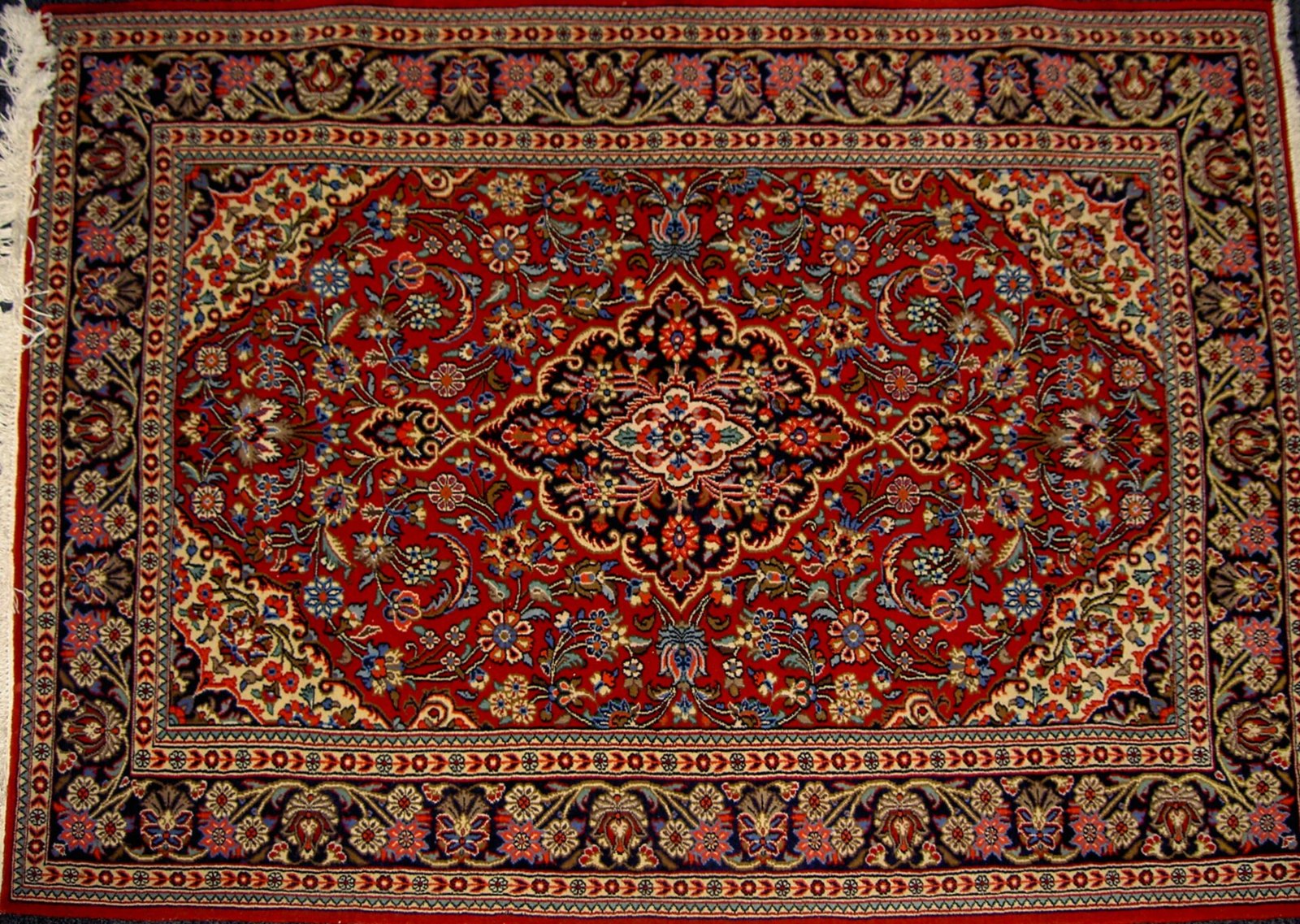
Representative photographs, not of any specific catalogued object. Sources on the credits page.