
Definition
Monabbat-kari is the carving of ornament directly into the surface of a solid wooden panel using chisels and gouges, removing material to leave a raised or sunken pattern in a single piece of wood, rather than assembling the design from separately cut or inlaid pieces as in khatam or marquetry.
The technique is applied to doors, mirror frames, furniture panels, Quran stands and architectural elements such as pillars and ceiling panels, and ranges from shallow low-relief surface decoration to deep, boldly undercut high relief with strongly three-dimensional floral and arabesque forms.
History
Relief-carved wooden doors, panels and architectural elements are documented in Iran across several historical periods, with notable surviving and well-studied examples from the Safavid period onward in religious and domestic architecture in cities such as Isfahan and Shiraz. Earlier carved woodwork existed but is less completely preserved, since wood survives poorly compared with stone or ceramic, which limits how far back a continuous technical lineage can be traced with confidence.
Carved wood furniture and decorative panels remained a significant craft through the Qajar and Pahlavi periods, associated particularly with workshops in Isfahan, Shiraz and Kerman producing both architectural commissions and freestanding furniture, mirror frames and boxes for domestic use and sale.
Materials
Walnut is favoured for its fine, even grain and workability under the chisel, along with other regionally available hardwoods where walnut is scarce or where a different colour or grain is wanted. Finishing typically uses oil or wax rather than an opaque coating, so the carved relief and the wood's natural figure remain visible.
- Walnut or comparable close-grained hardwood
- A range of chisels, gouges and mallets sized to the depth of cut required
- Oil or wax finishes that preserve visible wood grain
Technique
The design is drawn or transferred onto the wood surface, and the carver works progressively from roughing out the general forms with larger tools to refining detail with fine chisels and gouges, removing background material to leave the pattern raised, or cutting into the surface to leave it recessed, depending on the intended effect.
Depth of relief and degree of undercutting distinguish grades of work: shallow, largely flat-relief carving is faster and used for less prominent surfaces, while deep, undercut high relief with strongly modelled floral and figural forms represents the more demanding and time-intensive end of the craft, requiring sound, defect-free wood to avoid breaking through thin undercut sections.
Motifs
Scrolling arabesque vinework, layered floral compositions and, on some pieces, bird-and-flower groupings appear frequently, along with geometric borders framing the main field. Figural and narrative scenes appear on some commissioned pieces but are less central to the tradition than plant-based ornament.
Collecting and identification
Hand-carved relief shows tool marks, slight asymmetry between repeated elements, and undercut areas with visible depth and shadow; machine-routed or CNC-cut imitations tend toward a flatter, more mechanically uniform repeat and can leave characteristic router-bit rounding in corners that hand chisel work does not produce.
Age and workshop attribution for carved furniture are often asserted without documentation; condition issues such as old shellac, replaced hardware, or later added elements are common on genuinely old pieces and should be assessed rather than treated automatically as red flags or, conversely, as proof of age.
Preservation
Deep relief carving, especially undercut high relief, is structurally more fragile at its thinnest points and vulnerable to knocks and to wood movement from humidity change, which can crack thin undercut sections. Maintain stable humidity, avoid direct sun which dries and cracks wood surfaces, and dust carved detail with a soft brush rather than a cloth that can catch on raised elements.
Refit loose joints and stabilise cracked relief through a woodworking conservator rather than with general household glue, since inappropriate adhesives can stain the wood or make later proper conservation more difficult.
Gallery
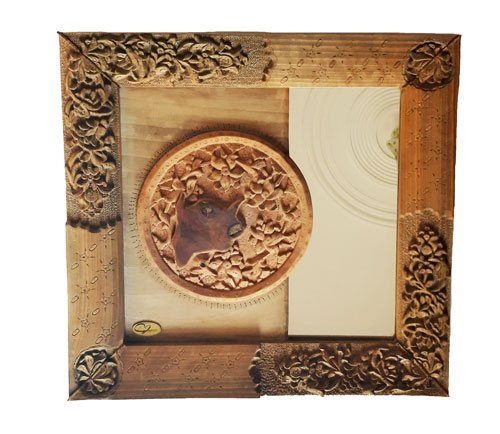
Images are representative examples, not evidence for the sample marketplace records. Their sources and permission status are listed in the photography credits.
Marketplace
No objects of this craft are currently listed.
- Construction
- Relief carved from solid timber
- Object reading
- Structure, materials and condition before attribution
- Evidence status
- Educational summary under editorial review
Relief carved from solid timber
Monabbat removes wood around motifs so the forms project above a lowered background. Tool marks and depth vary with timber, scale and finishing. It differs from inlay, which inserts material into or onto a base.
Protect raised edges
Inspect grain orientation, joins, paint, varnish and repairs; avoid oiling an older carved piece without specialist advice.
- Raised relief above cut-away ground
- Chisel and gouge traces
- Vulnerable projecting edges
Context, preservation and evidence
Workshops, households, museums and contemporary makers can use the same craft name in different ways. Record who made, sold and documented a piece before assigning a date or location. Condition and technique are observable; origin, attribution and value require further evidence.
These reading notes are educational, not an authenticity certificate or valuation. The associated source list is a starting point; many claims and translations still require specialist review.
Technique: what to look for
A relief is cut into wood by removing the background around raised motifs. Grain orientation and tool marks affect what can survive at delicate projecting edges.
Historical and regional context
The same carving vocabulary can appear on doors, furniture and smaller objects. A repeating design is not evidence of a specific carver or date.
Collecting and documentation
Look for worm holes, splits, old glue and replacement pieces, particularly on the reverse and at joints. Avoid oil or polish on a historic finish without specialist advice.
These checks are non-destructive educational prompts, not an authentication, attribution or appraisal. Keep a record of which claims were observed and which came from a seller.
Wood carving (Monabbat) in photographs
Representative photographs, not of any specific catalogued object. Sources on the credits page.
| Type | How to distinguish it |
|---|---|
| Monabbat | Carved relief in wood |
| Khatamkari | Micro-mosaic veneer applied to wood |
| Gereh-chini | Open geometric lattice joinery |
| Observed process | Often confused with | What to examine |
|---|---|---|
| Carved solid-wood relief | Applied moulded ornament | Carved forms remain part of the timber; applied decoration is attached as a separate material. |
Timeline
- Preparation
Season and shape the timber.
- Carving
Lower the ground and refine projecting surfaces.
- Use
Record any later paint, filling or structural repair.
Key terms
- Monabbat منبت
- Carved wooden relief.
References and further reading
- [1] Wulff, H. E. The Traditional Crafts of Persia. MIT Press, 1966.Background reference; individual statements and attributions still require editorial verification.
These sources provide context, not authentication or provenance for an individual object. Editorial interpretations remain under review.
Sources & references
- Book: Wulff, H. E. The Traditional Crafts of Persia. MIT Press, 1966.
- Journal article: Encyclopaedia Iranica, entry on woodworking and carving traditions in Iran.
Where origins, dates or symbolism are contested, this entry states the competing readings rather than choosing between them. Editorial analysis is not presented as documented fact.