
Definition
Gelim, commonly known in English as kilim, describes a family of flat-woven textiles produced without knotted pile. The design is created by interlocking coloured wefts directly against each other, or by slit-weaving where blocks of colour meet, leaving small vertical gaps at the colour boundaries that are a structural signature of the technique rather than a flaw.
Because the surface carries no pile, kilims are lighter, more flexible and typically reversible compared to knotted-pile carpets, and the same interlocking-weft logic underlies related utilitarian forms such as saddlebags, grain sacks and tent bands woven by pastoral and village weavers.
History
Flatweaving is among the oldest textile technologies practised in the Iranian plateau, closely tied to pastoral and semi-nomadic life where lighter, packable textiles suited seasonal movement. Documented regional kilim traditions associated with Fars, Kerman, Sistan and Khorasan describe distinct weaving groups, though precise dating of individual older pieces is rarely possible without technical or documentary evidence.
Through the Qajar and Pahlavi periods, kilims were woven primarily for household and pastoral use rather than for export, and only later entered wider decorative and collector markets alongside knotted-pile carpets, a shift that changed sizes and, in some workshops, colour choices to suit external buyers.
Materials
Wool is the dominant fibre for both warp and weft in pastoral and village kilims, valued for its availability from local flocks and its capacity to hold natural dyes. Cotton is used in some regional traditions for the warp, giving a firmer, flatter foundation than an all-wool structure.
- Handspun wool weft for colour and pattern
- Wool or cotton warp depending on regional practice
- Natural or synthetic dyes, varying by period and workshop
- Goat hair sometimes used for edge binding and reinforcement
Technique
The weaver works from the base of the warp upward, packing each weft row tightly with a comb-like beater so no warp threads show through on the finished face. Pattern areas of different colour are woven independently and either interlocked, where adjacent wefts loop around a shared warp, or slit-woven, where they simply abut and are left open.
Slit-weave construction permits sharp, angular motifs but leaves the fabric more prone to widening gaps if not finished carefully, so many traditions favour interlocking technique for smaller repeating figures and reserve slit-weave for bold geometric fields.
Motifs
Kilim design vocabulary favours large, high-contrast geometric fields, diamond lattices, hooked medallions and stylised animal or plant forms rendered as blocky shapes suited to the technique's straight and diagonal lines. The boteh figure and geometric latch-hook forms recur across many regional groups, though their attributed meanings are largely oral and vary by weaving community.
Collecting and identification
Examine the reverse: a genuine handwoven kilim shows the same design as the front with no knots or pile nap, and slit-weave seams are visible as small openings between colour blocks. Uneven selvedges, occasional weft irregularities and natural dye variegation (abrash) are consistent with handwork rather than defects to be alarmed by.
Attribution to a specific tribal or regional group is often asserted confidently in the trade but is difficult to verify without provenance; buyers should treat unsupported attributions as informed guesses rather than certainties.
Preservation
Flatweaves tolerate folding better than pile carpets but should still be stored rolled rather than folded for long periods to avoid permanent creasing. Keep away from prolonged direct sunlight, which fades both natural and synthetic dyes unevenly, and address moth activity in wool promptly with appropriate, low-intervention methods rather than chemical treatments applied at home.
Gallery
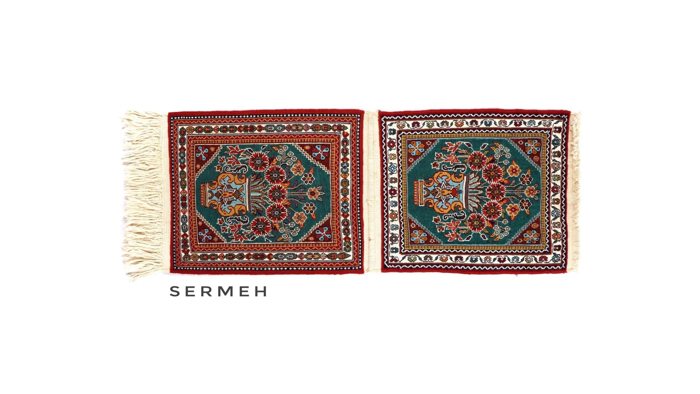
Images are representative examples, not evidence for the sample marketplace records. Their sources and permission status are listed in the photography credits.
Marketplace
No objects of this craft are currently listed.
- Construction
- Pileless interlaced cloth
- Object reading
- Structure, materials and condition before attribution
- Evidence status
- Educational summary under editorial review
Pileless interlaced cloth
Flatweave is a structural term: coloured wefts make the visible field without individually tied pile knots. In slit-tapestry examples, adjacent colour blocks turn around separate warps and leave small vertical openings; interlocked wefts avoid those openings. Do not confuse either method with a knotted carpet.
Read an object
Examine the reverse for the same weft pattern, note the boundaries between colour fields, and inspect the selvage and warp ends. A dealer label such as Shiraz or Qashqai may identify a trading convention rather than a proven workshop.
- Pileless surface, with no clipped knot ends
- Colour junctions may show slits or interlocked wefts
- Warp and weft materials should be identified separately
Context, preservation and evidence
Workshops, households, museums and contemporary makers can use the same craft name in different ways. Record who made, sold and documented a piece before assigning a date or location. Condition and technique are observable; origin, attribution and value require further evidence.
These reading notes are educational, not an authenticity certificate or valuation. The associated source list is a starting point; many claims and translations still require specialist review.
Technique: what to look for
Weft-faced tapestry makes colour blocks without knotted pile. Examine how adjacent colours meet: slits, interlocking and dovetailing are structurally different solutions, with distinct reverse and edge behaviour.
Historical and regional context
Kilim is a broad term used across communities and markets. A geometrical motif does not on its own identify a tribe, date or province.
Collecting and documentation
Photograph both faces and all edges, then note replaced wefts, joined panels, insect loss and any backing. Ask the seller which visible structural feature supports the stated origin.
These checks are non-destructive educational prompts, not an authentication, attribution or appraisal. Keep a record of which claims were observed and which came from a seller.
Kilim (Gelim) in photographs
Representative photographs, not of any specific catalogued object. Sources on the credits page.
| Type | How to distinguish it |
|---|---|
| Pile carpet | Individually knotted pile clipped to create a surface |
| Kilim | Weft-created surface without knotted pile |
| Jajim | Usually warp-faced narrow strips joined together |
| Observed process | Often confused with | What to examine |
|---|---|---|
| Weft-faced kilim | Warp-faced jajim | Weft-dominant fields and colour joins differ from lengthwise warp stripes and often seamed narrow panels. |
Timeline
- Warping
Prepare fibre and space the warps for the intended width.
- Weaving
Interlace coloured wefts, managing colour joins by the chosen method.
- Use
Record patched slits, edging and later backing separately.
Key terms
- Gelim گلیم
- General Iranian term for a flatweave; narrower regional usages vary.
References and further reading
- [1] Housego, J. Tribal Rugs: An Introduction to the Weaving of the Tribes of Iran. Scorpion Publications, 1978.Background reference; individual statements and attributions still require editorial verification.
These sources provide context, not authentication or provenance for an individual object. Editorial interpretations remain under review.
Sources & references
- Book: Housego, J. Tribal Rugs: An Introduction to the Weaving of the Tribes of Iran. Scorpion Publications, 1978.
- Museum catalogue: Victoria and Albert Museum, Middle East collection records, flatweave textiles.
Where origins, dates or symbolism are contested, this entry states the competing readings rather than choosing between them. Editorial analysis is not presented as documented fact.