
The two crafts in photographs
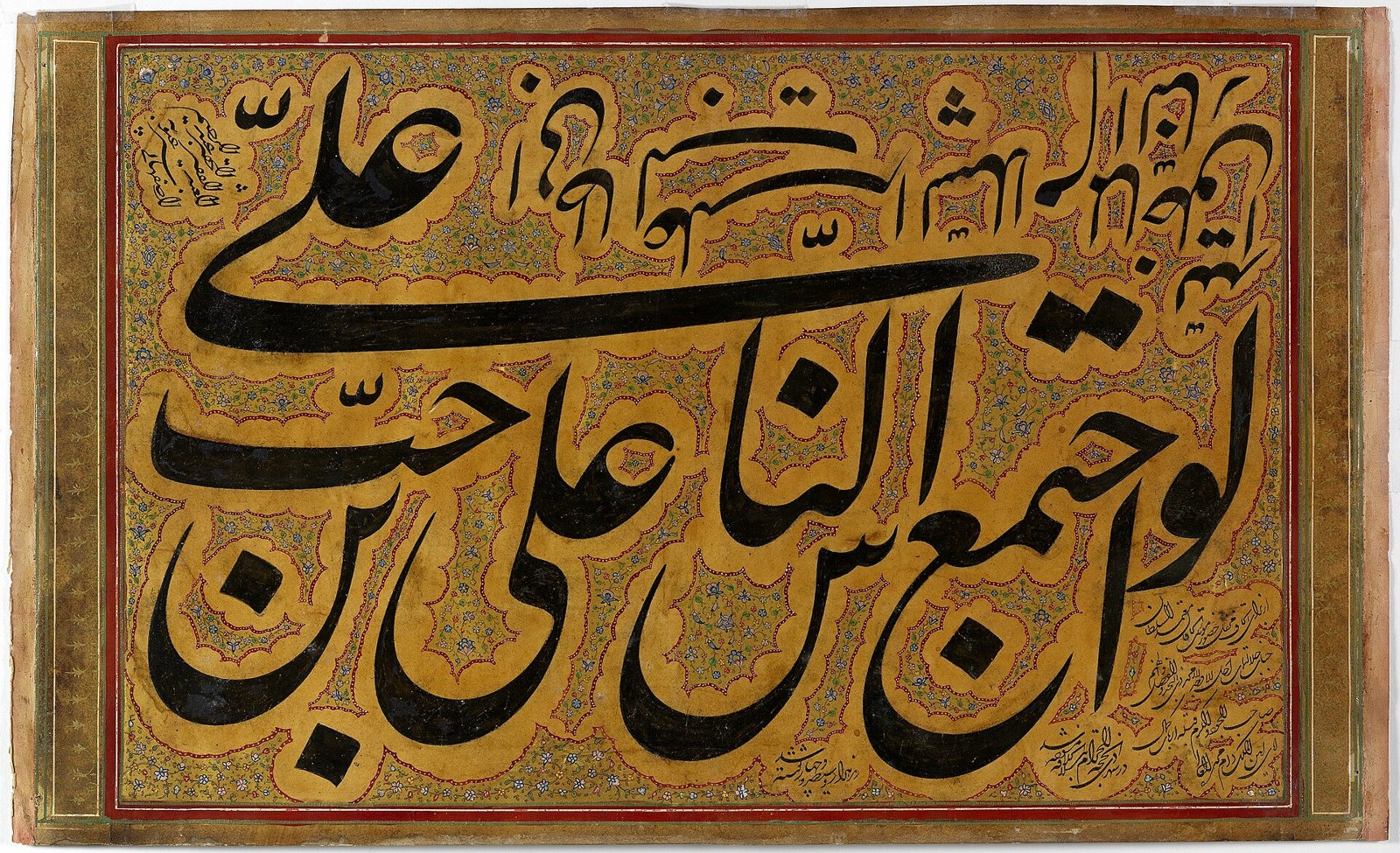
Nasta'liq calligraphy
Persian lacquer painting
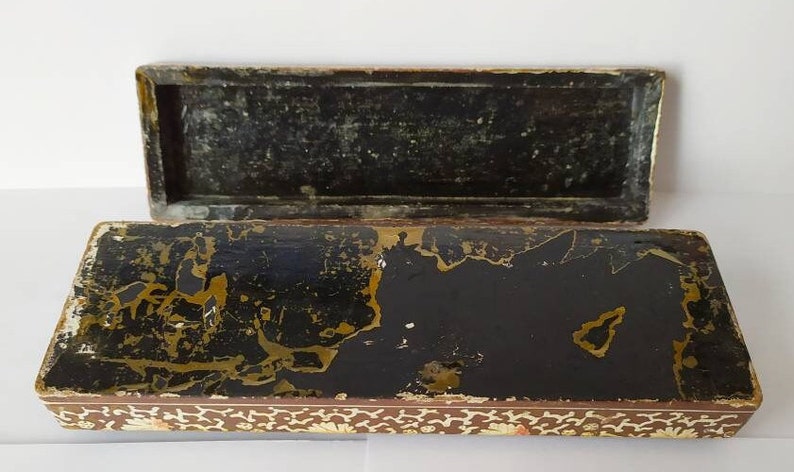
Photographs show documented examples of each craft for visual comparison; they do not prove what any other object is.
Side by side
| Nasta'liq calligraphy | Persian lacquer painting | |
|---|---|---|
| Persian name | نستعلیق | لاکیکاری |
| Category | Calligraphy · Script | Painting · Decorative lacquer |
| Materials | Paper | Paper, Lacquer coating |
| Techniques | Tazhib illumination | Painted lacquer finishing |
| Regions | Shiraz, Isfahan, Tabriz | Isfahan, Shiraz |
| Periods | Timurid, Safavid, Qajar, Contemporary | Safavid, Qajar, Pahlavi, Contemporary |
| Motifs | Eslimi arabesque | Gol-o-morgh, Eslimi arabesque |
| Current vitality | Living tradition | At risk |
What they share
- Materials: Paper
- Regions: Shiraz, Isfahan
- Motifs: Eslimi arabesque
- Periods: Safavid, Qajar, Contemporary
How to tell them apart
- The Persian lacquer painting record lists Lacquer coating, which the Nasta'liq calligraphy record does not.
- Nasta'liq calligraphy typically involves Tazhib illumination.
- Persian lacquer painting typically involves Painted lacquer finishing.
- A material listed for only one craft is a question to ask, not an identification test.
- The stated place of making is a useful clue, but never proof on its own.
Background on each craft
About Nasta'liq calligraphy
Definition
Nasta'liq is written with a reed pen cut to a fine oblique nib. Its proportions are taught as fixed ratios expressed in nib-widths, so a letter is judged against a measurable standard rather than by impression.
History
Tradition credits the script's formalisation to Mir Ali Tabrizi in the late fourteenth century, an attribution repeated in many sources but not securely documented. It became the standard hand for Persian poetry and remains closely tied to literary manuscripts.
General background on the craft, not a statement about any individual object; dates and attributions summarise common positions in the literature and remain under review. Read the full Nasta'liq calligraphy entry.
About Persian lacquer painting
Definition
Persian lacquer painting decorates small objects, most often pen boxes, mirror backs, jewellery boxes and book covers, formed from papier-mâché or thin wood, with painted scenes or floral ornament and then protected by successive coats of clear varnish that give the surface its characteristic glossy depth.
The painting itself draws heavily on the conventions of Persian miniature painting, including fine figural and courtly scenes, alongside a strong tradition of gol-o-morgh, flower-and-bird compositions, particularly on mirror cases and smaller decorative objects.
History
Painted and lacquered small objects are documented in Iran from the Safavid period, when pen boxes and bookbindings were decorated with fine miniature painting under a protective varnish, connecting the craft closely to the book arts and to miniature painting workshops of the period. Production expanded in the Qajar period, when lacquered pen boxes, mirror cases and larger decorative panels became popular among a wider range of patrons, and painters developed distinct regional styles.
Through the twentieth century, lacquer painting continued as a specialist craft, with some workshops maintaining fine miniature-style painting on traditional forms while a broader market developed for simpler floral-decorated boxes aimed at general buyers, a divide that persists in the range of quality found in the craft today.
General background on the craft, not a statement about any individual object; dates and attributions summarise common positions in the literature and remain under review. Read the full Persian lacquer painting entry.
Read more
Disclaimer
This comparison is educational and built from entries still under review. It cannot confirm what a particular object is.